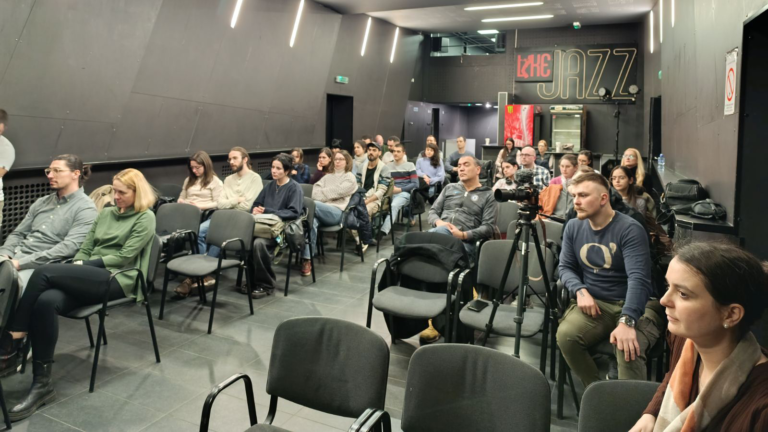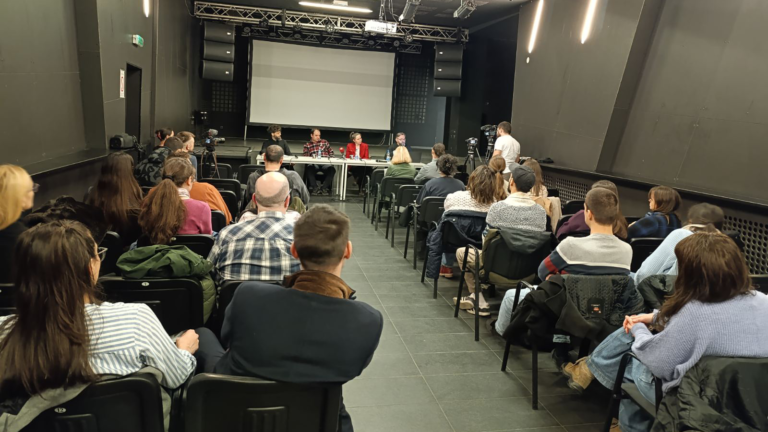

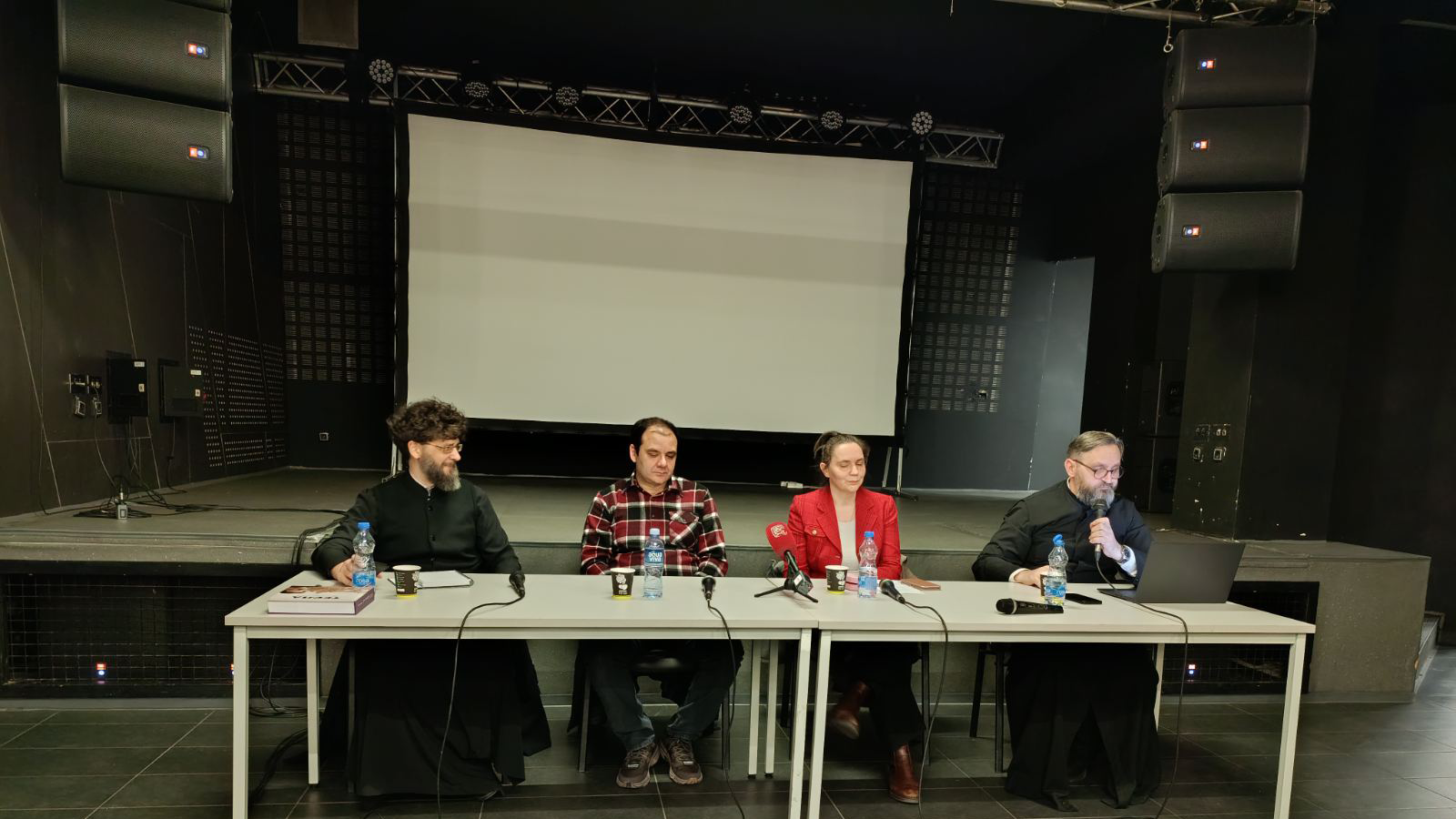
Organized by the Section for Dialogue in the Public Sphere of the Missionary Department of the AEM, a panel discussion entitled “The Body, Technology, and Immortality – Posthumanism and Orthodox Anthropology” was held on 26 February 2026 at 7:00 p.m. at the Belgrade Youth Centre. The panel was devoted to one of the most pressing questions of our time: whether the human being is a biological “project” that can be technologically redesigned, or an unrepeatable person called to communion with God.
The panel brought together distinguished interlocutors from the fields of psychology, philosophy, and theology: Prof. Dr. Vanja Ković and Prof. Dr. Duško Prelević from the Faculty of Philosophy of the University of Belgrade, as well as Presbyter Stevan Jovanović, Deputy Chair of the AEM Committee for Religious Education. The discussion was moderated by Presbyter Dr. Aleksandar Milojkov, Coordinator of the Section for Dialogue in the Public Sphere of the Missionary Department of the AEM.
The discussion panel consisted of three parts:
In the introductory segment, the fundamental question was posed: What is the human being? Attention was drawn to two powerful intellectual currents that shape contemporary understanding of human nature.
On the one hand, the Darwinian abandonment of essentialism and the emphasis on variability as the primary reality open the possibility of conceiving the human being as a “transitional animal” — a passing phase within an evolutionary sequence. If the human being has no enduring essence but represents merely a statistical moment within the continuum of biological change, then the idea of transhumanist “enhancement” appears as a logical continuation of such a worldview.
On the other hand, Orthodox anthropology understands the human being as the image of God — an unrepeatable person whose vocation lies not in the technological transcendence of his or her own nature, but in its transfiguration through communion with God.
The second part of the discussion was devoted to transhumanism as a practical-technological project. Questions concerning genetic interventions, neuro-implants, life extension, and the idea of “uploading” personality into digital space were examined.
Essential questions were also raised:
• Is it possible to transfer a person into a digital medium?
• Would a digital copy constitute a person or merely a clone?
• If two identical copies were to exist, which one would be the “real” one?
Particular emphasis was placed on the internal tension within the transhumanist project: how can a naturalistic worldview devoid of goal and purpose be reconciled with the language of “project,” “enhancement,” and the “better human,” all of which presuppose purpose and meaning? It was concluded that transhumanism as a project can only be understood as a simulation of immortality — that is, as a simulation of the living and unrepeatable person.
In the concluding segment of the panel, the boundary between healing and the redesign of the human being was considered, as well as the relationship between technological life extension and the Christian understanding of immortality.
It was emphasized that the Christian faith does not reject technological progress or medical treatment; however, it poses a fundamental question: does the human being seek salvation in technology or in God? While transhumanism offers a vision of a “better human without God,” Christianity speaks of the new human being in Christ — not as the product of technical intervention, but as the gift of grace and communion.
The discussion confirmed that the issue of posthumanism is primarily anthropological and only secondarily technological: before the question of what we can do stands the question of who we are and what we are called to become.
The panel discussion was covered by Television Hram, whose recording will be shared upon its official release.