
We continue with the interpretation of the fourth verse of the eighth chapter. Saint Ephraim the Syrian wrote about the inner state of the leper, about his loss of trust in the power of the Old Testament law: “Moreover, since the leper saw that the various instructions given by the priests concerning leprosy only made life more difficult, and that the lepers did not receive healing from them, the rites of the Law lost their power in his eyes. That is why the leper said: If You will, You can make me clean. The Lord, being angered by such thoughts, commanded him: ‘Go, show yourself to the priests and fulfill the Law which you despise.’”
From this explanation of Saint Ephraim it becomes clear that the Lord is opposed to the notion that ritual impedes religion, or that a person must completely abandon any form of ritual and simply believe “in the soul,” which is the opinion of many of our contemporaries. It is also necessary to point out that in the aforementioned Third Book of Moses (Leviticus), God prescribed a form of isolation for those suffering from serious disease. It is equally important to emphasize that the Lord Jesus Himself respected this law of quarantine and its conclusion by the very fact that He sent the man to the priests to offer the gift according to the Old Testament law. Many today might wish that the Lord had said: “Only believe in Me, do not fear or guard against any illness. Whoever believes in Me will never suffer from any disease.” Yet we see that no such words, no such teaching exists in Scripture.
We now proceed to the fifth and sixth verses:
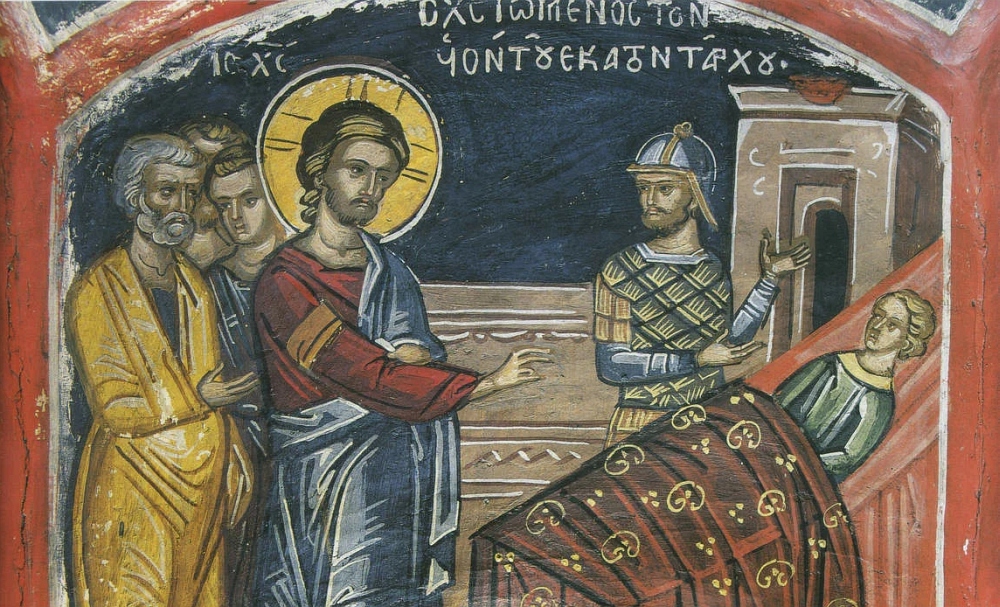
When He entered Capernaum, a centurion came to Him, pleading with Him and saying: Lord, my servant is lying at home paralyzed, and is grievously tormented.
Saint Chrysostom makes a comparison between the lepers and the Roman centurion, and says: “While the leper came to Jesus after He descended from the mountain, the centurion does so after His entrance into Capernaum. Why did neither of them ascend the mountain? It was not from laziness, for both had fervent faith, but in order not to interrupt His teaching… Some say it was impossible to bring the paralyzed man, who was suffering and at the point of death… That the servant was at the very brink of death is testified by Luke, who writes that he was near to dying (Lk. 7:2). In my opinion, this shows the great faith of the centurion, far greater than that of those who lowered the paralytic on a bed through the roof (cf. Matt. 9). The centurion knew clearly that a single command was sufficient for the servant who lay sick to rise, and thus considered it unnecessary even to bring him.”
Saint Nikolai of Ohrid explains the difference in the description of this event by the Evangelists: “Whoever reads the accounts of this event by the two holy Evangelists, Matthew and Luke, will at first glance think there is a great discrepancy between them. For Matthew writes that the centurion himself personally came to Christ and begged Him, whereas Luke writes that he first sent Jewish elders and through them presented his request, and then, when the Lord was on His way to his house, he sent his friends to meet the Lord and to tell Him not to enter his house, since he—the centurion—was not worthy of it, but only to say the word, and the servant would be healed. Indeed, there is a difference in these two accounts, but there is no contradiction. The difference is only that Matthew omits and does not mention the two delegations which the centurion first sent before the Lord, while Luke omits and does not mention that finally the centurion himself, despite all his contrition and humility before the majesty of Christ, also came forth to meet Him.”
The seventh and eighth verses read:
And Jesus said to him: I will come and heal him. The centurion answered and said: Lord, I am not worthy that You should enter under my roof; but only say the word, and my servant will be healed.
Chrysostom here speaks of the difference in the Lord’s action and the reason for it: “What does Jesus do? Something He had not done anywhere before. In all other cases He responded to the desire of the one who asked Him. But here He Himself anticipates the centurion’s request and promises not only that He will heal, but also that He will come into his house. And He does this so that we may understand the virtue of the centurion. If the Lord had not made this promise, but had simply said: Go, let your servant be healed, then we would never have known the virtue of the centurion.”
Blessed Jerome continues and explains why the Lord acted in this way and what moved Him to do so, writing: “We must not suppose that there was vanity in the Lord. He promises to go at once and heal the centurion’s servant, because He sees the centurion’s faith, humility, and prudence. Faith—because, being a Gentile, he believed in the possibility that the Savior could heal the paralytic. Humility—in that he considered himself unworthy for the Lord to enter under his roof. Prudence—in that, beneath the veil of flesh, he perceived the divinity hidden within, for he knew that what would help him was not what even unbelieving men could see, but that which was concealed within.”
Thus, we clearly see that the Lord desires to see virtue within us and is moved by what is in our souls. Our God is not some indifferent sun that shines alike on human choices of good and evil. He loves every one of His creatures, but pours out more gifts upon those who strive to be faithful to God and to purify themselves from sin. As Saint Ignatius Brianchaninov says: “The measure of the gift corresponds to the degree of preparation; for God, even in His mercy, is a righteous Judge.”
Saint Nikolai of Ohrid describes Christ’s power and authority over illness: “See how He speaks as One who has authority and power! He does not say: we shall see! Nor does He ask, as He asked others: do you believe that I can do this?—for He already sees the heart of the centurion and knows his faith. Rather, He speaks decisively, in a way no physician has ever dared to speak: I will come and heal him.”
Blessed Augustine here speaks of a spiritual law which is often unclear to many beginners in the life of the Church—how is it that people of virtuous life call themselves unworthy? Here is what he writes about the centurion: “By calling himself unworthy, the centurion revealed his true worth, so that Christ might enter not only within the walls of his house, but into his heart. For the centurion would not have spoken these words with such faith and humility if he did not already bear within his heart the One whom he feared to admit into his home. For it would not have been of great benefit if the Lord had entered his house, but was not in the centurion’s heart.”
Abba Dorotheus, in his well-known Teachings, gives an excellent explanation of why holy men sincerely consider themselves unworthy. He writes: “I remember, once we were speaking about humility. One of the notable citizens of Gaza was amazed when he heard our words, that the nearer a man draws to God, the more sinful he appears to himself. He said: ‘How can this be?’ And not understanding, he wished to learn what those words meant. I said to him: ‘Sir, tell me, how do you regard yourself in your own city?’ He replied: ‘I consider myself great and first in the city.’ Then I asked: ‘And if you were to go to Caesarea, how would you consider yourself there?’ He said: ‘As the least among the nobles there.’ ‘And if,’ I continued, ‘you went to Antioch, how would you consider yourself there?’ He answered: ‘There I would regard myself as one of the common people.’ ‘And if,’ I said again, ‘you went to Constantinople and came near to the emperor, how would you regard yourself then?’ He replied: ‘I would be as a pauper.’ Then I said to him: ‘So it is with the saints: the nearer they draw to God, the more sinful they appear to themselves.’”
The ninth and tenth verses read:
For I also am a man under authority, having soldiers under me. And I say to this one: Go, and he goes; and to another: Come, and he comes; and to my servant: Do this, and he does it. When Jesus heard it, He marvelled, and said to those who followed: Truly I say to you, I have not found such great faith, not even in Israel.
Blessed Augustine, in this event—the event of Jesus marvelling at the faith of a Gentile—perceives also a hidden prophecy concerning the future success of Christianity among the then still-pagan nations. He writes: “The Gentiles neither saw nor believed in Christ (while He was bodily on earth). He was seen and encountered by the Jews. And although in the flesh the Lord did not enter the centurion’s house, yet, being absent in body, He healed both the centurion’s faith and his household by His majesty being present there. Among the other nations the Lord Jesus was not born of a Virgin, did not suffer, did not sojourn, did not preach, and did not work divine miracles. None of these things occurred among the other nations. But through the centurion it was fitting that the Scripture be fulfilled: You deliver me from the strivings of the people; You make me the head of the nations; a people whom I have not known shall serve me (Ps. 18:43).”
Saint Nikolai of Ohrid sublimely explains the depth of the centurion’s faith as expressed in his words: “If he, being a man under higher authority, and having received a measure of authority himself, can command his soldiers and servants, then how much more can Christ—who is under no authority, but who Himself is supreme authority over nature and mankind? … Who are Christ’s soldiers and His servants? Is not life in all beings the army of Christ? Are not the angels with the saints and with all God-fearing men the soldiers of Christ? And all the powers in nature, and death, and disease—are these not His servants? The Lord commands life: Go into this or that being, and life goes; Return, and life returns. He sends life; He permits death and disease; He raises the dead and He heals the sick. At His word the angelic hosts bend like flames before a mighty wind. … To drive sickness away from a paralyzed servant is a deed beyond the power of all mortal men on earth; yet it is a small deed for Christ. For such a work He does not need to labour or to walk into the centurion’s house; He need not even see the sick man; He need not take him by the hand and lift him up. Only let Him say the word, and the deed will be accomplished. Such was the centurion’s thought concerning Christ, and such was his faith in Him. … Why did Christ marvel, when He could have known in advance what the centurion would answer? Was it not He Himself who prompted the centurion to give such a reply by His extraordinary words: I will come and heal him? Why then does He marvel? He marvels for the instruction of those who followed Him. He marvels in order to show them what alone is worthy of admiration in this world. He marvelled at the great faith of one man, so as to teach His disciples also to marvel at great faith. Truly, nothing in this world is so worthy of admiration as the great faith of one man. Christ never marveled at the beauty of the Lake of Galilee; for what is that beauty compared to the heavenly beauty which He knows? Nor did He ever marvel at human wisdom, or wealth, or power; for all these are nothing compared to the wealth, wisdom, and power of the Kingdom of God which He beholds. Nor did He ever marvel at the great multitudes assembled at a festival in Jerusalem; for such a gathering on earth is vain and paltry compared to the radiant assembly of angels in heaven, which He had beheld from the foundation of the world. When others marvelled at the beauty of Solomon’s temple, He foretold its destruction to the very foundations. The only thing He marvelled at was the great faith of one man. This is the greatest and most glorious thing on earth.”
Adapted for the contemporary reader from the patristic commentaries by: Stanoje Stanković