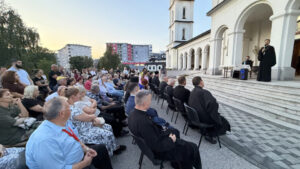
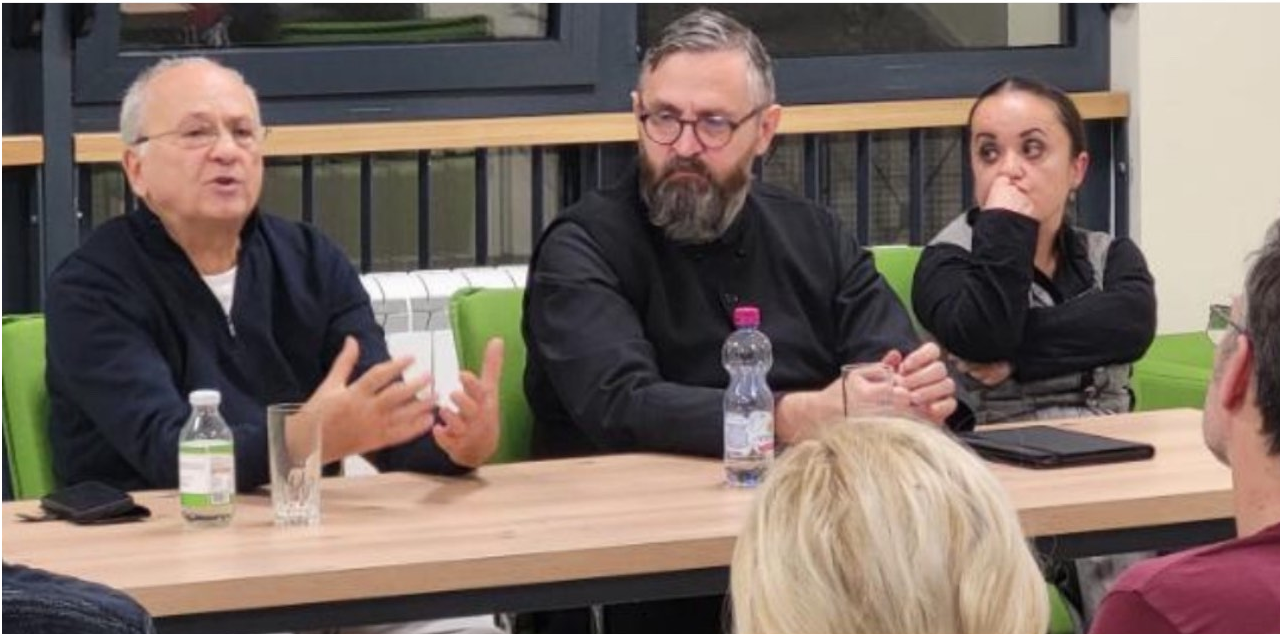
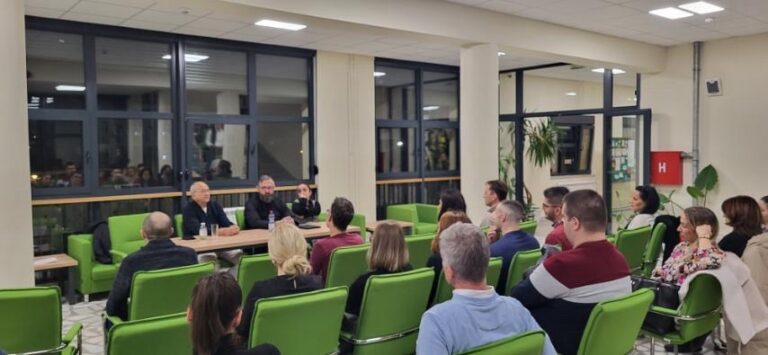
In a joint organisation of the Missionary Department and the Religious Education Board of the Archdiocese of Belgrade–Karlovci, the second lecture on parenting, titled “The Family in Anticipation of the Holidays,” was held on 25 November 2025 at the Primary School Oslobodioci Beograda.
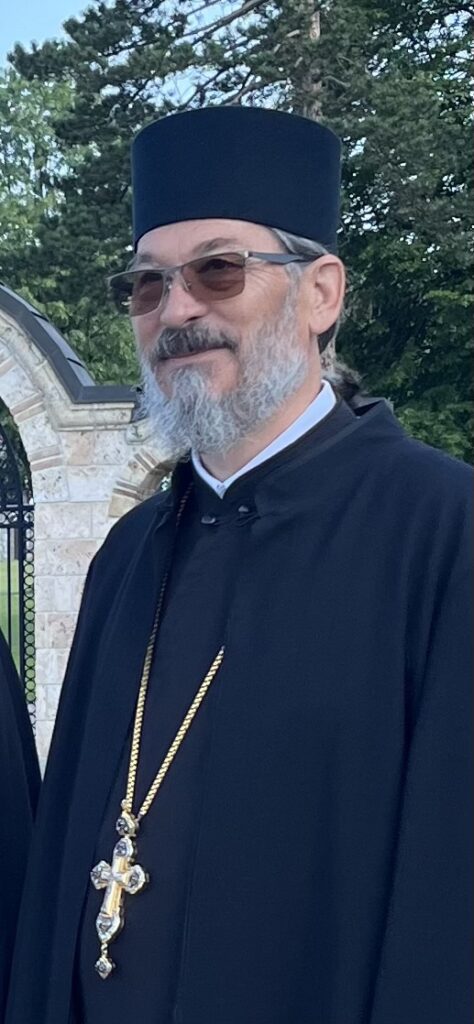
Before the school principal, teachers, and parents of the pupils, the lecture was delivered by Clinical Psychologist Dr Vlajko Panović and Presbyter Dr Aleksandar Miloјkov, Coordinator of the Section for Dialogue in the Public Sphere of the Missionary Department of the Archdiocese of Belgrade–Karlovci.
In a dynamic and interactive lecture, which began with the participation of the pupils’ parents in the discussion, the speakers addressed family crises and the challenges of raising and educating children. Each from his own professional domain, the lecturers complemented one another in their theoretical and practical reflections on family relations in a time of accelerated living, alienation, and extreme individualism, as well as on the “values” implicit in such a mode of existence—from selfishness and self-centred realisation to the absence of closeness, aggression, and conflict.
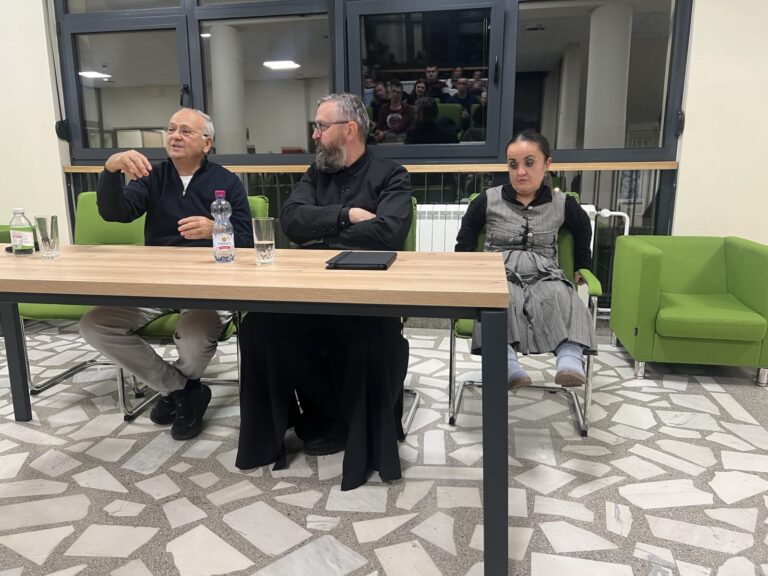
Presbyter Dr Aleksandar Miloјkov, speaking from the perspective of Christian anthropology, presented an understanding of the human being as a creature of communion, elaborating on the Christian concept of personhood and concreteness (identity), which is inconceivable apart from the relationship of love with God and with one’s neighbour—promoting freedom as an active “freedom for the other.” He emphasised that it is impossible to be free, in the true and authentic sense, without the other person—that is, without one’s neighbour. This stands in sharp contrast to the individualistic concept of freedom as a “freedom from the other”—a freedom which, as Dr Panović remarked, “will be our undoing.” Such so-called freedom contains within itself selfishness and self-love, and even turns holidays into consumerist carnivals and frantic discount-hunting—an attempt to sate greed, which self-love naturally engenders.
Dr Panović invited the parents present to recall their own celebrations of holidays in the past. In their reflections, it became evident that the notion of encounter stood out as something that had remained enduringly valuable. Building on this observation, Presbyter Dr Aleksandar Miloјkov noted that the verb to meet and the noun happiness are etymologically linked—that the joy and happiness of a holiday are primarily manifested in meeting, in the gathering of the family, and in the mutual relations of love, giving, and closeness.
In this context, emphasis was also placed on the significance of the table as a symbol of communion and unity. The table in Andrei Rublev’s famous icon The Hospitality of Abraham reveals the unity of the Holy Trinity—the mystery of the unity of the three divine persons: the Father, the Son, and the Holy Spirit. Furthermore, the central place in church architecture and worship is again the Holy Table—around which the faithful gather into the one Body of Christ, into the very liturgical event of the Church. Accordingly, the family holiday table ought to become an expression of the mystery of the family’s unity—a place of encounter among household members, where each one finds happiness and the source of his or her joy.
In relation to this, Dr Panović offered practical advice drawn from his many years of rich professional experience, and reminded the audience of some long-forgotten family-life patterns—from mealtime practices to bedtime routines—that are often disrupted and, as such, may be the cause of various psychosomatic difficulties and disorders.
After the lecture, the parents in attendance posed questions and shared additional impressions, thereby demonstrating their strong interest in the topic.