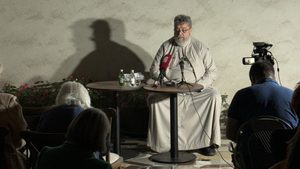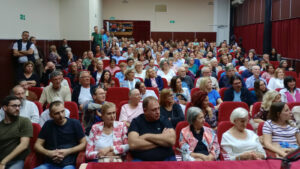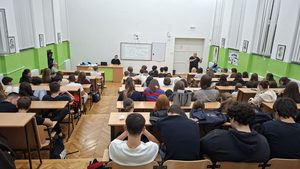

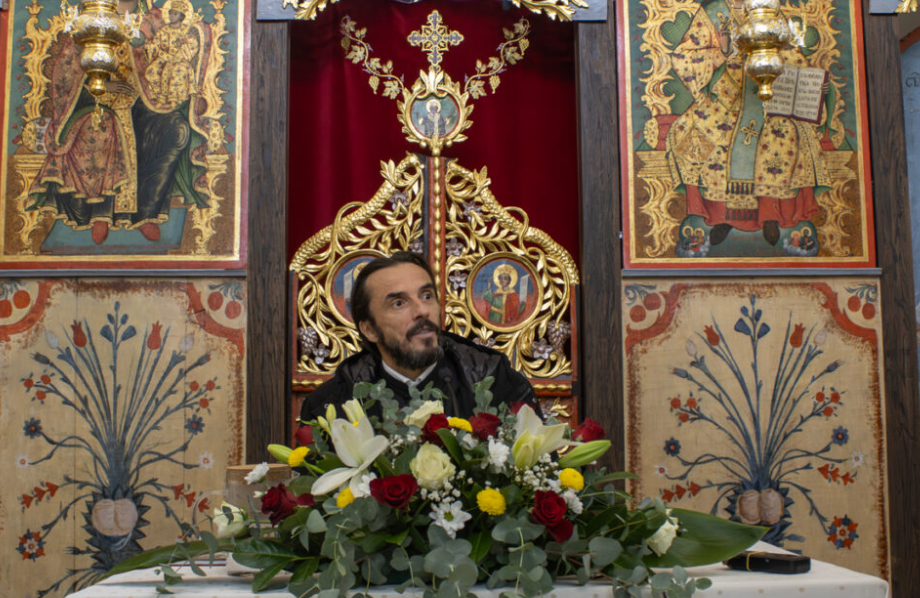
Within the courtyard of the Church of Saint Sava in Savinac, the series of events titled Savinac Spiritual Evenings was held. On Thursday, 2 October 2025, in the Church of the Holy Trinity in Savinac, a lecture was delivered on the topic “Challenges of Family Life in the Age of Artificial Intelligence.” The lecturer was Presb. Dr. Oliver Subotić, Director of the Missionary Department of the Archdiocese of Belgrade–Karlovci, who, through a rich and engaging presentation, spoke about the contemporary challenges facing the family in the era of technological advancement, as well as about the ways to preserve spiritual values in an increasingly digitalized world, outlining key principles. The lecture aroused great interest among those present, who afterwards had the opportunity to ask questions and engage in a fruitful discussion.
A report from the lecture, along with an audio recording and photographs, has been published on the portal https://takovo.net/.
On the second evening of the Savinac Spiritual Evenings, Presb. Dr. Oliver Subotić lectured on the family’s relationship to digital content. Drawing on his profound experience and knowledge arising from the intersection of Christian life and information technology, Father Oliver shared his insights with special zeal and enthusiasm. By providing answers to numerous questions, he succeeded in inspiring those present to engage in a renewed struggle—a struggle against modern harmful habits in the use of digital communication tools.
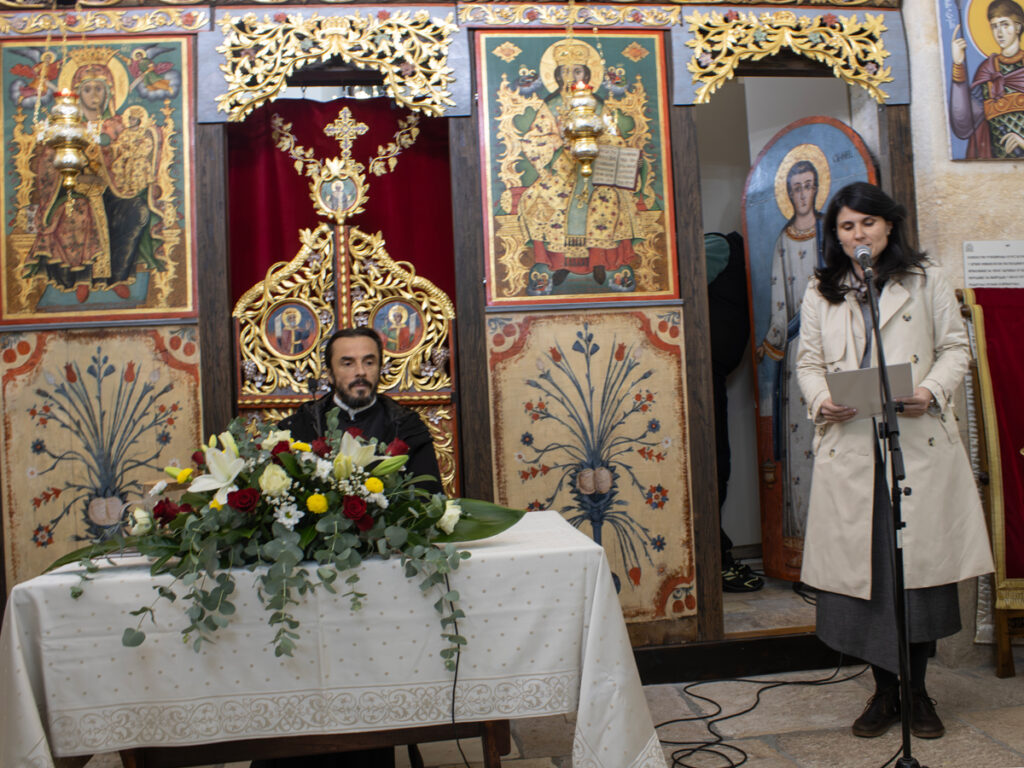
In the introduction to his lecture, he reflected on the historical influence of technology on family life, beginning with the Industrial Revolution and proceeding to the contemporary era. In this segment, he presented how the structure of shared family life has gradually diminished over time, leading to various forms of separation and alienation among family members. Today, we are faced with a situation in which each member of the household possesses a personal computer, tablet, or smartphone, with which they spend far more time than in conversation with their loved ones. The emergence of radio and television, personal computers, the internet, and smartphones—and their impact on the family, as well as the prevention of their misuse, the treatment of modern addictions to electronic content, and the consequences awaiting us in the near and distant future—was the content which Father Oliver presented to the audience in the next hour of his lecture.
“Where does the fundamental problem lie in relation to the phenomenon of artificial intelligence when it comes to family life? Primarily, it amplifies the intensity of old challenges. For example— while the first officially diagnosed case of addiction to electronic content appeared twenty years ago, today it has become a pandemic. The models of artificial intelligence, in their suggestiveness, due to their ability to provide an even stronger form of dopaminergic stimulation, will only exacerbate this problem,” explained Dr. Subotić.
He went on to elaborate on how the mode of human interaction with the computer has changed: the computer now seduces the user even more deeply into another reality. In addition to the already existing forms of digital addiction, we are now facing various sub-addictions. Yet, what affects society most deeply is the excessive use of smartphones.
As can be seen from all of this, the modern human being finds himself pressed against the wall by a multitude of “smart” devices, surrounded by applications and wireless gadgets. Yet, as Father Oliver emphasizes, man is still the wiser creature. He retains the capacity to govern his own life and the lives of those entrusted to his care.
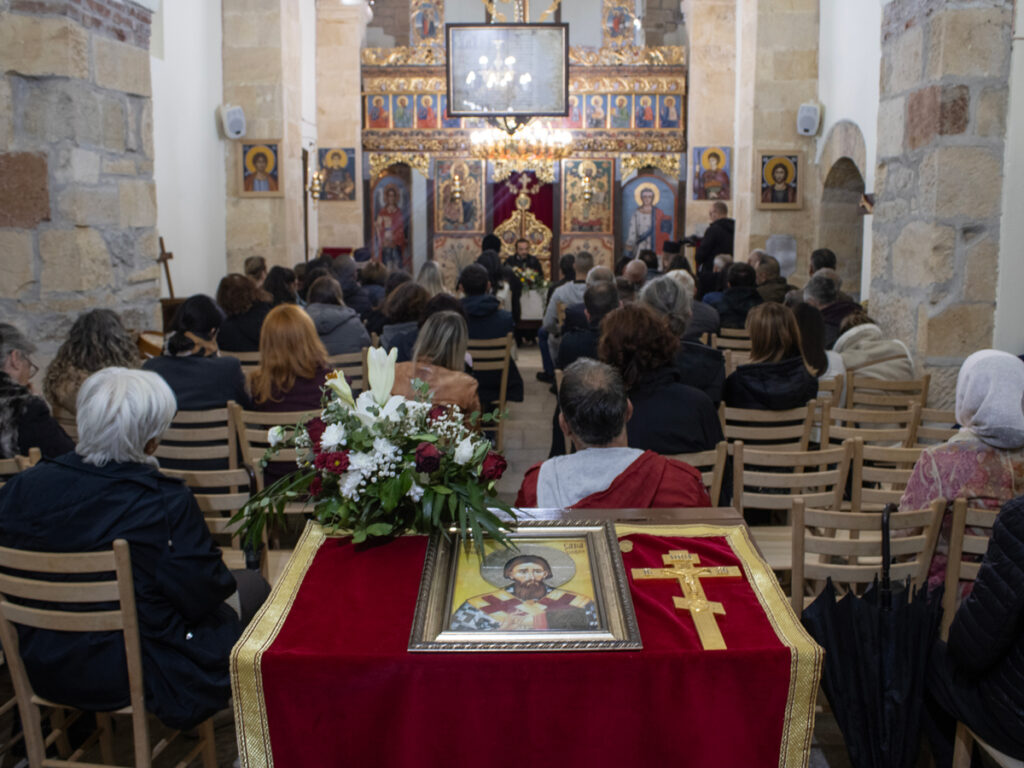
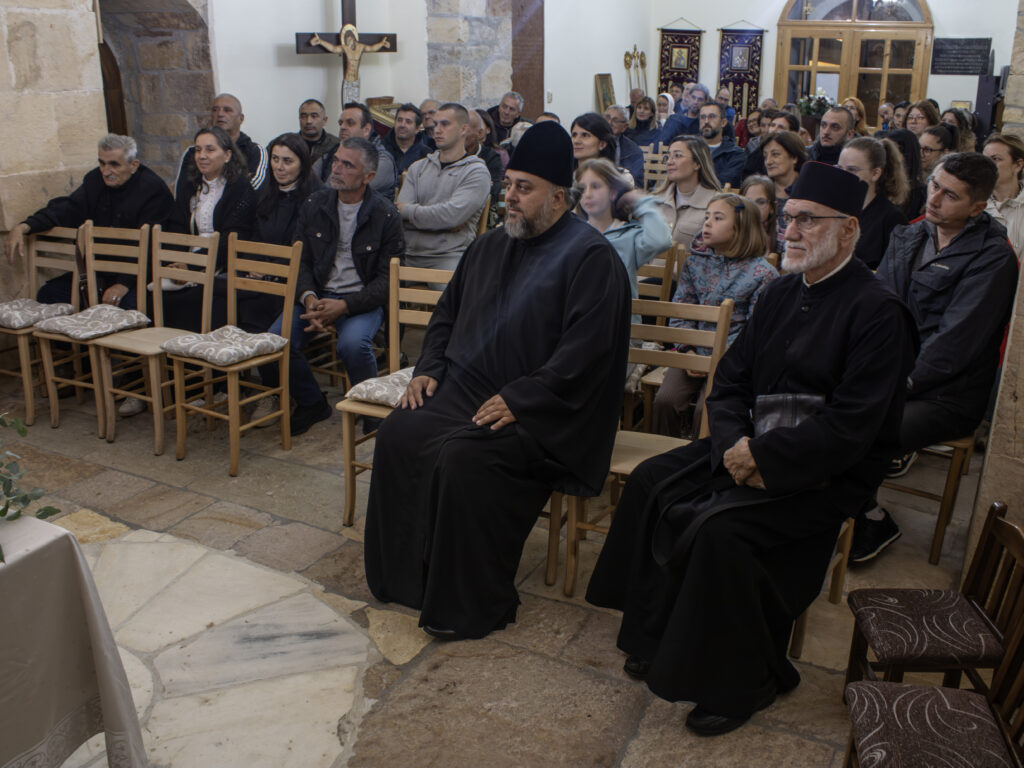
“First and foremost, we must preserve—or, where necessary, restore—good habits concerning our relationship with technology. Let us take as an example our attitude towards screens, which have become the very symbol of modern technological life. To begin with, it is essential to establish a clear set of rules.
1. Morning discipline. The phone must not be the first thing we reach for in the morning (except, of course, to turn off the alarm). One of the simplest indicators of digital dependence is precisely this question: does a person first reach for the phone or for the soap? Instead, when we rise, the first thing we should do is make the sign of the Cross, pray to God, then go to the bathroom for ablutions, greet our family, and only then get ready for work and look at our phone. We check it for messages, and in doing so, we invert the pattern—the phone is no longer our master. Instead, we condition it in a way that signals to the phone that we pick it up and choose to use it when we want to.
2. Evening discipline. The same principle applies to the end of the day. The phone must not be the last thing we hold before going to sleep—the Holy Scripture should be.
3. Courtesy and presence. We must not allow ourselves to become uncivilised or impolite! How often does it happen that, while someone is speaking, the other person’s phone rings, and he abruptly ends the conversation in order to answer it? That is primitivism of the highest order—utter rudeness. What can we do about it? If the phone rings, it is entirely appropriate to ask your interlocutor whether you may answer. Technology must not deprive us of basic courtesy or turn us into savages!
4. The family meal. The family meal has always been a reflection of the health of family relationships. During the meal, there should be a strict rule: no phones on the table, and turned off TV screens. It is a very simple habit, easily formed and maintained.
5. Shared viewing. Let us watch television programmes together. When a commercial break comes on, mute the sound. Ignore it completely and use this time to talk to each other instead.
6. Agreeing the terms with children. In matters of technology, parents often apply one of two extremes:either a radical approach imposing a total ban (which is useless), or a liberal one that simply lets things take their own course. Instead, we must set clear boundaries. An agreement with children is crucial. There is a fair rule that we can all agree on: the same amount of time they spend in front of the screen should equal the amount of they spend playing sports.
“All of this,” concludes Father Oliver, “represents the restoration of our mastery over technology.”
Alongside these methods, the inspired speaker offered plenty of different practical advice essential in the struggle to cultivate good habits. What particularly stood out among them was his idea of establishing schools of parenthood, which would prepare perspective parents for their profoundly important roles.
These roles, he emphasized, are of such significance that parents must be made aware that they bear responsibility for the upbringing and for the spiritual and physical development of their children. Yet these children are not merely their private possession. Among them are the future scientists, priests, athletes, ministers, and artists of our society.
Therefore, parenthood should be understood as a new form of patriotism, while the only revolution that can bring about genuine improvement is the revolution within the family—achieved through a return to faith and to the values of the Gospel.
The full lecture of Dr. Oliver Subotić, delivered in the Church of Saint Sava in Savinac, may be heard in its entirety in the audio recording below.
Source of text and photographs: takovo.net