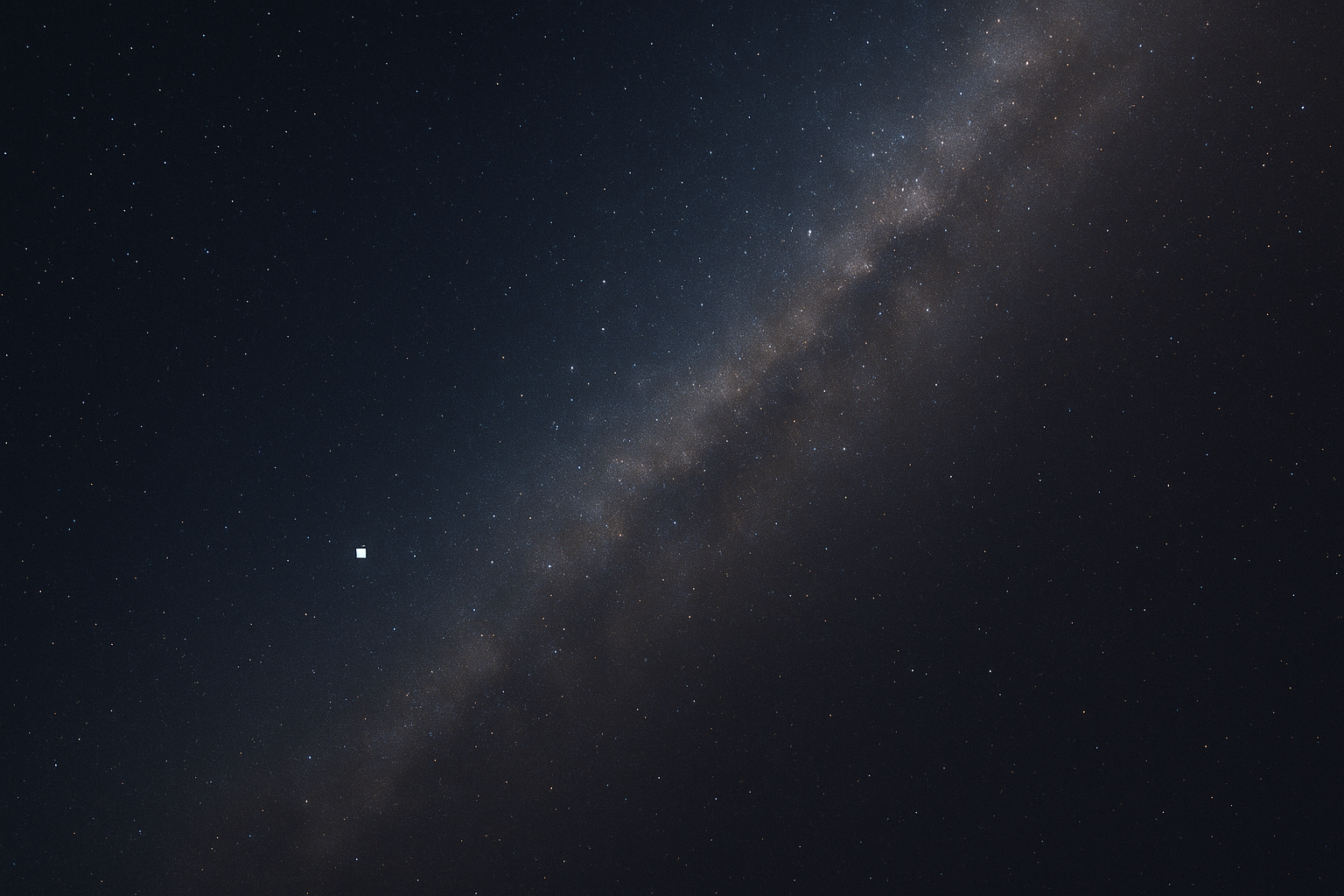
One of the common atheistic arguments directed against the exclusivity of planet Earth and, in particular, of the human being—within the context of the infinite cosmos—is the emphasis on the physical (quantitative) insignificance of the Earth and humankind. If God truly created Earth and humankind, some atheists ask, then what is the purpose of such a vast universe in which Earth appears as a tiny, invisible pixel?
This argument is often framed within a scientific narrative. At first glance, it appears powerful—indeed, quite convincing. Namely, Christian theology and anthropology, especially in the Western tradition, were exegetically rooted in the cosmological premises of the ancient Ptolemaic system, in which Earth was positioned at the centre of the cosmos (a geocentric system), while the Sun, Moon, and planets revolved around it in fixed spheres within a closed universe. However, in ancient thought, this central location signified the centre of descent: humanity’s central place denoted not exaltation, but ontological baseness, a condition immersed in matter and close to dust and changeability, rather than to the immutable and incorruptible heavenly spheres. Yet for Christianity—which never rejected the ontological significance of matter in the constitution of the human being—this central position indicated the God-given uniqueness and importance of humanity and planet Earth.
When, in the time of Nicolaus Copernicus (1473–1543), the so-called Copernican revolution occurred—where the Sun, rather than the Earth, was placed at the centre (heliocentric system)—this marked the beginning of the cosmological decentralisation of Earth and man, understood as no longer central or exceptional. This was a moment of considerable significance in the history of Western Christian thought. Church authorities responded vehemently to the scientific insights of the time, and many works were banned as heretical—particularly the heliocentric theory, which was further developed by Galileo Galilei, who was consequently sentenced to house arrest (he “recanted,” fortunately, otherwise he might have been executed, as was Giordano Bruno). Interestingly, none of these scientists were atheists, nor did they blaspheme God or any Christian truth. Their thought was questioned not on theological grounds, but because it challenged the Aristotelian and Ptolemaic cosmological framework into which Christian theology had been exegetically embedded.
From that period remains a crucial lesson: the danger of dogmatising scientific theories and transforming them into vehicles for theological assertions. Unfortunately, similar temptations persist today. Under the guise of dialogue between faith and science (a dialogue which, of course, is necessary), some theologians—including certain Orthodox voices—are engaged in the dogmatisation of a particular scientific theory: the biological theory of evolution. There is a growing tendency to reinterpret theology and theological anthropology through the foundational premises of this theory. But what will happen when, as is not uncommon in science, there emerges a new “Copernican revolution” even within this field? How many further awakenings will be required before we finally grasp that the immutable (theology) cannot be clothed in the exegetical garb of the mutable (scientific models of reality)? Especially when the latter cannot rightly be ascribed the status of immutability—that is, of truth.
The atheistic “insignificant pixel” argument seemingly gains further strength when one considers the dimensions of our Solar System. Its planetary radius (the region demarcated by the orbit of the outermost planet—Neptune) spans approximately 28 billion kilometres, with the Sun, of course, as the central point of measurement. However, if we take the boundary to be the so-called heliopause—the outer edge where the solar wind encounters the interstellar medium—the radius of our Solar System reaches 113 billion kilometres. Finally, if the boundary is defined by the Oort Cloud—a spherical shell of icy bodies surrounding the Solar System—then the radius is an astonishing 94 trillion kilometres. In light of the fact that Earth’s equatorial diameter is merely 12,756 kilometres, it is difficult to resist the impression that our planet is but a minuscule pebble within the vast sea of the Solar System.
And yet, the story does not end there—just as the cosmos does not end at the Oort Cloud. Our Solar System is only one among an estimated 100 to 400 billion stellar systems in the Milky Way galaxy, according to NASA data. Imagine: hundreds of billions of stars like our Sun, each with its own planetary system! The diameter of the Milky Way is an astonishing 100,000 light-years, meaning that light—travelling at a speed of 300,000 kilometres per second—would take one hundred thousand years to cross from one end of the galaxy to the other. Billions of these stars and their planets, including our own Sun, Earth, and its companions, orbit the galactic centre. Located near the outer edge of the galaxy, our Solar System takes roughly 225 to 250 million years to complete a single orbit—a cycle known as a galactic year. Within such an immense expanse, not only Earth but even our Sun with its planetary system appears as little more than an imperceptible pixel.
Until the 1920s, scientists believed the Milky Way constituted the entirety of the cosmos. However, in 1924, Edwin Hubble (after whom the famous telescope is named) observed various cosmic nebulae—including the Andromeda Nebula—and concluded that these were in fact separate galaxies lying beyond the Milky Way. The Hubble Telescope has since contributed to establishing the estimated number of galaxies in the observable universe: between 100 and 200 billion. In such proportions, even the Milky Way itself becomes just another invisible pixel. The Solar System and planet Earth? They truly resemble a grain of sand in a desert.
All of this seems to deliver a powerful blow to the notion of Earth and humanity as exceptional, unique, and profoundly significant. Indeed, the strength of this atheistic argument has been reinforced by the aforementioned (Western) Christian dogmatisation of an outdated cosmological model. That fatal error helped create the illusion that science invalidates and nullifies faith. Hence, the seemingly logical question arises: why would God create such an immense number of galaxies and such vast cosmic space for the sake of a single insignificant pixel on that infinite screen? And yet, significance and value do not reside in position or size. The atheistic argument contains a number of logical fallacies. Fundamentally, it represents a category mistake, combined with the fallacy of argumentum ad magnitude—an appeal to size. That is, it establishes a false analogy, conflating physical categories (such as size and mass) with existential and ontological ones (such as worth, meaning, and purpose). This yields a non sequitur—a logical fallacy whereby the conclusion does not follow from the premises. The atheistic and naïvely materialistic reasoning might be expressed as follows: Earth is vanishingly small in comparison to the cosmos → therefore, humanity is insignificant → therefore, if God existed, He would not concern Himself with something so trivial → therefore, God and His providence over humanity do not exist. This fallacy is rooted in a deeply personal and markedly limited intuition; it may thus be classified as an argumentum ad incredulitatem—an appeal to personal incredulity. The reasoning would resemble the following: I cannot imagine that an all-powerful God would care about such a negligibly small planet → therefore, God does not exist.
Physical size and importance—significance—belong to entirely different categories and should never be conflated or equated. On the contrary, something physically small can be of profound essential value—as is evident even from scientific experience. A cell is exceedingly small, visible only under a microscope, yet it constitutes the basic unit of life—so essential that life could not exist without it. Likewise, the DNA molecule is invisible to the naked eye, yet so vital that it encodes the complete set of information specific to each living organism.
In his book The Future of the Mind: The Scientific Quest to Understand, Enhance, and Empower the Mind, the renowned scientist Michio Kaku presents the following fact about the human brain: it weighs merely 1.4 kilograms, and yet it is the most complex object in the Solar System. Truly, the human being is (in terms of value) something great housed within something (physically) small.
The Holy Fathers referred to man as a microcosm, and in that sense, Saint Gregory the Theologian remarked that man is “great in smallness”—that the entire cosmos, the totality of visible and invisible creation (the macrocosm), is encapsulated within the small psychosomatic nature of the human being.
In support of this, one may also consider the astounding reality of the DNA molecule. Each cell in the human body contains two metres of DNA (compactly coiled within the cell, with a diameter of only about six micrometres). The average human body contains approximately 37 trillion cells. When multiplied by two metres of DNA per cell, this yields the astonishing figure of 74 billion kilometres of DNA. That distance is approximately 493 times greater than the distance from the Earth to the Sun. Astonishing, is it not? Truly—greatness within smallness.
Michio Kaku notes that all the physical laws governing the cosmos could fit on a single sheet of paper – a single equation capable of describing everything from the collision of stars to the vibration of the quarks. And yet, the code that defines just one human being – his DNA – if fully extended, would be 493 times longer than the distance from the Earth to the Sun. So which is truly greater: the cosmos, whose essence may be compressed into a few elegant equations, or the human being, whose internal blueprint stretches across nearly 500 astronomical units?
Physically, man is indeed small in comparison with the cosmos: What is man that You are mindful of him, or the son of man that You care for him? (Ps. 8:4). But he is great in value and significance: You made him a little lower than the angels; You crowned him with glory and honour; You gave him dominion over the works of Your hands, and put all things under his feet… (Ps. 8:5–6).
Presbyter Dr Aleksandar Milojkov