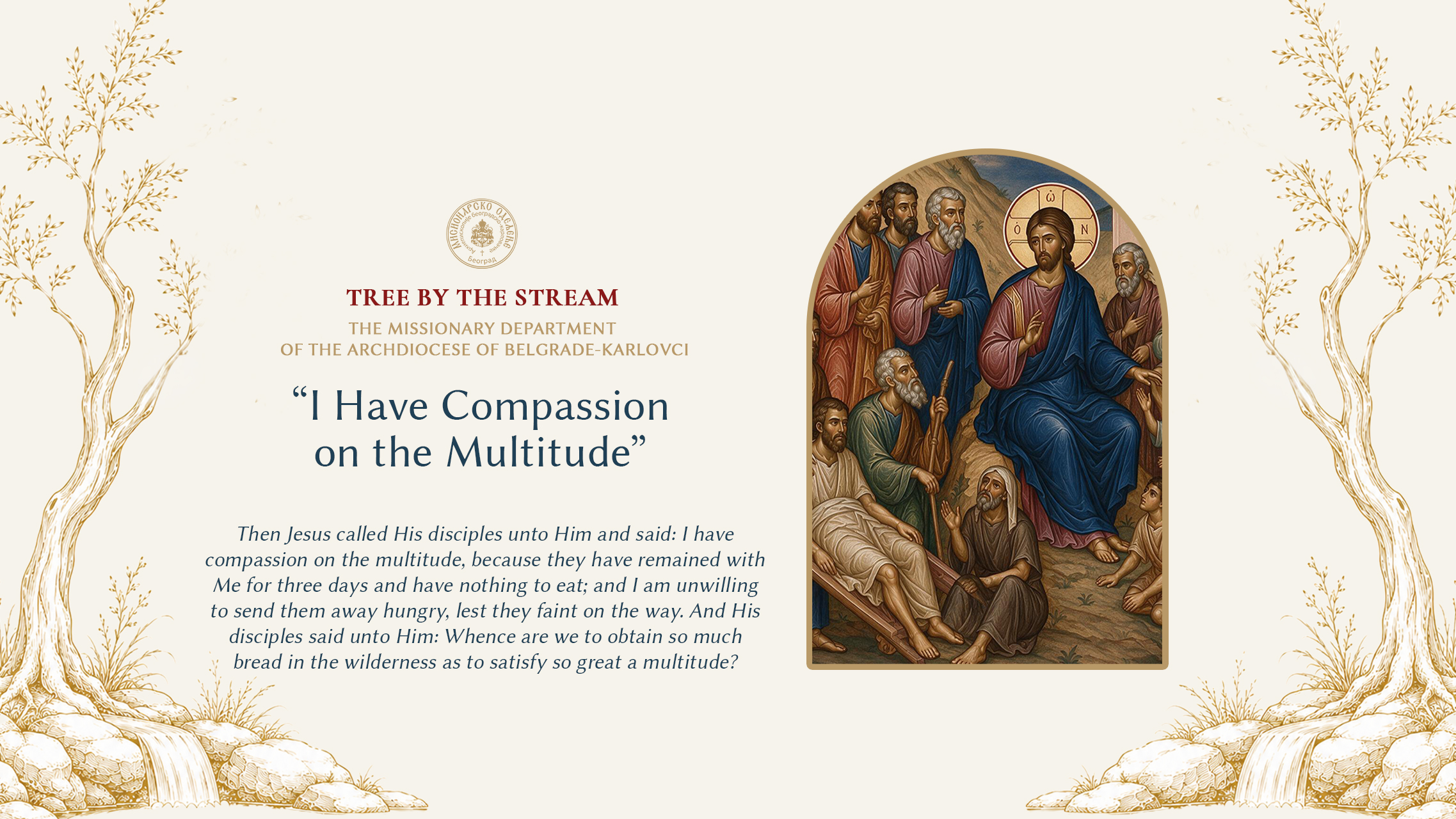
Before us are verses 29 to 31 of the fifteenth chapter.
And Jesus departed from there and came to the Sea of Galilee; and going up onto a mountain, He sat down there. And great multitudes came to Him, bringing with them the lame, the blind, the mute, the maimed, and many others; and they laid them at Jesus’ feet, and He healed them, so that the people marvelled when they saw the deaf hearing, the mute speaking, the maimed made whole, the lame walking, and the blind seeing; and they glorified the God of Israel.
At this point in the Gospel, Saint John Chrysostom reflects upon the spiritual growth of the people who sought the Lord Jesus: “Sometimes the Lord Himself seeks out the sick, while at other times He waits for them to come to Him of their own accord… Now they do not touch His garment, but begin to reason more rightly. They cast themselves at His feet and demonstrate a twofold faith: despite their lameness, they climb the mountain, and they ask for nothing except to be laid at Jesus’ feet. It was truly wondrous and astonishing to see those who had previously been carried now walking by themselves, and the blind no longer needing a guide. Moreover, both the great number of those healed and the ease with which they were healed filled the people with amazement. Do you know why Jesus healed the woman—the Canaanite—only after such a lengthy delay, whereas He healed these people immediately? It was not because they were more worthy, but because she possessed greater faith than they did. Therefore, Jesus delays and waits before granting her healing in order to reveal her steadfastness, whereas He bestows the gift upon the people immediately in order to silence the unbelieving Jews and deprive them of every excuse. Indeed, a person who receives greater blessings is subjected to a greater punishment when he proves ungrateful, if the honour bestowed upon him does not make him better. For this reason, the rich are punished more severely than the poor for their insensibility, because, despite their abundance, they showed no compassion.”
In this event, Blessed Theophylact explains the essence of the spiritual life—namely, that the solution to all our problems lies in falling down at Jesus’ feet and living in His presence. This is how he writes: “Therefore, you too must ascend the mountain of the commandments, where the Lord is seated. If you are ‘blind’ and unable to perceive for yourself what is good; or lame, because you perceive the good but are unable to attain it; or deaf and mute, because you are unable either to hear the instruction of others or to instruct others yourself; or maimed, because you do not know how to extend your hand and give alms; or if you are afflicted in any other way—if you fall at Jesus’ feet and take hold of the hem of His garment, you will be healed.”
In these verses, Saint Luke of Crimea draws attention to the abundant working of miracles by the Lord and writes about the essence of miracles in Christianity. He also compares the miracles of Jesus with those described in the Qur’an: “All of Christ’s miracles had as their purpose the alleviation of human suffering. He healed multitudes of people who suffered from various illnesses and came to Him; with five loaves and two fish, He fed an immense multitude of hungry people. If any of you has read the Muslim Qur’an, you were surely astonished by the immense difference between Christ’s miracles and those which Muslims attribute to their false prophet Muhammad. Muhammad’s miracles are strange and of no benefit to people; they are more akin to tricks!”
Saint Hilary of Poitiers draws our attention to a highly significant truth that contemporary Christians may have forgotten. This is how he writes: “People who remain in unbelief, like those who are sick, fall down before the Lord at the counsel of believers and are healed. All the faculties of the soul and body are restored so that one may hear and behold the Lord, offer praise to Him, and follow Him!” This is extremely important, for it reveals the patristic and Orthodox understanding of the purpose of miracles and, more importantly, of the responsibility borne by the person for whom a miracle has occurred. In his sermons, the priest Daniel Sysoev taught that the purpose and meaning of healing lie precisely in what Saint Hilary describes: a person is healed so that he may thereafter follow the Lord. This is the only proper response of a person following a miracle. For this reason, he also spoke of the responsibility borne, for example, by those of other faiths who are healed at Orthodox holy sites. If they do not subsequently turn to the true God, that healing will serve for their condemnation at the Last Judgement. An interesting fact is recorded in the Life of Saint John of Kronstadt: after praying for the healing of people of other faiths or non-Orthodox Christians who had sought his help, Saint John would always convert them to Orthodoxy.
The next two verses:
Then Jesus called His disciples unto Him and said: I have compassion on the multitude, because they have remained with Me for three days and have nothing to eat; and I am unwilling to send them away hungry, lest they faint on the way. And His disciples said unto Him: Whence are we to obtain so much bread in the wilderness as to satisfy so great a multitude?
Saint John Chrysostom writes about the order that Christ observes before performing the miracle of the multiplication of the loaves: “On the previous occasion, when Christ intended to perform a similar miracle, He first healed those who were suffering from bodily illnesses. He does the same now, proceeding to perform the miracle after healing the blind and the lame. … But observe how, even now, Christ does not simply proceed to perform the miracle, but also draws His disciples towards it. The people who had come to be healed of their illnesses did not dare to ask for bread; nevertheless, Christ, being compassionate and caring, gives even to those who do not ask and says to His disciples: I have compassion on the multitude, and I am unwilling to send them away hungry. However, lest anyone should say that the people had brought supplies of bread with them, Christ says: They have remained with Me for three days. Consequently, even if they had arrived with provisions, those provisions would have been exhausted. For this reason, He performed this miracle neither on the first nor on the second day, but only after they had consumed everything, so that, having first experienced their need, they might receive the miracle with greater joy. Therefore, He also says, Lest they faint on the way, thereby indicating that the journey to the nearest settlement was long and that the people had nothing remaining. Yet if You are unwilling to send them away hungry, why do You not perform the sign? He acted in this way so that, through His question and the disciples’ response, He might awaken greater attentiveness within them and provide them with an opportunity to demonstrate their faith by approaching Him and saying, ‘Create loaves.’ … What, then, do the disciples do? Their thoughts still remain fixed upon earthly things. Although Christ had endeavoured in every way to imprint this miracle upon their memory—through questions and answers, by having them distribute the bread, and by ensuring that baskets of bread remained—they were still imperfect. The Apostles most unwisely supposed that Jesus had said this because He intended to leave it to them to feed the people. On the previous occasion, He had said to them, Give ye them to eat(Matt. 14:16), in order to provide them with an opportunity to ask Him to perform the miracle. Now He does not say those words, but rather: I have compassion on the multitude, and I am unwilling to send them away hungry. Through these words, He leads them still closer to that thought, urges them even more strongly, and makes it clear that they should ask Him to feed the people. These words demonstrated that Jesus could not send them away hungry and bore witness to His power. This is precisely the meaning of the words: I am unwilling.”
The Venerable Maximus the Confessor offers an allegorical interpretation of this event and writes as follows: “What do the three days that the people spent with the Lord in the wilderness signify? The three days represent the three faculties of the soul, by virtue of which it dwells with the divine Word of virtue and knowledge: through the first faculty, the soul seeks; through the second, it waits; and through the third, it struggles for the truth, receiving the incorruptible food that nourishes the human mind with knowledge. Alternatively, the three days signify the three universal laws: the written law, the natural law, and the spiritual law, or the law of grace.”
Blessed Jerome also draws attention to a hidden meaning that may have escaped us while reading these verses: “Jesus summons His disciples and tells them what He is about to do. He does this either to provide teachers with an example of consulting those beneath them and their pupils, or so that, through this conversation, the disciples might comprehend the magnitude of the sign by replying that they have no loaves in the wilderness. I have compassion on the multitude, because they have remained with Me for three days. Jesus demonstrates compassion towards the multitude because, through the number of days, it has manifested faith in the Father, the Son, and the Holy Spirit, yet has nothing to eat. The multitude always experiences hunger and remains in need of food unless it is fed by the Lord. I am unwilling to send them away hungry. Following their grievous bodily infirmities, the people felt hunger and patiently awaited food. Jesus does not wish to send them away hungry, lest they faint. Thus, a person who hastens to reach his desired dwelling place without heavenly bread exposes himself to danger. For this reason, the angel also says to the Prophet Elijah: Arise and eat, because the journey is too great for thee (1 Kings 19:7).”
Saint Hilary of Poitiers writes something that is highly significant for us today and may bring us comfort: “What is the mystery? The Lord has compassion on those who follow Him and place their trust in Him, for they have already been with Him for three days. So that they may not grow weak during their life in this world—the world of everyday existence—Jesus desires to satisfy and strengthen them with His bread.” Thus, the Lord cares for us and thinks of us even amid our daily routines and busyness.
Verses 34 and 35:
And Jesus said unto them: How many loaves have ye? And they said: Seven, and a few little fishes. And He commanded the multitude to sit down on the ground.
Blessed Theophylact explains the significance of the difference in the number of people present at the first and second miraculous multiplications of the loaves: “Intending to teach them humility and simplicity, He commands them to sit down on the ground; and in order to teach us to give thanks to God when we sit down at the table to eat, He Himself also gives thanks. Perhaps you wonder why, on the former occasion, there were five loaves, five thousand people were fed, and twelve small baskets remained, whereas here there are more loaves, fewer people are fed, and only seven baskets remain? It must be said that the large baskets were larger than the small baskets, or else that the Lord did not wish the miracle to be forgotten because of a numerical equivalence. Had twelve small baskets remained on this occasion as well, the numerical equivalence might have caused people to forget that He had performed the miracle with the loaves a second time. But you should also know that four thousand people—that is, those who are perfected in the four virtues—were fed with seven loaves, namely, with words that were more spiritual and perfect, for the number seven symbolises the seven spiritual gifts. They sit upon the ground because they have placed all earthly things beneath them, just as the five thousand people had previously sat upon the grass—that is, they had cast beneath themselves the flesh and its glory, for all flesh is grass, and all the glory of man is as the flower of the field. Here, seven baskets remained because these were more spiritual and perfect things that they could not consume—that is, understand. There was as much left as could be contained in seven baskets; that is, as much as the Holy Spirit alone knows, for the Spirit searches all things, even the deep things of God.”
Adapted for the contemporary reader based on patristic interpretations by Stanoje Stanković