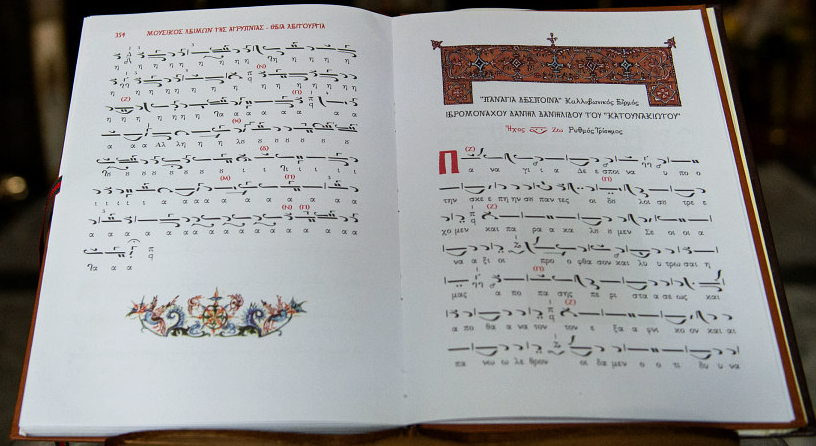
The text was published on the Kinonia portal, in the column “From the Editor’s Pen,” on October 19, 2025.
“Learn to sing, for those who sing are filled with the Holy Spirit.” (Saint John Chrysostom)
When the holy Thessalonian brothers translated the liturgical books and the dogmas of faith into the Slavic language, they carefully selected expressions that best conveyed the essence of the original text. At times, however, they had to forgo the multiple meanings inherent in the elevated style of the ancient Greek language. The word Tvorac (Creator) is an exact translation of the Greek term ποιητής (poietes). Yet this word also bears other meanings: creator, originator, maker, inventor, and finally—poet. He who is for us simply the “Creator of heaven and earth” was for every Greek at the same time the “Poet of heaven and earth.” The Psalmist David declares that God made all things in wisdom. These words may be most concretely understood as praise of the perfect Divine poetry, for everything was created perfect and harmonious—just as verses are woven from carefully chosen words, while the poet already knows in advance what the finished work will look like. Man, as the crown of God’s creation, is capable not only of perceiving the beauty of Divine art but also of imitating his Creator, and thus becoming a creator himself.
Singing is mentioned both in the Old and the New Testament, under various synonymous expressions such as hymn, praise, glorification, and thanksgiving to God. Song appears for the first time in the Old Testament in the Book of Exodus, when Moses sings a song of gratitude to God for leading the people safely across the Red Sea. This song has both a doxological and a eucharistic character. Saint Basil the Great calls song “theology in its highest form.” In the Acts of the Apostles, Paul and Silas, while imprisoned, sing hymns to God—after which a miracle occurs and they are freed. According to Saint John Chrysostom, the apostles’ fervent prayers “moved” God to perform this miracle. We thus see that singing and miracle are intimately connected and mutually complementary, for a miracle is God’s response to our prayer—our song.
The Holy Apostles and Evangelists Matthew and Mark write that, after the Last Supper, Christ and His disciples “sang a hymn” and went out to the Mount of Olives (Mt. 26:30; Mk. 14:26). The Holy Evangelist Luke, describing the same event in greater detail, says: “As He drew near the descent of the Mount of Olives, the whole multitude of the disciples began to rejoice and praise God with a loud voice for all the mighty works they had seen, saying: Blessed is the King who comes in the name of the Lord! Peace in heaven and glory in the highest!” (Lk. 19:37).
The Apostle Paul, in his Epistle to the Ephesians, counsels: “Addressing one another in psalms and hymns and spiritual songs, singing and making melody to the Lord with your heart, giving thanks always and for everything to God the Father in the name of our Lord Jesus Christ” (Eph. 5:19–20). He repeats the same instruction in his Epistle to the Church in Colossae: “Let the word of Christ dwell in you richly; teach and admonish one another in all wisdom; and with gratitude in your hearts sing psalms, hymns, and spiritual songs to God” (Col. 3:16). In the Epistle to the Hebrews, Paul cites David’s psalm: “I will declare Your name to My brethren; in the midst of the congregation I will sing praise to You” (Heb. 2:12). From these words it is evident that the Apostle Paul regarded singing as a fitting form of glorifying God. In order to prevent mere aesthetic enjoyment of music, he emphasized the necessity of an inner disposition of piety—that is, the need for singing to be “in one’s heart.” In this sense, liturgical hymns were experienced as a “spiritual offering, a spiritual sacrifice,” fully in harmony with Christ’s teaching on “worship in spirit and in truth” (John 4:23).
Throughout the centuries, hymnography has faithfully reflected the relationship between God and man across history—especially from the Incarnation and Pentecost onwards, through the martyrs and the holy fathers, and up to the present day. In this light, we may rightly say that inspired hymnography can also be understood as an interpretation of the history of salvation. Singing, in the sense in which we know it today, first appears toward the end of the second and the beginning of the third century in one of the letters of the hieromartyr Justin the Philosopher, while the term in its present usage is first found in the fourth century, specifically in the Church History of Eusebius of Caesarea.
Chanting is connected with our dichotomous nature. According to the God-inspired words of Saint John of Damascus, “Christ took on both body and soul because man is composed of body and soul; therefore baptism is twofold—by water and by the Spirit; and communion, and prayer, and chanting (psalmodia)—all consist of two parts, bodily and spiritual.” The venerable father perceives the twofold nature of chanting in the fact that it is both prayer and music, word and hearing, learning and pedagogy. Saint John Chrysostom says that our word is born from our soul, just as the Logos is begotten of the Father. In the same spirit, Saint Nilus of Sinai teaches: “We must glorify God with words, honor Him through deeds, and worship Him with thoughts.”
In the chanting of the Orthodox Church, word and melody are inseparably united, for melody is both a complement to and a kind of adornment of the word. Melody is never an artificial addition, for it, like the word, arises from human nature and, as such, is a gift. Through chanting we express the essence of the text, and through words we glorify the Lord.
From ancient times, Orthodox chanting has been monophonic, for we glorify the Lord with one mouth and one heart—that is, with one voice. What do we mean by monophonic chanting? It means that the singers chant together with one voice, or, as Saint John Chrysostom says, “as if all their voices were coming from one mouth.” We should not forget that in the first ten centuries Western Christianity also cultivated exclusively monophonic church singing. Polyphonic chanting originated in the West and, from the eighteenth century onwards, became present in the Russian Orthodox Church, later spreading to other Orthodox Churches.
Over time, through the historical development of liturgical music, the system of Octoechos—the “eight tones”—was adopted and perfected as the framework within which church music and liturgical worship developed. Historically speaking, two chronologically unequal periods in the process of the development of church music can be distinguished, which meet in the fourth century. Their division coincides with the time when Christianity was recognized as a lawful religion of the Roman Empire, a process definitively and irrevocably established by the founding of the new imperial capital—Constantinople. The first period may therefore be called pre-Byzantine, and the latter—Byzantine.
Just as the Ecumenical Councils defined the theological foundations of the Church, the hymnographers naturally introduced the truths of faith into the liturgical life. They enriched the Liturgy with defined dogmas precisely to instruct the faithful, thus strengthening and edifying the faith. When Father Georges Florovsky was asked where one could best learn the dogmas of the Church, he replied: “Go and stand beside the chanters for a year, and you will learn the theology of our Church.”
The history of our Holy Church abounds with examples of fathers who adorned their ascetic struggle with a special divine gift—the gift of composing hymns of thanksgiving about the struggles of other ascetics. They are known as hymnographers, church poets, and “sweet singers,” who, by means of that gift, offered abundant thanksgiving to God by glorifying Him. The treasury of liturgical hymns consists of works of many writers from all eras and all regions. In the works of church poets—whether from Sicily and Cyprus, Constantinople and Damascus, Jerusalem and Ohrid, or Žiča—the universal character of the Church is reflected.
Most church poets will forever remain anonymous, primarily because of their personal humility. The most renowned among them, Saint Romanos the Melodist, signed his works as “the unworthy.” Hymnographers belonged to all ranks of the clergy—from simple monks to patriarchs. Church poetry was always of great importance, so much so that even emperors—from Theodosius II, Justinian, and Leo the Wise, to Manuel II Palaiologos—wrote liturgical hymns that are still sung in sacred worship today. Among the church poets there were also several notable poetesses, holy nuns inspired by God’s grace. To this day, the names of six divinely inspired poetesses are known: Gregoria, Martha, Theodosia, Thecla, Kassia, and Palaiologina.
For centuries, the Holy Fathers and Teachers of the Church, through their theological writings and homilies, have often taught about the importance of sacred worship and of chanting as an integral part of divine service. That the offering of praise to God was an inseparable part of the ascetic life and the lives of the saints is attested by many examples and testimonies—among them, the words from the Life of Saint Simeon the Myrrh-Gusher, in which Saint Sava describes the last moments of his father’s earthly life:
“When morning came and the church chanting began, the face of the blessed elder immediately became radiant, and turning towards heaven he said: Praise God in His sanctuary, praise Him in the firmament of His power. And I said to him: Father, whom do you see that you speak so? And he, looking at me, said: Praise Him for His mighty acts, praise Him according to the multitude of His greatness. And having said this, he immediately gave up his most blessed spirit and fell asleep in the Lord.”
The blessed significance of church chanting and its influence upon the human soul were also taught by modern Athonite elders, among whom Saint Paisios the Athonite and Saint Porphyrios of Kavsokalyvia stand out.
Saint Paisios the Athonite said the following about the power of chanting:
“Chanting will help you greatly. Always hum softly. Chanting calms the soul. It even soothes wild beasts—how much more, then, man. When they hear chanting, lions and wolves sit quietly like lambs and listen peacefully. When a man chants, he is like a farmer who, in the heat of the day, must harvest a field overgrown with thorns, where the ears of grain are bent low. And he begins to reap while singing. Through song he forgets his hardships and joyfully completes his work. He gains the fruit of his small labor, and afterwards he feels rested.”
Saint Porphyrios of Kavsokalyvia spoke of the importance of chanting for the soul of the believer, emphasizing its healing power:
“Chanting is very beneficial. No Christian should exist without knowing it. We should all learn it, for it has a direct connection with the soul. Chanting sanctifies the soul without blood. Without effort, in joy, one becomes holy. Especially for the healing of depression, chanting is a most effective remedy. Where are those who hurry to find a cure for depression? When they learn chanting and feel sadness approaching—at once!—a single Doxology, and the sorrow that comes to overwhelm you, a kind of spiritual melancholy, becomes a hymn to God. I believe this—without any doubt, I believe it. I tell you that one who knows chanting, who loves it, and who is devout can transform his hardship into a musical work, or sing an existing hymn instead. Thus, instead of weeping and tormenting himself, he offers praise to God. Chanting is very easy when the soul loves it. So great is the benefit that harmony brings to the soul! He who knows chanting and has humility possesses the grace of God.”
Chanting and the Dichotomous Nature of the Human Being
By Catechist Branislav Ilić, Editor of the Kinonia Portal