
Verses 23 and 24 of the ninth chapter are before us:
“And when Jesus came into the ruler’s house and saw the minstrels and the people making a tumult, He said unto them, ‘Give place: for the maid is not dead, but sleepeth.’ And they laughed Him to scorn.”
Blessed Theophylact at this point emphasizes the importance of the people’s mockery of Christ, and explains its purpose as follows:
“Since the girl was unmarried, they lamented for her with wedding flutes, which was contrary to the Law. The Lord said that she was sleeping, because for Him—who could easily raise the girl—death was but sleep. Do not be astonished that they laughed at Him, for this all the more confirms the miracle, since He raised up the girl who had truly died. All those present bore witness that she was indeed dead, so that afterwards no one could say she had merely lost consciousness.”
Saint John Chrysostom also explains why only the parents and the apostles were present at the raising of the girl:
“Christ drove out all except the parents; and even them He left only so that it might not be said that someone else had raised the girl and not He. And before raising her He said, ‘She is not dead but sleeps.’ Since He Himself was yet to die, by raising others He prepared His disciples to face death with courage and peace, for after His coming, death itself became but sleep.”
We see, therefore, that the Lord used every event to prepare the apostles for the struggle that awaited them.
Saint Justin of Ćelije writes thus concerning Christ’s words about death as sleep:
“The Lord Jesus establishes a new perspective, a new vision of death: death is sleep. Death is sleep for the God-Man and His friends. This is a new relationship towards death, impossible for the Old Testament and for the people of the old covenant—that is why they laughed at the Lord Jesus. Whoever mocks this, mocks the very meaning of life itself, the only true joy of human existence on earth.”
The next two verses read:
“But when the people were put forth, He went in, and took her by the hand, and the maid arose. And the fame hereof went abroad into all that land.”
Saint Chromatius of Aquileia explains the mystery hidden in the Lord’s command to cast the people out and the profound meaning behind this act. He writes:
“The Lord did not command them to leave without purpose, for by doing so He showed that He, the Creator of life and Master of the Kingdom of Heaven, will utterly deprive all unbelievers of the promise of eternal life.”
Blessed Jerome adds that this was entirely just and deserved:
“Indeed, those who had uttered unworthy mockery against the One who brought resurrection were unworthy to behold the mystery of the Resurrection Himself.”
Thus, in Scripture we see clearly that those unworthy to behold the miracles of the Lord or to hear the mysteries of the faith are not granted access to them. This too serves as a lesson for us, for sadly, many mysteries of our faith today are made accessible to those whose lives and faith do not make them worthy of them.
Saint John Chrysostom gives a detailed account of the entire event:
“Seeing the minstrels and the multitude, Christ cast them out of the house, and in the presence of the parents performed the miracle—not by returning another soul into the girl, but by recalling the same soul that had departed, as though awakening her from sleep. To confirm the faith of those who watched, He took her by the hand, thus laying the path towards belief in the Resurrection. The father had asked Jesus to lay His hand upon her, but He does even more—not simply placing His hand, but taking her lifeless hand in His own and raising her, showing thereby that all things are easy for Him. Moreover, He commands that food be given to her, lest anyone think the miracle an illusion. And He does not feed her Himself, but commands the parents to do so. But notice not only the resurrection, but also that Christ instructs all not to speak of it. From this learn humility and avoid vainglory. Observe also that He cast out all who wept, deeming them unworthy to behold so great a wonder. Therefore, do not be like the flute-players whom the Lord cast out, but rather like Peter, John, and James. If the Saviouur then cast out those who wept, much more will He do so now—since at the time of the girl’s resurrection it was not yet known that death is sleep. But now that truth shines clearer than the sun. Does the Lord not raise your daughter now? He surely will—yet with far greater glory. For she who then arose died again; but your daughter, when she rises, shall rise immortal. Let no one weep, let no one grieve or deny the work of Christ. Truly, He has conquered death. Why weep in vain? Death now is nothing more than sleep. Why do you mourn and lament? If the pagans act thus, they are worthy of mockery. But when a believer gives in to despair, how can he justify himself?”
I would emphasize that Saint John here does not condemn the natural feeling of sorrow at the loss of a loved one, but rather the excessive grief that descends into despair—a condition perilous to our souls. As confirmation, we may cite his own words elsewhere:
“What, you ask, is a man not to weep? I do not forbid weeping; I only forbid tearing oneself apart with immoderate wailing. I am neither beast nor inhuman. I know that sorrow is natural, that man seeks companionship and daily communion. It is impossible not to grieve. Christ Himself wept over Lazarus. Do likewise: weep, but quietly, wisely, and with the fear of God. If you weep thus, it will not show disbelief in the resurrection, but only the heaviness of parting.”
We continue with the next verses:
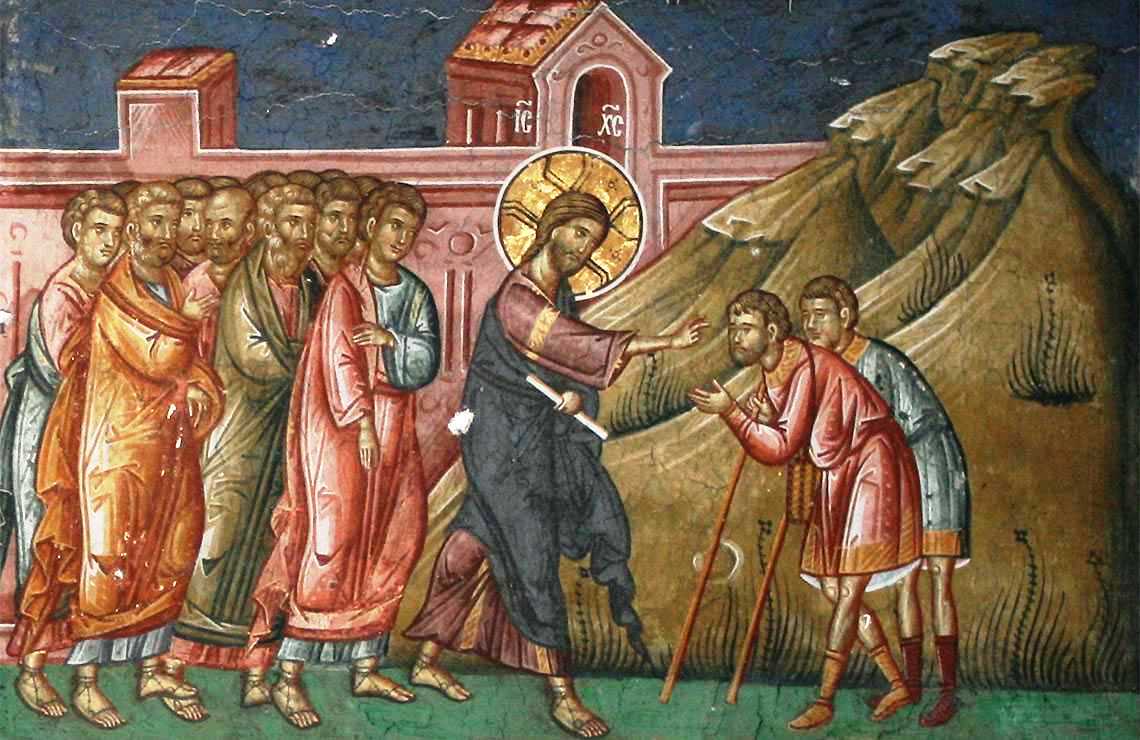
“And when Jesus departed thence, two blind men followed Him, crying and saying, ‘Have mercy on us, O Son of David!’ And when He was come into the house, the blind men came to Him: and Jesus saith unto them, ‘Believe ye that I am able to do this?’ They said unto Him, ‘Yea, Lord.’”
Saint Gregory Palamas here draws attention not only to the bodily healings of the blind wrought through faith in the Lord Jesus—which have occurred beyond number throughout history—but also to the spiritual illumination granted to all who have come to believe in God. He writes:
“Living upon the earth in the body He assumed for our sake, our Lord Jesus Christ healed many who were blind—both in body and in soul. If one considers the spiritual enlightenment that consists in passing from unbelief to faith, from ignorance to the knowledge of God, it is impossible to count the multitude of the blind who, through the Lord’s Incarnation, have received sight; their number is known only to Him who knows even the number of the hairs upon our heads. If we consider the healing of bodily eyes, we find that some were healed by His mere word, others by His touch; some by simply approaching and falling before Him, and others by being anointed with spittle or clay.”
Saint John Chrysostom, in turn, reveals deeper lessons hidden in this act of Christ:
“Why does Christ compel the blind men to follow Him and cry for mercy? That He might teach us even here to flee from human glory. Since the house was near, He leads them there to heal them in private. This is shown by the fact that He charged them to tell no one. This also condemns the Jews: for while the blind, deprived of sight, come to faith by hearing alone, the Jews, who saw miracles with their own eyes, act in complete opposition. Observe, too, the fervor of the blind men—judged by their cries and pleas: they said nothing but, ‘Have mercy on us!’ Bringing them into the house, Christ also questions them. He often healed only after being asked, that none might think He sought glory for Himself, and that He might show the healed to be worthy of healing. Otherwise, they could say that if He acted purely from mercy, all should have been healed.”
Saint Nikolai of Ohrid continues this reflection, offering a deeper insight into the Lord’s delay in granting the healing:
“As long as the blind men cried after Christ, He neither turned nor answered them. Why? First, that He might intensify their thirst for God and strengthen their faith in Him; second, that many hearing the cry of the blind might be moved to examine their own hearts and test their faith; and third, that by avoiding public spectacle, He might reveal His meekness and humility—healing these sufferers not on the road before the crowd, but in the house before only a few witnesses. ‘Do you believe that I am able to do this?’ the Lord asks. Why does He ask, when He knows their faith? He who sees the heart? He asks so that they may declare their faith openly, both for their own strengthening and for the instruction of those present. For by public confession faith is confirmed both in the one who confesses and in those who hear. ‘Yea, Lord,’ they answer—overjoyed that Christ has even spoken to them, their faith in Him and His power flamed forth all the more. They no longer call Him the Son of David, which now seems too little and indirect, but call Him Lord. In this lies their confession of faith: that Jesus Christ is Lord, the God-Man and Saviour—and that is enough.”
Saint Hilary of Poitiers, commenting on the same passage, speaks about the identity and faith of the blind men who sought healing:
“The Law itself revealed to these blind men, who lived in ignorance, from whom they should seek healing. The Law, which declared that their Saviour would come from the line of David according to the flesh, illumined their souls darkened by ancient sin. For without instruction, the blind would not have recognized Christ in Jesus. The Lord showed that faith must not follow healing, but that healing follows faith. The blind received sight because they believed, not that they believed because they saw. It is clear, therefore, that by faith they merited the fulfillment of their prayer, and did not gain faith as a result of it. If they believe, Jesus promises them sight. Yet He commands those who believe to keep silence, for preaching is the work of the apostles.”
Here the saint does not mean that lay people should never bear witness, but that the preaching of the Church can bear fruit and be pleasing to God only when it proceeds under the blessing and guidance of the Church. No self-will or self-assurance in preaching can yield fruit worthy of eternity.
Adapted for the contemporary reader based on patristic commentary by: Stanoje Stanković