Before moving on to the following verses, we may present the reflection of St. Theophan the Recluse, which remains highly relevant for us and for our spiritual life. St. Theophan writes the following about the faith of the Roman centurion: “This is the very faith that the Lord required of all; such faith is required of us as well. Whoever possesses such faith lacks nothing, and whatever he asks, he receives. This was promised by the Lord Himself. Oh, if only we might attain even a trace of such faith! But indeed it is a gift, and for this gift we must pray, and pray with faith. We shall pray, at the very least, with a sense of our need for it; we shall pray unceasingly, with persistence, while at the same time aiding its growth within us through fitting reflections, and above all through obedience to the commandments of God.”
Verses 11 and 12 read:
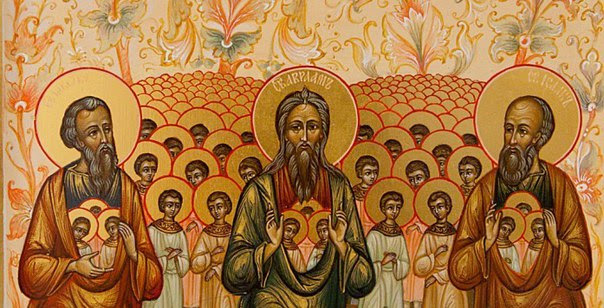
“I tell you, many will come from east and west and will sit at table with Abraham, Isaac, and Jacob in the kingdom of heaven; while the sons of the kingdom will be cast out into the outer darkness; there men will weep and gnash their teeth.”
St. John Chrysostom here explains also the reason why the Lord uttered these words. Here are his words: “The Lord here speaks prophetically concerning the Gentiles and offers them a good hope. Among those who followed Him were also inhabitants of Galilee of the Gentiles. Jesus spoke these words in order not to leave the Gentiles in despair, but also to humble the pride of the Jews. However, so that His words might not offend the hearers or give any occasion for opposition, Christ introduces the subject of the Gentiles not at the beginning, but when the occasion was provided by the Roman centurion. And the Lord does not explicitly name the Gentiles, for He did not say ‘many of the Gentiles,’ but ‘many from east and west,’ which signifies the Gentiles.”
Blessed Augustine, for his part, interprets the meaning of the phrase “from east and west” and writes the following: “That is why it is written that many will come from the east and the west. Not all, but many. Ultimately, the very words ‘from east and west,’ these two parts of the world, signify the whole world. Many will come from east and west and recline with Abraham, Isaac, and Jacob in the Kingdom of Heaven; but the sons of the kingdom will be cast into the outer darkness. The sons of the kingdom are the Jews. Why are they called sons of the kingdom? Because they received the Law, to them were sent the prophets, they had the Temple and the priesthood, they celebrated the foreshadowings of all future events. And although they celebrated the types of these events, they did not acknowledge their fulfillment. This is why Christ declares that the sons of the kingdom will be cast into the outer darkness…”
Euthymius Zigabenus also gives the reason for Christ’s mention of the patriarchs, particularly Abraham: “The Lord mentioned Abraham in order to rebuke the Jews even more sharply, by showing that He has adopted the Gentiles into Abraham’s sonship. By the bosom of Abraham He meant the repose and delight of the righteous, their mutual communion and life, which together constitute the Kingdom of Heaven.”
As we can see, even here the Lord clearly reproves the Jews for their passionate nationalism and for their conviction that they were, by themselves, worthy of the Kingdom of Heaven, merely because they had Abraham, Isaac, and Jacob as their forefathers.
St. Gregory Palamas, in his explanation of these words of Christ, emphasizes an important point—namely, that the Lord’s warning directed toward the sons of the kingdom also applies to negligent Christians. Here is how he speaks on this matter: “Who are these sons of the kingdom who will be cast into the outer darkness? They are those who, though they confess the faith, reject God by their deeds, for they are hateful, disobedient, and negligent in every good work. And who are those who will sit at table with Abraham, Isaac, and Jacob in the Kingdom of Heaven? They are those who, along with true faith, follow the Law or the teaching of the Spirit, and who manifest their faith through works.”
Before us stands verse 13:
“And to the centurion Jesus said, ‘Go; let it be done for you as you have believed.’ And the servant was healed at that very moment.”
St. Nicholas of Ohrid explains Christ’s power and how He connects it with God’s action at the creation of the world: “Having uttered a prophecy, He then performs a miracle. It is as though, by this miracle, He intends not only to reward the centurion’s faith but also to confirm His great prophecy. He spoke, and the servant was healed. Just as at the first creation God said, and it came to be, so now, at the New Creation, the Lord merely spoke a word—and so it was. The paralyzed man, whom the entire Roman empire could not save, rises at a single divine word of the Savior and becomes healthy. Sickness is a servant of God, and when the Master says: go, it goes; when He says: come, it comes. Without medicines or ointments, the sick man was healed, for the servant recognized the command of his Master, acknowledged it, and fled. Medicines and ointments do not heal; it is God who heals. God heals either directly, through His word, or indirectly, through medicines and ointments—according to the lesser or greater faith of the sick person. There is no cure for any illness in the entire vast world that can banish disease and restore health without the power of God, without the presence of God, without the word of God.” These final words of St. Nicholas can easily be taken out of context, leading some to argue that man has no need of physicians or medicine. Such an interpretation is utterly mistaken. The Church has always preached that our hope rests in God, but also, according to the words of the wise Sirach: “The Lord created medicines from the earth, and a sensible man will not despise them” (Sirach 38:4).
Basil the Great points out an important detail—that the servant was healed on account of the centurion’s faith. He writes: “Therefore know, brother, that it was not by the presence of Christ but by the faith of the one who prayed that the sick servant was freed from his infirmity. Likewise, even now, wherever you may pray, if the sick person believes that your prayers will help him, everything will be fulfilled according to his desire.” We see that healing depends not only on our prayer for another but also on the faith of the one for whom we pray, that our prayers will indeed help him. The Lord considers all.
Verses 14 and 15:
“And when Jesus entered Peter’s house, He saw his mother-in-law lying sick with a fever; He touched her hand, and the fever left her, and she rose and began to serve Him.”
Blessed Jerome of Stridon draws attention to the swiftness with which the healing occurred, highlighting also the difference from the ordinary course of human illness. He writes: “Human nature is such that fevers further weaken the body, and even after the return of health, the heavy consequences of the illness are still felt. However, the healing bestowed by the Lord is immediate and complete; and concerning Peter’s mother-in-law it is written not only that she was healed, but, in order to show the full restoration of strength, it is added: ‘And she rose and began to serve Him.’ The very hand that felt the touch of Christ was healed and served.”
Blessed Theophylact of Ohrid offers a pleasant observation, one that is significant for us Christians who live in the world. Here are his words: “From this, understand that marriage in no way hinders virtue, for even the chief Apostle had a mother-in-law.” This provides an appropriate response to the dilemma that often arises among people who, for one reason or another, suppose that they can please God only in the monastery, and who then abandon their families without the consent of their spouse and children.
St. John Chrysostom, at this point, draws attention to Peter’s humility. Here again we see the beauty and depth of patristic interpretation, in which the Fathers especially notice details that might escape us: “Observe here Peter’s regard for Christ. Though he had a mother-in-law lying at home with a great fever, Peter did not bring Christ into his house but waited until the teaching was finished and all others had been healed; only then, when Jesus entered his home, did he begin to entreat Him. Thus Peter, from the very beginning, learned to place the benefit of others above his own. So Peter does not bring Christ into his home, but Christ, of His own will, comes after the centurion had said: ‘I am not worthy that You should enter under my roof,’ thereby showing how well disposed the Lord was towards His disciple. And imagine what the homes of these fishermen must have been like; yet for all that, Christ did not disdain to enter into their humble cottages, teaching you to trample upon all human pride. Sometimes Jesus heals by words alone, sometimes He stretches out His hand, and sometimes He does both, that His healing might be manifest. He did not wish always to perform miracles in an extraordinary way. It was still necessary for Him to remain hidden, especially in the presence of His disciples, for in their great joy they would have spread the word everywhere. The Evangelist writes: ‘She rose and served Him,’ which was a sign both of Christ’s power and of the woman’s disposition towards Him. From this we can also see that Christ, through the faith of some, grants healing to others. Yet He bestows goodness only if the one who seeks healing is not obstinate in unbelief, but is either hindered by sickness from approaching Christ, or by ignorance or immaturity lacks an exalted understanding of Him.”
St. John of Kronstadt offers a spiritual interpretation of these words in the following way: “…he saw his mother-in-law lying sick—that is your soul, cast down and burning with passions. Behold, the Lord touches her hand, and the fire of passion leaves your soul. She rises and serves the Lord with a free heart.”
Adapted for the contemporary reader, based on patristic commentaries, by Stanoje Stanković.