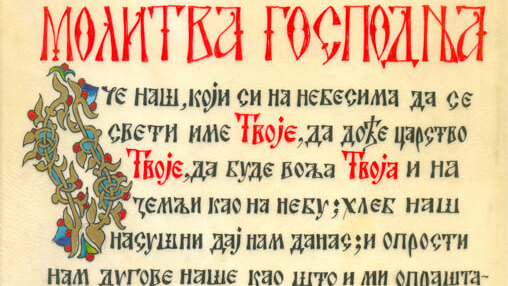
We now continue with the next verse from the Lord’s Prayer:
Give us this day our daily bread.
This verse is one of those passages where the Holy Fathers offer diverse interpretations. Some of the Fathers understand “daily bread” as our ordinary, physical sustenance; others interpret it as referring to the Holy Eucharist.
Here is how Saint John Chrysostom explains it:
“What is daily bread? It is the bread needed for each day. Since Christ had just said: Thy will be done on earth, as it is in heaven, and was speaking to those clothed in flesh—those who are subject to the necessary laws of nature and cannot attain the passionlessness of angels—He, though commanding us to live according to the angelic standard, nonetheless condescends to the weakness of our nature. It is as if He says: ‘I ask of you an angelic way of life, but not angelic dispassion, for your nature still has need of nourishment.’
And behold how much that is spiritual is present even in this physical request! The Saviour commands us to pray not for riches, not for pleasure, not for fine clothing or anything like that—but only for bread, and not even bread in abundance, but daily bread. He asks that we not be anxious even about tomorrow’s portion, which is why He adds daily, meaning that which is necessary for today. Nor does He stop there: He adds give us this day, so that we do not burden ourselves with concern for the day to come. For if you do not even know whether you shall live to see tomorrow, why worry about it at all?”
And here is the interpretation of Saint Ignatius Brianchaninov:
“This does not refer to perishable food! Therefore do not be anxious, saying, What shall we eat? or What shall we drink? or What shall we wear? (Matt. 6:31). What is meant here is the food that gives eternal life—the food given to mankind by the Incarnate Son of God. The phrase daily bread (ἐπιούσιος in Greek) indicates that this bread, by its nature, is above all created things. Its greatness and holiness are infinite and incomprehensible; the sanctification and dignity imparted through its partaking are inexpressible and beyond explanation.
Give us this day our daily bread.
This petition is joined to a command that gives Christians an obligation—a command which today is widely neglected: the command to receive the Holy Mysteries daily. By saying this day, the Lord expresses that we are incapable of living even a single day of spiritual life without this Bread. The fact that He says this day reveals that it must be taken daily; that its reception on a previous day is not sufficient if we do not receive it again today.
There is no day on which we do not need this Bread—by receiving it, we strengthen the heart of our inner man. Such an interpretation of daily bread should not seem strange to us, especially considering the practice of praying the Lord’s Prayer before meals—material bread serves as an image of the Bread that has come down from heaven.”
We can observe that these differences in interpretation among the Fathers do not in any way indicate a breakdown of doctrine, or, as some would falsely claim, prove the teachings of the Church to be contradictory or deceptive. On the contrary, they reveal the depth and richness hidden in Christ’s words—something for which we must be profoundly grateful to the Holy Fathers.
Venerable Maximus the Confessor adds yet another spiritual layer to the understanding of these words. He writes:
“The person who prays to receive this daily bread does not receive it in its fullness as it exists in itself, but only to the extent that he is capable of receiving it. For the Bread of Life, in His love for mankind, although He gives Himself to all who ask, does not give equally to all. To those who have accomplished great deeds, He gives more; to those who have done less, He gives less—that is, He gives to each according to the measure of their spiritual capacity.”
From these words we see that the Lord is just in His reward to those who believe in Him, and that those who have laboured more diligently shall receive a more abundant recompense.
And forgive us our debts, as we forgive our debtors.
In these words, the Lord, in a lofty and awe-inspiring manner, entrusts the judgment of ourselves to us. Saint John Chrysostom explains:
“There is no doubt that the Lord gave this law of prayer because He Himself knew perfectly—and wished to teach us—that even after Baptism, it is still possible for sins to be cleansed. By reminding us of our sins, He reminds us of humility; by commanding that we forgive the sins of others, He eradicates resentment within us. And by promising that we ourselves will be forgiven on account of this, He strengthens in us good hope and teaches us to reflect on the unspeakable compassion of God…
In this way, the forgiveness of sins depends primarily upon us. For the judgment passed on us lies within our own power. So that no one might have grounds to complain of an unjust verdict, the Saviour makes you—who are the accused—your own judge. It is as if He says: Whatever judgment you pronounce upon yourself, that same judgment I will pronounce upon you. If you forgive your brother, you will receive the same mercy from Me—although the mercy I show you far surpasses what you have offered. You forgive another because you yourself need forgiveness, but God forgives with no such need. You forgive a fellow servant, whereas God forgives His servant. You are full of countless sins, while God is without sin.”
Saint Cyprian of Carthage reflects on the practical significance of these words for our spiritual life. He writes:
“How necessary and saving it is to be reminded that we are sinners! This reminder urges us to ask for the forgiveness of our sins, so that—begging mercy from God—our spirit may be awakened. And so that no one may take pride in some imagined innocence and perish from arrogance, man is given both a reminder and instruction to know that he sins daily. He is commanded to pray daily because of his sins.
The Apostle John teaches the same in his epistle, saying: If we say that we have no sin, we deceive ourselves, and the truth is not in us. But if we confess our sins, He is faithful and just to forgive us our sins and to cleanse us from all unrighteousness (1 John 1:8–9).”
The next petition reads:
And lead us not into temptation, but deliver us from the evil one. For Thine is the Kingdom, and the power, and the glory, forever. Amen.
Saint Justin of Ćelije begins by clarifying what temptation means in this context. He writes:
“Temptation is a state in which a person is put to the test, so that he may freely choose between good and evil, between truth and falsehood, between virtue and sin, between God and the devil. God does not tempt anyone with evil (James 1:13). The devil cannot force a man to do evil. The Saviour’s words lead us not are to be understood as: do not allow us to be led into temptation.
Thus, temptation is a situation in which we are placed in order to reveal whether we will remain obedient to God or not.”
Blessed Theophylact adds to this by saying:
“If we have already fallen, we must pray that the temptation not overcome us entirely. One who has been defeated and conquered by temptation is said to have fallen into the pit of temptation. This does not apply to the one who has fallen but has still managed to prevail over the temptation.”
Saint John Chrysostom gives an inspired pastoral exhortation that protects us from many spiritual dangers:
“The Saviour here plainly reveals our weakness and humbles our pride, teaching us not to avoid ascetic struggle, but also not to run headlong into it of our own will. In this way, our victory will shine all the more brightly, and the devil’s defeat will be all the more bitter.
When the time for battle arrives, we should stand firm with courage. But if no battle arises, let us quietly await the time of struggle—so that we will not appear arrogant, but steadfast.
Christ here calls the devil the evil one, commanding us to wage an uncompromising war against him. He shows that the devil is not evil by nature; evil depends not on nature, but on free will. The devil is called evil not only because of the great wickedness in him, but because he wages relentless war against us—though he has received no harm from us…
Moreover, Christ does not say deliver us from evil ones, but from the evil one, thus teaching us never to be angry with our neighbour for the wrongs we sometimes endure from them. Rather, we are to direct all our enmity against the devil as the true source of all evil.”
Saint Ignatius Brianchaninov draws attention to what our attitude should be towards all that is sorrowful or unpleasant in life.
He writes:
“By temptations are meant those truly unfortunate circumstances and tragedies in which, because of our own inclination towards sin, we are handed over to the power of the devil and perish—as Judas Iscariot did. This petition does not teach us to reject the sorrows which are necessary for our salvation and which protect us from our passions and the demons… Not only should we pray that the passions do not gain dominion over us—through which we become enslaved to the devil—but we should also pray to be delivered from the bondage to the devil that we are already in, as a result of our fall.”
We continue with verses 14 and 15:
For if ye forgive men their trespasses, your heavenly Father will also forgive you. But if ye forgive not men their trespasses, neither will your Father forgive your trespasses.
This is one of those places in the Gospel where the attentive reader may be struck by the simplicity of the path that leads into the Kingdom of Heaven—namely, the act of forgiving others. Saint John Chrysostom adds that this spiritual work makes us resemble God. He writes:
“Here Christ again mentions heaven and the Father in order to stir the listener to shame. To be a child of God, it is not enough to receive grace—one must also perform works. Nothing makes us so much like God as when we forgive evil people who offend us.”
Saint Justin of Ćelije, in his reflection, adds:
“Out of His boundless love for mankind, the gentle Lord Jesus places even the Dread Judgment into your own hands. At the Last Judgment, you will condemn yourself if you have not forgiven others their sins; and you will justify yourself if you have forgiven them. Every human being holds in their hands the scales of eternity; in their hands is their final destiny: either eternal blessedness in the light of the Tri-radiant Divinity, or eternal torment—in the darkness of selfish will and devilish self-love.”
Saint Maximus the Confessor offers a practical word of counsel for those who seek reconciliation with someone who refuses to be reconciled. He writes:
“The soul that harbours hatred toward another person cannot have peace before God, Who has given us the commandment… Even if your brother does not desire peace with you, preserve yourself from enmity. Pray for him sincerely, and do not speak ill of him before anyone.”