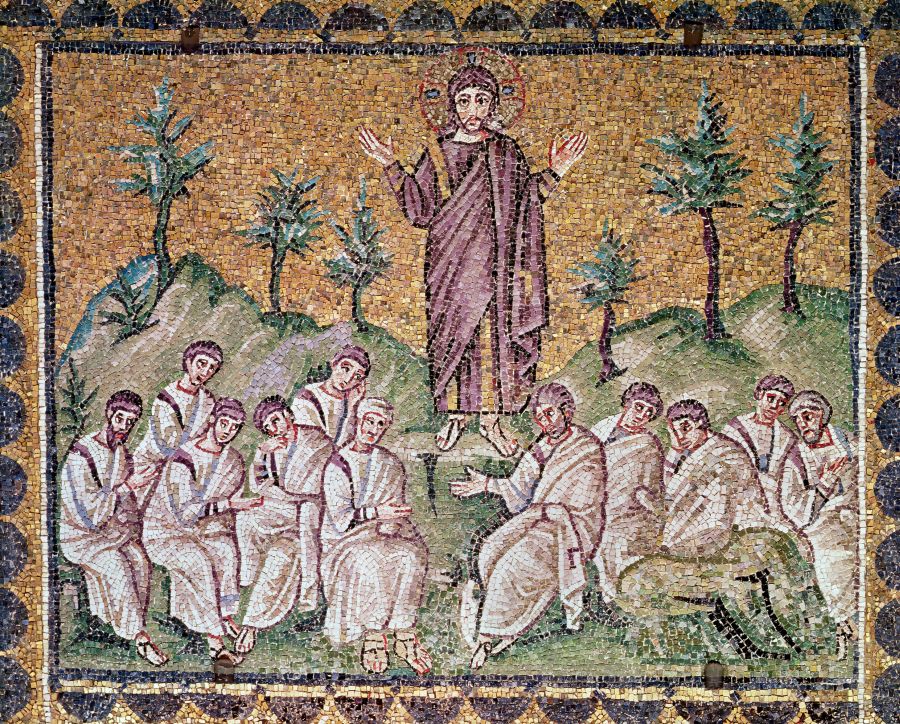
The eighth verse of chapter 12:
For the Son of Man is Lord of the Sabbath.
Saint John Chrysostom explains the essence and meaning of the Old Testament Sabbath: “The Apostle Mark says that Jesus spoke these words by applying them generally to human nature. There it is written: The Sabbath was made for man, not man for the Sabbath. But why, then, was the man who gathered sticks on the Sabbath punished (Numbers 15:33)? Because laws that are disregarded at the very beginning are scarcely observed later. The Sabbath brought great benefit: for example, it made people gentle and humane towards their neighbours; it led them to the knowledge of God’s providence and governance; little by little, as the prophet Ezekiel says, it taught people to turn away from evil and disposed them towards spiritual realities. If the One who established the law of the Sabbath had said to them, ‘Do good on the Sabbath, and do not do evil,’ they would not have refrained even from evil. Therefore a general command was prescribed: do nothing on the Sabbath. Yet even so they did not refrain. … For them the time had come to be instructed in all things through the most exalted realities, and there was no longer any need to bind the hands of a person who, having been freed from malice, strove towards all that is good. … It was no longer necessary for men to stand by the Ark of the Covenant and the golden altar—men who had within themselves the Lord of all and who entered into communion with Him in every way: through prayer, offerings, Scripture, almsgiving, and by bearing God within themselves.”
Finally, Saint Justin of Ćelije concisely shows that Jesus, precisely as Creator, has the authority to replace the Sabbath with a new day: “Jesus gives meaning and content to time. He came into the world of time and space in order to abolish the Sabbath and replace it with the Day of the Resurrection.”
Here are the verses in which the Apostle Matthew describes the event of the healing of the man with the withered hand:
“And departing from there, He went into their synagogue. And behold, there was a man with a withered hand; and they asked Him, saying, ‘Is it lawful to heal on the Sabbath?’—that they might accuse Him. And He said to them, ‘What man among you, if he has one sheep, and it falls into a pit on the Sabbath, will not lay hold of it and lift it out? How much more valuable is a man than a sheep! Therefore it is lawful to do good on the Sabbath.’ Then He said to the man, ‘Stretch out your hand.’ And he stretched it out, and it was restored, whole like the other.”
Saint Chrysostom also shows how much love for the Pharisees was hidden in this action of the Lord, how greatly the Lord desired to soften their hearts. This is how Chrysostom explains it: “Again Christ heals on the Sabbath and thereby justifies His disciples. The other Evangelists say that Jesus called the man to stand in the midst and asked the Jews whether it is lawful to do good on the Sabbath. Observe the Lord’s mercy. He called the man into the midst in order to soften the Pharisees by the sight of him—so that, moved by this, they might abandon their malice and, ashamed before the man, cease to be cruel. Yet, being untamable and inhuman, they preferred to obscure Christ’s glory rather than to see the sick man healed; they revealed their malice all the more—that is, their hostility and opposition to Christ—persisting so stubbornly against Him that they even blasphemed His beneficent deeds performed for others. The other Evangelists say that Christ Himself asked the question; Matthew says that they questioned Christ, saying, ‘Is it lawful to heal on the Sabbath?’—that they might accuse Him. Most likely both occurred. The Jews, being impious and knowing that Jesus would certainly proceed to heal, hastened to forestall Him with a question, hoping thereby to prevent Him. Thus they asked, ‘Is it lawful to heal on the Sabbath?’ not with the intention of learning from Him, but in order to accuse Him. Although the deed itself was sufficient for accusation, they strove to entrap Him also in words, that they might have more grounds for accusation. Yet the Lover of mankind both heals and answers, teaching us humility and meekness; Jesus turns everything against them, exposing their cruelty. He calls the man to the midst not because He feared them, but because He wished to confer benefit upon them and incline them towards compassion. And when even this could not soften them, He became angry, as Mark writes (Mk 3:5), because of the hardness of their hearts, and said: ‘What man among you, if he has one sheep, and if it falls into a pit on the Sabbath, will not lay hold of it and lift it out? How much more valuable is a man than a sheep! Therefore it is lawful to do good on the Sabbath.’ By this example He admonishes them to abandon their shamelessness and not to accuse Christ again of transgression. But observe how Christ everywhere, in various ways and with propriety, defends the apparent violation of the Sabbath. When He made clay for the blind man, He did not defend Himself before the Pharisees, although they accused Him then as well, because the very manner of the miracle sufficiently showed Him to be the Lord of the Law. When they accused Him for healing the paralytic who carried his bed, Jesus defended Himself both as God and as man. He defended Himself as man when He said: ‘If a man receives circumcision on the Sabbath, so that the law of Moses is not broken, why are you angry with Me because I made a man entirely well on the Sabbath?’ (Jn 7:23). And He defended Himself as God when He said: ‘My Father is working until now, and I am working’ (Jn 5:17)… So also in this situation He says: ‘What man among you, if he has one sheep…’ Jesus knew that they were more motivated by profit than by love of mankind. Another Evangelist says that Christ, in posing this question, looked at them, in order to soften them by His very gaze; yet even this did not make them better. Here the Lord performs a miracle with a single word, whereas in many other cases He heals also by the laying on of hands. Yet neither did one nor the other make the Pharisees meek; when the man gained health, they became even worse because of that healing. Before the man with the withered hand, He wished to heal the Pharisees and employed countless means of healing—previous words and actions; but since their disease was incurable, Jesus proceeds to the deed itself. Then He said to the man: ‘Stretch out your hand.’ And he stretched it out, and it was restored, whole like the other.”
Saint Philaret at this point answers a dilemma that still exists today among church people—namely, the question of what is permitted to be done on Sunday: “And He said to them: ‘What man among you, if he has one sheep, and if it falls into a pit on the Sabbath, will not lay hold of it and lift it out?’” (Mt 12:11). The Sabbath was made for man, not man for the Sabbath. Therefore the Son of Man is Lord even of the Sabbath (Mk 2:27–28). From these sayings two rules may be discerned. First: works of necessity are permitted on the Lord’s Day. Second: beneficent and philanthropic works are worthy of the Lord’s Day.
But from this it is also necessary to conclude that the Gospel—and likewise the ancient Law—on the Lord’s Day forbids works for which there is no unavoidable necessity, as well as works that possess neither moral worth nor beneficence.” Saint Theophan the Recluse continues this line of thought and shows how we Christians ourselves violate this commandment concerning the day dedicated to the Lord: “Therefore it is lawful to do good on the Sabbath” (Mt 12:12). The Lord said this after healing the man with the withered hand in the synagogue on the Sabbath day, as a rebuke to the Pharisees, who had so reduced the commandment of Sabbath rest that they even calculated how many steps one might take on that day. Yet, since good works cannot be performed without movement, they preferred to renounce them rather than risk erring by excessive walking. The Saviour reproved them for this more than once. For on the Sabbath abstinence was required from worldly cares, not from works of piety and brotherly love. In Christianity, in place of the Sabbath, Sunday is observed with the same aim: to refrain from worldly labours and to devote the day exclusively to works done according to God. Christian sobriety has never descended to Pharisaic petty scrupulosity—namely, to the absence of any activity on Sunday. However, the permitted dispensation for activity on that day has far exceeded the bounds of propriety. The Pharisees’ inactivity on the Sabbath drew them away from doing good deeds, whereas Christians are drawn away by the activities they allow themselves on Sunday. On Saturday evening—going to the theatre, and then every other kind of entertainment. After that—a morning slept through: there is no time for church. A few visits, lunch, and in the evening entertainment again. Thus the whole time is devoted to the stomach and the gratification of the other senses, and there is no time even to think of God and good works.” Although Saint Theophan wrote this more than a century ago, it is today more applicable than ever.
Blessed Jerome writes of the Pharisaic cunning concealed behind this question. This cunning on their part is evident throughout the Gospel: they pose such questions to the Lord later as well, when they raise the question of paying tax to Caesar, and so forth. This is how Blessed Jerome writes: “This man is the third to be healed in a synagogue. And it should be noted that the withered hand was made whole not on the road, not outside the house, but in the place where the Jews assembled. After Jesus had given a sufficient example justifying the apparent violation of the Sabbath for which the Pharisees accused the disciples, the Pharisees wished to accuse Him Himself. They asked Him, ‘Is it lawful to heal on the Sabbath?’ in order to accuse Him either of cruelty or of inability if Jesus did not heal the sick man, or of transgressing the law of the Sabbath if Jesus did heal the man.”
Blessed Theophylact also provides an allegorical interpretation of these verses. He writes: “Many people even today have withered hands—that is, they are unmerciful and miserly; but when they hear the word of the Gospel, they stretch out their hands in order to give alms. They do so even though the Pharisees—the proud demons who are separated from us—do not wish, in their hatred towards us, that we should stretch out our hand for the giving of alms.”
Verses 14 and 15:
But the Pharisees went out and took counsel against Him, how they might destroy Him. But Jesus, knowing it, withdrew from there; and many followed Him, and He healed them all, and charged them not to make Him known;
Blessed Jerome at this point indicates the inner motive for this Pharisaic course of action. He also exposes their hypocrisy, since here the Lord did nothing other than what they themselves did on the Sabbath day. These are the words of Blessed Jerome: “The cause of their plotting against the Lord is malice. For indeed, what did Jesus do to provoke the Pharisees to kill Him? Only that the man stretched out his hand. Yet which of the Pharisees did not stretch out his hand on the Sabbath to carry food, to hand someone a cup, and to do other things necessary for life? If, then, the stretching out of the hand and the lifting of a cup and food on the Sabbath do not constitute transgression, why do they condemn what they themselves could be accused of—especially when that man held nothing of the sort in his hand, but merely stretched out his hand at the Lord’s command? Knowing their snares—that they wished to destroy their Saviour—Jesus withdrew from there in order to deprive them of the opportunity to commit an impious deed against Him.”
Saint John Chrysostom continues this thought of Blessed Jerome: “No one had wronged them, and yet they wished to kill Jesus. Such is the evil of envy! It does not wage war only against strangers, but continually even against its own. What does the meek and gentle Jesus do? He withdraws: ‘Jesus, knowing it, withdrew from there.’ Where then are those who say that signs ought to have been shown? By this He showed that the insensitive man is not persuaded even by miracles, and at the same time He made it clear that they were accusing His disciples in vain. Yet it is also worthy of note that the Jews were especially offended by good deeds shown to one’s neighbour, and they accused Christ and raged against Him all the more whenever they saw someone delivered from sickness or sin. Thus they slandered Jesus when He wished to save the harlot, when He ate with tax collectors, and now when they saw the hand healed.”
Blessed Theophylact emphasizes the reason for Jesus’ withdrawal from the Pharisees and writes thus: “Jesus withdraws from there because the time of His suffering had not yet come, and also in order to spare His enemies from falling into the sin of murder. To expose oneself to danger without reason is therefore not pleasing to God. Attend to the word ‘went out’: for the Pharisees took counsel to kill Jesus only after they had ‘gone out,’ that is, after they had departed from God—for no one who abides in God would desire to do such a thing.”
Saint Hilary of Poitiers also speaks of the meaning of Jesus’ prohibition against speaking of His beneficent deeds: “The Lord commanded those whom He had healed to keep silent. But does Jesus command silence concerning healing? For whenever health is restored, it bears witness of itself. Yet by commanding that the matter be kept secret, Jesus avoids self-glorification.”
Adapted for the contemporary reader based on patristic interpretation by Stanoje Stanković