We continue with the patristic illumination of the thirty-third verse of the eighth chapter:
St. Nikolai of Ohrid, in his commentary, draws attention to the immense hatred toward man that is concealed in the words of the demons. The holy bishop writes: “If You cast us out. They do not say: out of the man; they refuse even to mention the name of man—so loathsome is it to them. For of all creatures in the universe, the devil hates nothing so much as man, nor envies anything so much as man. But the Lord Jesus, on the contrary, emphatically stresses this word—man: Come out, unclean spirit, out of the man! They have no desire to depart from man; they would incomparably rather remain in men than go into swine. For what can they do with swine? Whereas they can turn men into swine, or even worse—what more could they accomplish with swine? Yet even when they dwell in swine, or in any other creature, their malice remains directed against man. Even through the swine they will contrive to harm man, if in no other way then by drowning the swine and provoking men to anger against God. Therefore, when the abyss stands before them, they prefer even to enter the swine rather than descend into the abyss.”
Here is also the final, thirty-fourth verse of the eighth chapter:
“And behold, the whole city came out to meet Jesus; and when they saw Him, they begged Him to depart from their region.”
On this point St. Nikolai of Ohrid explains the condition of those who begged God to leave them, and he warns us not to hasten in condemning them. He writes: “Fear and dread had filled both the swineherds and the townspeople, and they were greatly alarmed. They saw what they had neither heard of nor seen before: the demoniacs, of whom they had lived in terror for years, sitting at the feet of Christ, calm and in their right mind. And they heard from the apostles and from their own swineherds the account of how Christ had healed the possessed men; how the legion of demons trembled in fear at the mere appearance of Christ; how they begged Him in terror to send them at least into the swine, since He would not allow them to remain in men; and finally, how the evil spirits like a whirlwind swept the swine into the depths of the sea. They heard all this; they understood all this clearly; and they beheld two new men, who but a short while ago were worse than corpses, now cleansed and resurrected. They looked into the face of the meek Lord, who stood before them gentle and calm, as though He had not wrought a greater wonder than if He had overturned the mountains of Gergesa and cast them into the sea—and of all this, these benumbed citizens retained only one thing in mind and heart, namely: that their swine had perished irrevocably. Instead of falling to their knees and giving thanks to the Lord for saving two men, they grieved over the loss of their swine! Instead of inviting the Lord as a guest, they begged Him to leave as quickly as possible. Instead of singing glory to God, they lamented with dirges for their swine. But do not hasten to condemn these swine-loving Gergesenes before you look around in today’s society and count all your own swine-loving fellow citizens, who would likewise prefer their swine to the lives of their neighbours. … The whole story concludes with these words: And having entered into the boat, Christ crossed the sea and came to His own city. Not a word did He speak to the Gergesenes. What use are words where such divine wonders have no effect? He did not rebuke them. What use is rebuking dead tombs? Rather, He silently descended the hill, entered the boat, and departed from them. What meekness, what patience, what divine majesty! How paltry is the victory of Caesar, who proudly wrote to his Senate: ‘I came, I saw, I conquered!’ Christ came, He saw, He conquered—and He was silent. And by His silence He made His victory wondrous and eternal.”
We now turn to the ninth chapter of the Gospel according to Matthew. The first two verses read:
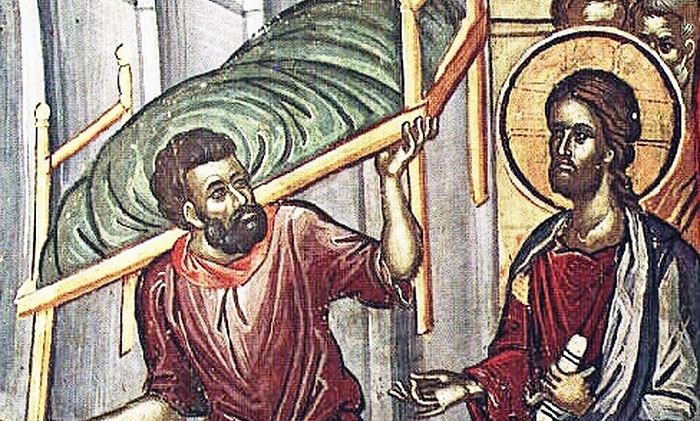
“And getting into a boat He crossed over and came to His own city. And behold, they brought to Him a paralytic, lying on a bed. And when Jesus saw their faith, He said to the paralytic, ‘Take heart, child; your sins are forgiven.’”
St. John Chrysostom explains that by “His own city” the Evangelist here means Capernaum. The city in which Christ was born was Bethlehem; the city in which He was raised was Nazareth; and the city in which He often resided was Capernaum. St. Gregory Palamas elaborates further on why this was considered the Lord’s city: “It was from this city that Jesus went out into the desert for prayer, or into the neighbouring towns to preach, and then returned again to it. Therefore the Evangelist Matthew calls this city His own.” The saint then adds a spiritual interpretation: this world in which we live is itself the city of Jesus, and the paralytic represents the soul of each one of us. He writes: “His city signifies this world into which He came, for as the Evangelist says: He came unto His own (Jn. 1:11). We may also say that the soul of every human being is paralyzed; yet when it is converted and comes to its senses, it brings to the Lord these four things: disdain for its sinful self, confession of sins, a promise to abstain from evil, and prayer to God.”
St. Hilary of Poitiers teaches that the paralytic is a symbol of the entire pagan world, and he interestingly adds that the man’s condition was not the result of any personal sin: “I do not agree that the paralytic had committed some sin; for indeed, elsewhere the Lord declared that blindness from birth was not a consequence of either personal or inherited sin.” Here St. Hilary is alluding to the account given in the Gospel of John (Jn. ch. 5).
St. Nikolai of Ohrid reflects on the faith of those who carried the sick man, while also extending St. Hilary’s reasoning concerning the paralytic himself. St. Nikolai writes: “And when He saw their faith. But whose faith? Was it only the faith of those who brought the sick man, or also that of the sick man himself? First of all, the faith of those who bore him is evident. By their faith alone the Lord could have healed the paralytic. For on many occasions Christ performed miracles without the knowledge or faith of the afflicted themselves. In the case of this paralytic, however, it is evident that the great faith lay with those who brought him to Christ. Christ did not need to judge their faith by outward signs; He looked directly into their hearts and saw their faith. But we, who cannot see into hearts, may discern by outward actions that their faith was indeed great. For four men to resolve to bring one hopelessly sick man to Christ—is this not a great sign of faith? And still more, to climb onto the roof, to open it, and to lower the sick man down through it before Christ—is this not manifest proof of strong faith? Imagine the risk these four men exposed themselves to, and the ridicule of their neighbours, had they after all this labour and the breaking open of the roof been obliged to carry the sick man back again unhealed! For men feared ridicule then no less than now, and they shrank from failure then as they do now. Only an exceedingly strong faith fears no ridicule and shrinks from no failure—indeed, such faith does not even consider ridicule, just as it does not doubt success. The Lord could therefore have healed the sick man on the strength of his bearers’ faith alone. Yet there are signs that the sick man himself had faith as well. First of all, any man of sound mind, had he been without faith, would never have consented to be dragged with his bed through the streets, and—what is still more significant—would never have allowed himself to be lifted onto a roof and lowered through it into a house. Moreover, there is yet another interior sign of the sick man’s faith. The Lord addressed him with the word, child—‘Child, your sins are forgiven.’ Would Christ have called an unbeliever ‘child’? Could it be said to one unrepentant: ‘Your sins are forgiven’?”
The next two verses read:
“And behold, some of the scribes said to themselves, ‘This man is blaspheming.’ But Jesus, knowing their thoughts, said, ‘Why do you think evil in your hearts?’”
St. John Chrysostom here points out how the Lord Jesus Christ Himself responds to the accusations of the scribes. This is useful to know, for it may serve as an answer to those who to this day attack the truth that Christ is God. Chrysostom says: “While the scribes were murmuring and saying that Jesus blasphemes, what did the Lord answer them? Did He deny their opinion? If Jesus were not equal to the Father, then He should have said: ‘Why do you think wrongly of Me? I do not have such power.’ But He said nothing of the kind; rather, He confirmed and proved quite the opposite, both by His words and by the miracle He performed. Yet because His words about Himself might have been offensive to His hearers, Jesus showed through others Who He was. And it is most admirable that He revealed this not only through His friends but also through His enemies, in which His supreme wisdom was displayed. … Some of the scribes said within themselves: ‘This man blasphemes.’ They did not utter these words aloud, they did not speak them with the tongue, but secretly conceived them in their hearts. And what does Christ do? He uncovered their hidden thoughts, wishing to show them the power of His Divinity even before demonstrating it through the healing of the paralytic’s body. And that it belongs to God alone to reveal the hidden thoughts of the soul is written in Scripture: ‘for You, You only, know the hearts of all the children of men’ (1 Kings 8:39).”
Blessed Theophylact writes that here Christ adapts Himself to the very way of thinking of the scribes. The saint reasons as follows: “Then He reproves them as though saying: ‘You think that I blaspheme because I claim for Myself the right to forgive sins, which is a great deed, and you suppose that I do this in order to avoid reproach. But when I heal the body, I will convince you that the soul also has been healed. By accomplishing what seems the lesser, though it appears more difficult, I will confirm that sins have been forgiven, which is truly the greater, although to you it seems easier, since it is not visible to the eye.’”
The great saint of our local Church, Nikolai of Ohrid, shows how attentive Christ was even towards those who hated Him. He writes: “The Lord does not mock them, does not attack them, does not reproach them, as an ordinary mortal might have done toward his enemies when he had succeeded in restoring health and strength to a paralytic man. Truly, not even the most considerate physician could have addressed his gravely ill patients more gently than did the meek and tender Lord address His senseless persecutors: ‘Why do you think evil in your hearts, when you could think good, and expect good, and rejoice in good?’”
Adapted for the contemporary reader from the patristic commentaries by: Stanoje Stanković