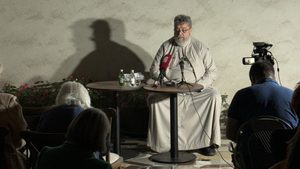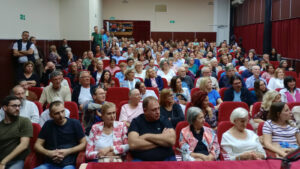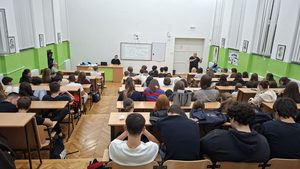
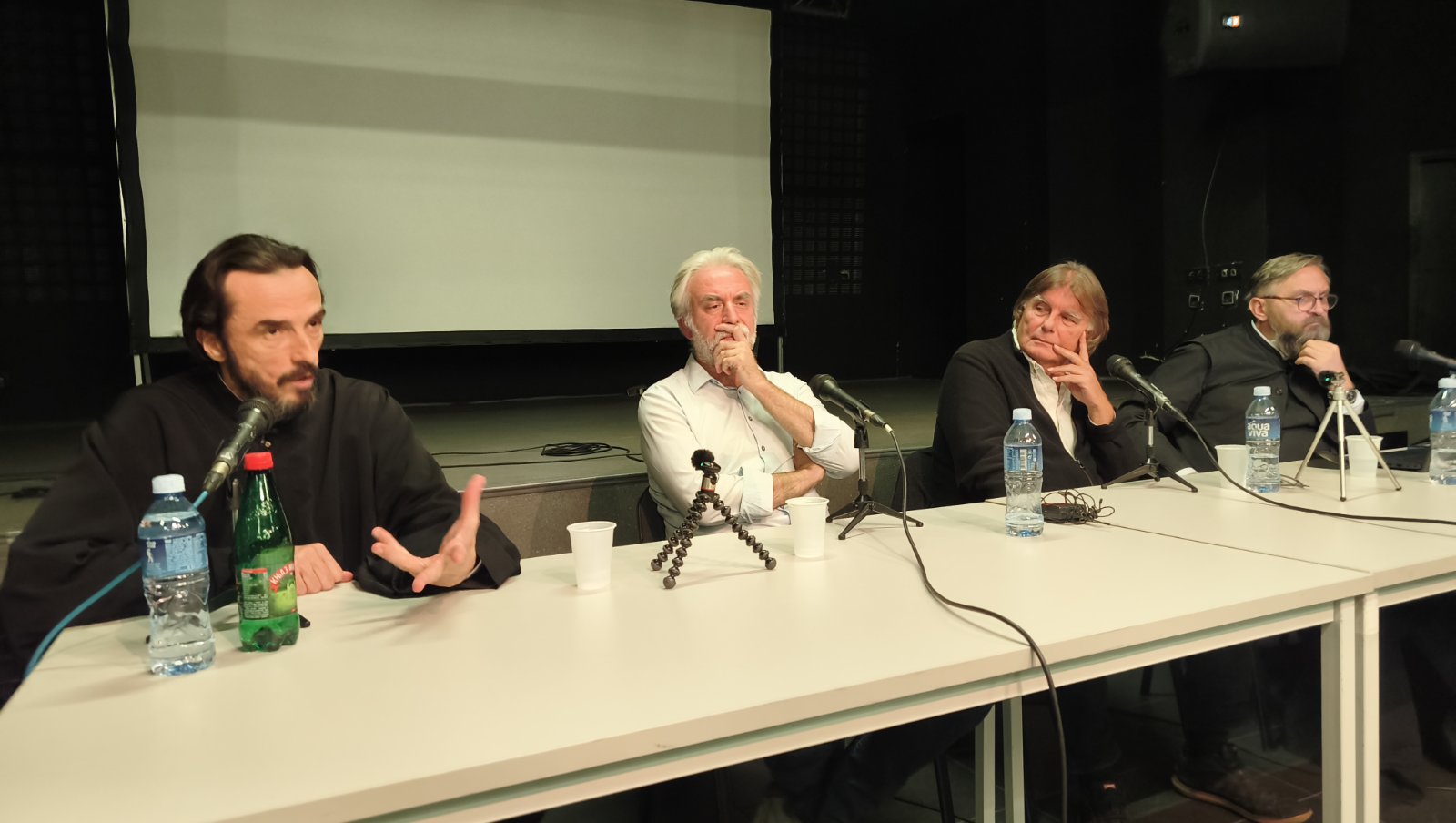
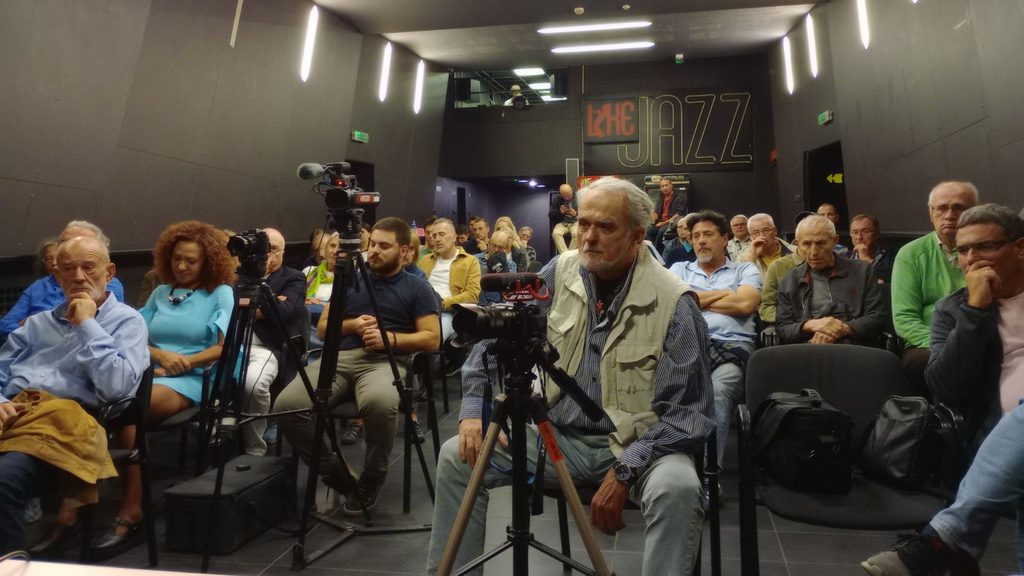
Organised by the Public Dialogue Section of the Missionary Department of the Archdiocese of Belgrade-Karlovci, the discussion panel “Nikola Tesla: Facts, Interpretations, Controversies, and Unknowns” was held at the Belgrade Youth Centre before a large audience. The event was organised to mark the 170th anniversary of Nikola Tesla’s birth. The well-attended evening brought together people eager to learn more about one of the most significant figures in the history of science and technology, beyond the familiar and often-repeated accounts.
The organisers’ intention was to discuss Tesla without idealisation or preconceived notions and, as far as possible, to distinguish clearly between documented facts and the interpretations, conjectures, and legends that have accumulated around his name over time.
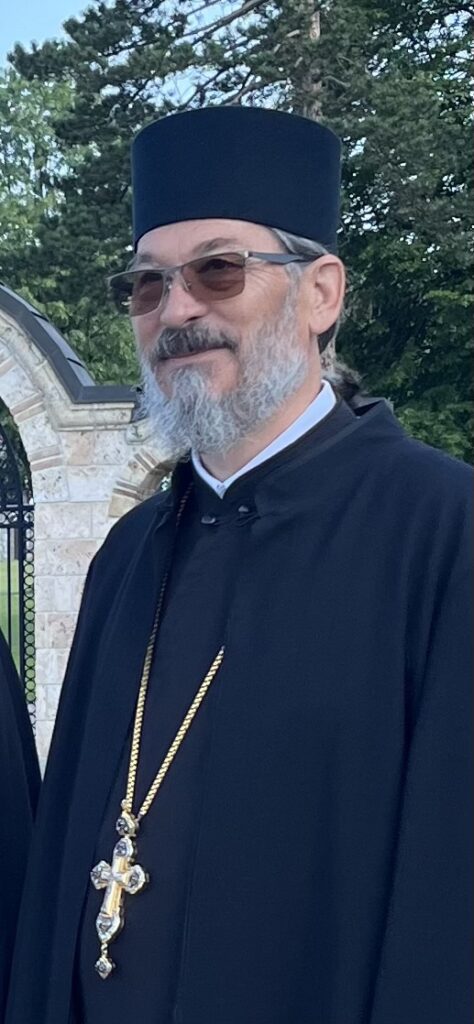
The participants were Presbyter Dr Oliver Subotić, Head of the Missionary Department of the Archdiocese of Belgrade-Karlovci; Professor Dr Dragan Novković of the Academy of Applied Technical and Art Studies Belgrade; and Vladimir Jelenković, former Director of the Nikola Tesla Museum and an eminent expert on Tesla’s life and work. The panel was moderated by Presbyter Dr Aleksandar Milojkov, Coordinator of the Public Dialogue Section of the Missionary Department.
The participants’ exceptionally informative, expert, and engaging presentations offered several complementary perspectives on Tesla’s life and work: historical, scientific and technological, and spiritual. The discussion was particularly valuable because the participants did not seek to present a simplified or idealised image of the great inventor. Instead, they argued carefully for a distinction between what can be reliably documented and the many popular perceptions that, over time, have become part of “Tesla” mythology.
The first thematic session, “Tesla Between History, Fame, and Controversy,” centred on Vladimir Jelenković. It addressed several of the best-known questions that have surrounded Tesla’s biography for decades: why he never received the Nobel Prize; what can actually be established about his relationship with Edison and Marconi; and how firmly grounded in historical evidence is the famous story that Tesla tore up his contract with George Westinghouse, thereby relinquishing enormous royalty payments.
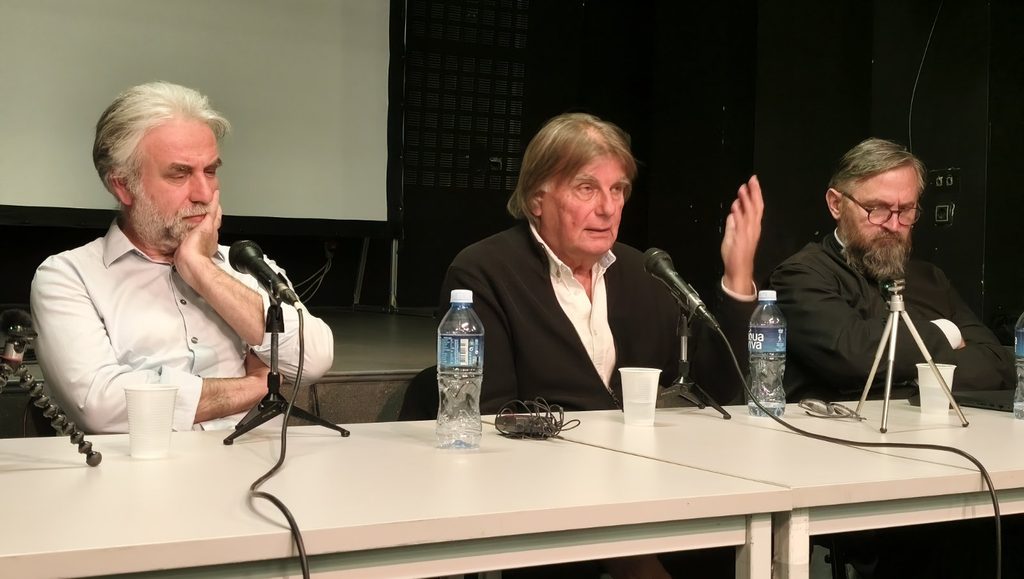
The second thematic session, “Tesla as Scientist, Visionary, and a Man at the Limits of the Possible,” was led by Professor Dr Dragan Novković. His engaging presentation enabled the audience to consider some of Tesla’s boldest ideas from the perspective of contemporary science and technology. Particular attention was given to the famous Wardenclyffe project and the possibility of transmitting electrical energy wirelessly over long distances, as well as Tesla’s concept of a directed-energy weapon, popularly known as the “death ray.” The discussion showed how important it is to distinguish Tesla’s undoubtedly brilliant and visionary insights from ideas whose practical feasibility was constrained by the scientific and technological capabilities of his time—or by the fundamental limits of physics.
The third thematic session, “Tesla’s Spiritual Portrait, Saint Nicholas, and the Problem of Fabricated Quotations,” attracted particular interest. Its principal speaker was Presbyter Dr Oliver Subotić. Drawing on his many years of research into Tesla’s spiritual and religious portrait, Father Oliver stressed the need to approach this aspect of Tesla’s personality without idealisation, while also taking account of his family and Orthodox Christian spiritual heritage.
A particularly striking part of the discussion focused on the numerous fabricated and altered quotations, texts, and photographs attributed to Nikola Tesla. These circulate rapidly online and on social media and are often accepted as indisputable historical facts. The participants outlined how the authenticity of words and documents attributed to Tesla can be verified by consulting primary sources, archival materials, correspondence, and first editions. The topic has particular relevance today, when an unverified claim, repeated often enough online, can readily acquire the appearance of an “established fact.” Mr Jelenković made a particularly effective contribution to this discussion, addressing contemporary attempts to falsify Tesla’s national identity.
The discussion then turned to a lesser-known but exceptionally interesting subject: Tesla’s relationship with Saint Nicholas. The participants drew attention to the complexity and occasional contradictions in Tesla’s religious views, while also considering evidence that his connection with Saint Nicholas was one of the few enduring spiritual constants in his life. Discussion of his family heritage, name day, accounts from his life, and the significance of Saint Nicholas during periods of personal crisis also raised a broader question: to what extent do the surviving sources allow us to understand Tesla’s private spiritual world?
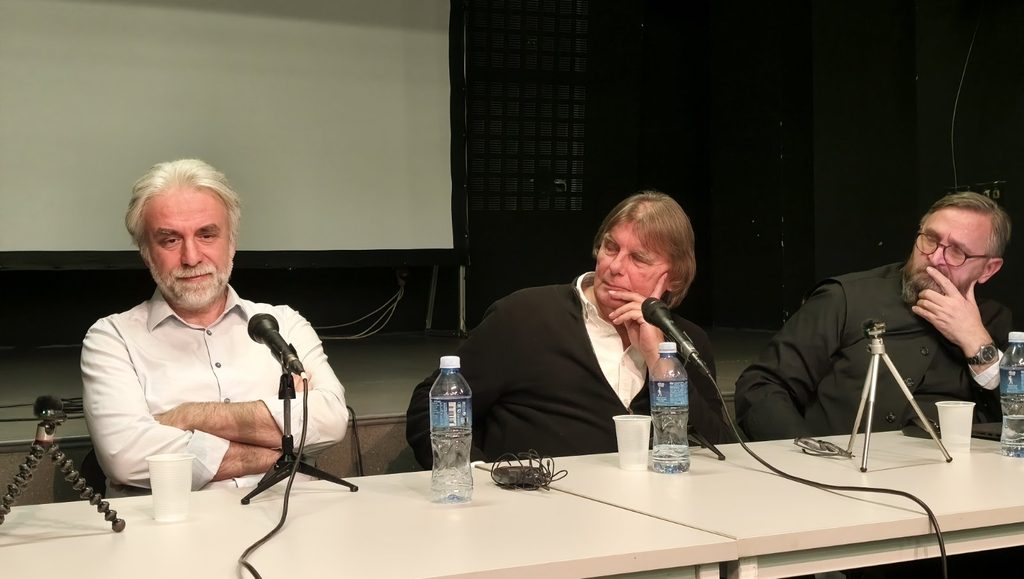
The panel was further enhanced by its format: in each thematic session, one participant served as the principal speaker, while the other two deepened the discussion with their reflections, additions, and observations. This approach gave rise to a genuinely interdisciplinary dialogue, bringing history, science and technology, philosophy, and theology into conversation.
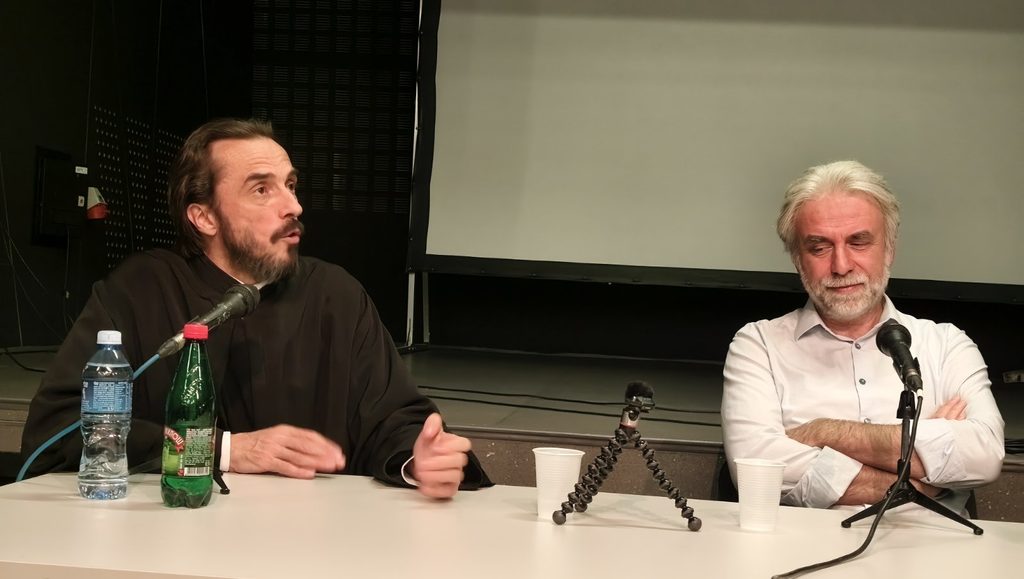
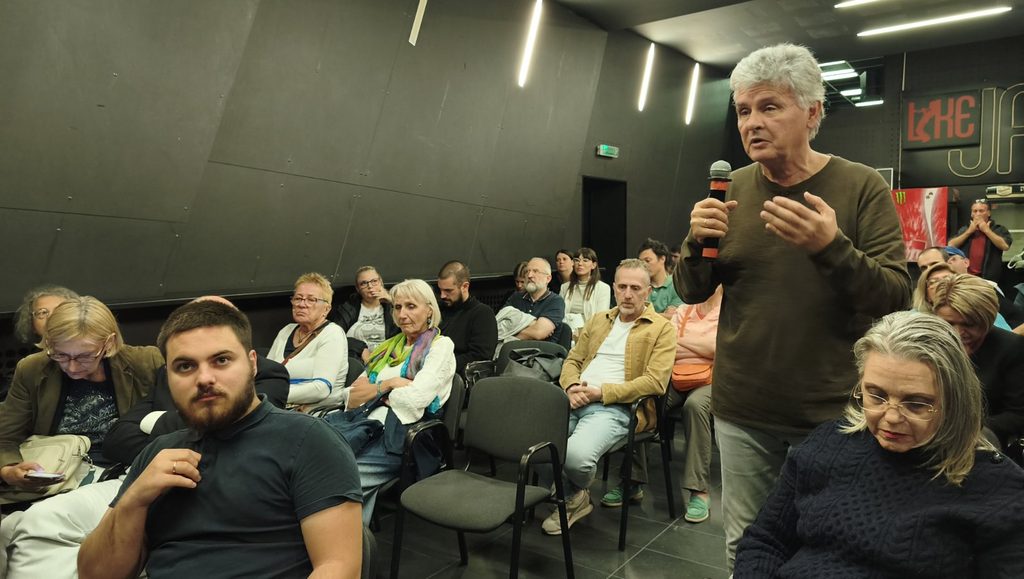
The audience’s lively response confirmed that the choice of topics had struck a chord with contemporary listeners. The presentations were followed attentively, and each thematic session concluded with an engaging question-and-answer exchange, turning the panel into an open and dynamic dialogue.
The audience’s strong interest and the high standard of the presentations and discussion demonstrated that, 170 years after his birth, Nikola Tesla continues to prompt new questions and capture public attention. This highly successful evening at the Belgrade Youth Centre also demonstrated the value of this kind of public dialogue, in which complex subjects are approached with expertise and openness and presented in a way accessible to a broad audience.
The panel was therefore more than another tribute to the renowned scientist and inventor. It sought to look beyond Tesla the legend and recognise Tesla as a real historical figure: a brilliant inventor and visionary, but also a man of his time, with a complex personality, unconventional ideas, and a spiritual heritage that continues to invite serious and responsible study.
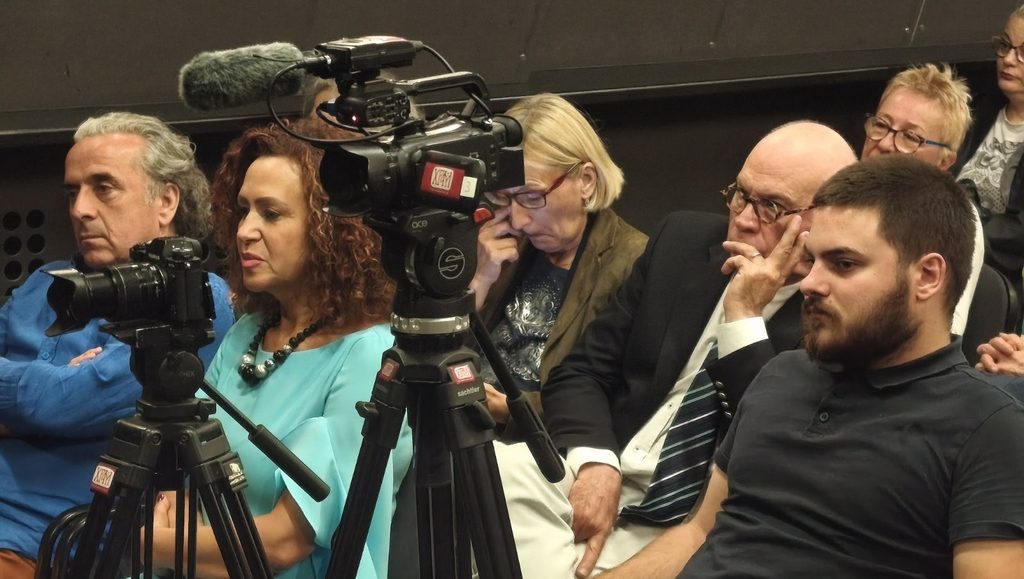
The event was covered by Hram Television. We will share the recording as soon as it is published.
PHOTOGRAPHS: Photo archive of Zoran Bulović