INTRODUCTION
In our time, marked by an overabundance of (mis)information, unrest, and personal crises, popular psychology and self-help gurus are gaining increasing attention. Their influence often assumes metaphysical dimensions.
The premise of the “psychologization of religion and sacralization of psychology” remains highly relevant. On the contrary, for the spiritual guides of the New Age movement, these are two mutually reinforcing processes, each resting upon the other. Within this framework, each figure promotes a personal alternative—be it a therapeutic-religious synthesis, a method, or a “path worth following.” Commonly implied is the concept of “faith through therapy” and/or “therapy through faith.”
The offer suggests that knowledge of God is attainable through disciplined self-work, that is, by fulfilling a therapeutic task… At the same time, none of the healing modalities is portrayed as excluded from cosmic currents or outside the frequencies of the universe…
Thus, to a large extent, it is precisely through New Age spirituality that a non-institutional, secular religiosity has taken root—one devoid of a personal God, Holy Scriptures, doctrine, or hierarchy. In this model, all beliefs are legitimate, and everyone is free to seek the transcendent according to their own experience, momentary inclination, or desire… The disoriented individual is presented with the idea that there is no real crisis, only an evolutionary delay that must be overcome. Quick solutions are offered. These include paths to self-realization, self-discovery, self-help… In short, one is presented with the notion that the paths of the universe are within reach, that God dwells within, and that one simply needs to “awaken inner potential” in order to find Him… For this, neither the Church, nor the Holy Mysteries, nor the priesthood are deemed necessary. In their place—according to the current spiritual paradigm shaped by New Age teachings—we find gurus, spiritual mentors, therapists, trainers, life coaches… and not infrequently, academically trained professionals who have adopted alternative interpretations of their disciplines as their life’s vocation.
We cannot ignore the fact that this strategy of offering a “shortcut to God, health, and eternal youth” has attracted tens, if not hundreds of millions of followers worldwide. Moreover, it enjoys robust media support, and it must be noted that a significant number of public figures (celebrities, politicians, actors, athletes…) have openly endorsed the self-improvement methods it promotes.
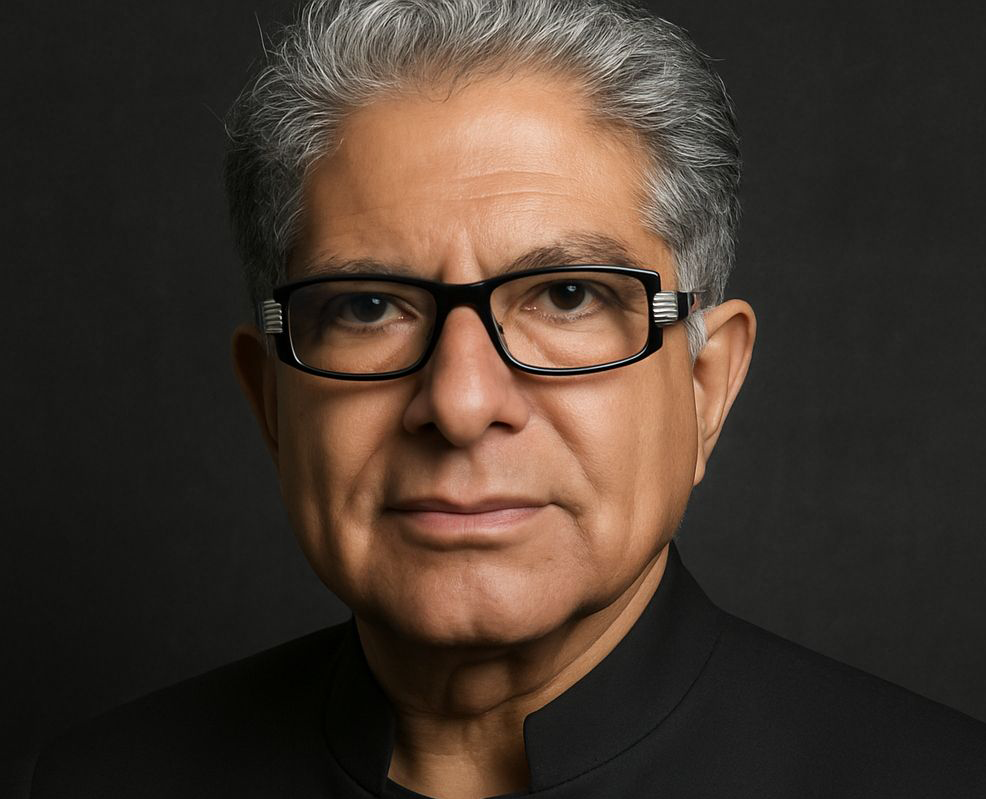
One of the most renowned and influential voices in this field is Deepak Chopra, an Indian-American physician who achieved global fame as a promoter of Eastern values and philosophy tailored to the Western markets of self-help, alternative medicine, spirituality, and psychological motivation.
Chopra recently addressed an audience in Serbia for the first time. Both the domestic and regional public had been invited for months in advance to attend “The Lecture That Changes Lives.” Following extensive preparations and accompanying programmes, the Indian speaker appeared before the audience in the Great Hall of the Sava Centre in Belgrade during the second week of July. The full title of his presentation was Deepak Chopra – Inspirational Lecture – An Awakened Life.
This occasion provides an opportunity, from the standpoint of Orthodox apologetics, to examine this figure—undoubtedly one of the leading authorities in today’s alternative spirituality. In order to offer a clearer and more accessible overview of Deepak Chopra’s work and mission, we shall now present a brief reflection on his oeuvre and spiritual endeavors.
BIOGRAPHY
Dr Deepak Chopra (b. October 22, 1946, New Delhi) began his professional career as an internist and endocrinologist, but during the 1980s he abandoned conventional medicine and turned toward Ayurveda, Eastern teachings, and matters of spirituality and human consciousness in the context of the future.
He is both an author and a promoter of New Age values. He is the founder of the Chopra Foundation, whose mission is to establish and disseminate integrative medicine, holistic health, and education—based on the premise of unity between spirit, soul, and body. A longtime practitioner of Transcendental Meditation, Chopra met its founder, Indian guru Maharishi Mahesh Yogi, in 1985. Since that time, he has been under the Maharishi’s direct influence. At the guru’s suggestion, he studied Ayurvedic medicine and the TM-Sidhi programme, and went on to found the American Association for Ayurvedic Medicine.
His ideas have reached a wide audience largely thanks to the numerous books he has authored—95 titles translated into 43 languages. Among the most influential are Perfect Health, The Seven Spiritual Laws of Success: A Practical Guide to the Fulfillment of Your Dreams, and Quantum Healing.
Chopra incorporates his “recipes” for happiness and eternal youth even into two of his books about Jesus Christ, creating a misleading sense of compatibility between his ideas and Christianity: The Third Jesus: The Christ We Cannot Ignore and Jesus: A Story of Enlightenment.
He is also the creator of more than thirty television and video series.
Chopra advocates a form of pantheistic monism, a model of existence in which the universe and the human body are inseparable in essence. He teaches that the universe resides within each of us, just as each human being is an omnipresent part of the cosmos. Guided by the principles of Ayurveda—traditional Indian medicine—Chopra offers advice on how to avoid ageing, overcome illness, transcend psychological and spiritual dissatisfaction, and escape poverty.
His teachings are also adapted to Western esoteric traditions, and he has “elevated” a version of adapted Tantra as a central element of his mission. Here, the emphasis is shifted from existential cosmological themes and the relationship between micro- and macrocosm to techniques involving sexuality, alchemy, breathing, and self-discipline—practices said to reveal supernatural powers to his followers.
In recent years, Chopra has begun exploring the potentials and implications of Artificial Intelligence. In his most recent book, Digital Dharma, he explains how modern technologies can be employed to elevate spiritual intelligence and personal well-being.
A VISIONARY OF THE FUTURE
In a world where humanity is increasingly losing contact with the very essence of existence, voices like that of Deepak Chopra resonate as echoes of ancient truths that the modern age is striving to forget.
Chopra begins with the premise that the human being is not merely a biological organism, but a manifestation of consciousness in material form. His philosophical approach is rooted in the Vedas, yet remains open to contemporary standards, phenomena, and trends. He poses a fundamental question: Who am I?—and responds not from a psychological standpoint, but from the perspective of ontology and spirituality. For Chopra, human consciousness is not a by-product of the brain, but the source of all things—including time, space, and matter.
His thought invites a reevaluation of reality itself: Is the world we see truly “real,” or merely a shadow of what occurs within consciousness? Is health merely the absence of disease, or a deeper harmony of body, mind, and soul?
Although his works are often criticized for blending science and mysticism, at their core Chopra’s teachings call for a simple yet radical way of living—with awareness, presence, and openness to the transcendent.
Chopra was once named by Time magazine as one of the 100 most influential people of the 20th century. The same magazine also dubbed him the “Soul’s Emperor” for his integration of medicine with Indian metaphysics, “telling Americans that body and spirit mutually influence each other.” In another Time article, it is stated: “The field of New Age healing medicine roughly consists of four categories. Chopra’s power lies in the fact that he embodies all four: he is an endocrinologist, a synthesizer of Indian medicine and quantum physics, a passionate writer, and a promoter of magic and mysticism.” Chopra is a Hindu mystic who embraces a monistic worldview according to which “on the cosmic level, we all simultaneously exist throughout the universe.”
In an era of general disorientation and aimless searching, of collective wandering between externally imposed technology and inner emptiness, it may be said that Western audiences—especially those in more prominent circles—have recognized in Chopra a man who first succeeded in reconciling Eastern spirituality with Western intellectual precision, and then in offering answers, pointing towards solutions, and meeting expectations. Deepak Chopra—physician, author, visionary—is undeniably one of the most sought-after spiritual teachers of our time.
Chopra is not merely the author of more than 90 books translated into dozens of languages—he has become, for many, a symbol of the quest for meaning in an age of superficiality. As one devotee of Transcendental Meditation put it: “His work is a bridge between ancient Vedic wisdom and modern quantum physics, between meditation and medicine, between spirit and body. On that bridge, he is not only the architect, but also the guide who courageously invites millions to turn inwards and discover their divine nature.”
What distinguishes Chopra from others is not only his knowledge, but also his charisma, calmness, and rare ability to translate complex truths into words that inspire. Admirers of his work emphasize that his vision of “conscious living” is not an escape from reality, but a full encounter with life in all its dimensions—physical, emotional, mental, and spiritual. They underscore that “…in a world filled with noise, Chopra offers silence. In a world marked by stress, he offers peace. In a world lost in materialism, he offers profound inner insight.” It is no surprise, then, that his message resonates with scientists and artists, doctors and patients, politicians and spiritual seekers alike.
To his followers, “Deepak Chopra is not merely a man. He is a movement. He is a reminder that man is not only body and mind, but also an infinite being of consciousness.” His message is simple, yet powerful: “You are not a drop in the ocean; you are the entire ocean in a drop.”
THE DRIVING FORCE OF THE NEXT AGE
Let us recall that for nearly an entire century, the New Age movement proclaimed the coming of happiness and universal well-being in the dawning Age of Aquarius. However, with the onset of the third millennium, the anticipated utopia of global progress was gradually abandoned in favour of an ideology centered on the individual improvement of the human being—an ideology dominated almost entirely by individualism and self-sufficiency. These characteristics constitute the very essence of the Next Age—a continuation of the New Age in a reformulated and individualized form—which is increasingly replacing the legacy of its predecessor on all levels.
In the Next Age, a narcissistic dimension of spirituality is promoted, along with an autonomous path in life and the pursuit of personal happiness. One is encouraged to love oneself, to care for oneself, and to place oneself at the center of one’s own joy and well-being.
Experts and analysts largely agree that Chopra is the initiator, ideologue, and one of the chief protagonists of the Next Age. He proclaims that even if society is stagnating, the individual can still attain a higher state of consciousness, prosperity, health, and happiness. Even if the world is undeniably heading towards collapse, this does not stand in the way of a person’s individual entry into a “golden age” through personal transformation.
In his major work The Seven Spiritual Laws of Success, Chopra outlines principles for healing the body according to traditional Indian Ayurvedic medicine. He teaches that the universe and the body form a unified whole, and that deep awareness of this essentially pantheistic worldview would, allegedly, enable the fulfillment of all desires—including the desire not to age and to overcome all psychological and spiritual afflictions.
Chopra’s thought reveals the underlying foundations of a neopagan anthropology, wherein the human being is his own god and the source of his own salvation. Themes of self-healing, self-realization, and the divine within are dominant.
His messages tend to avoid the reality of personal sin or moral deficiency. Confrontations with personal responsibility are often concealed beneath attractive messages aimed at awakening “inner strength” or the “divine potential within us,” or through instructions said to lead to “quantum healing.”
He places particular emphasis on the method of positive thinking and self-help techniques. More than others, Chopra has consistently advocated and widely promoted the ideas and pathways of so-called “consciousness evolution.” He has explored the ways in which understanding consciousness can enhance intuition and creativity, improve decision-making awareness, and thereby contribute to healing and the activation of personal potential—something each of us, he claims, can harness in a time dominated by collective fear.
To be continued
Missionary Department of the Archdiocese of Belgrade and Karlovci
Coordinator of the Section for Apologetic Mission
Zoran Luković