We begin with verses 31 and 32 of the fifth chapter:
“It was also said, ‘Whoever divorces his wife, let him give her a certificate of divorce.’ But I say to you that everyone who divorces his wife, except on the ground of sexual immorality, makes her commit adultery; and whoever marries a divorced woman commits adultery.”
The Holy Fathers explain the reasons for such a law in the Old Testament.
Saint John Chrysostom writes:
“In the Old Testament there was a law which did not forbid a man to dismiss his wife for any reason, should he cease to love her, and to marry another in her place. However, the law required that a certificate of divorce be given, so that the woman could no longer return to her former husband. In this way, the basic structure of marriage was, at least to some extent, preserved.
If there had been no such command, and it had been allowed to dismiss one wife, take another, and then take back the first again, it would have resulted in complete disorder. Everyone would constantly take each other’s wives, which would amount to open adultery. The Lawgiver showed great condescension in permitting the certificate of divorce. Even that was allowed only to prevent a greater evil. For if the law had forced a man to keep a wife whom he no longer desired, he might have killed her—and the Jews were capable of this. If they did not spare their own children, if they killed the prophets and shed blood like water, they would certainly not spare their wives. Therefore, God, who gave the Law, permitted the lesser evil to prevent the greater one.”
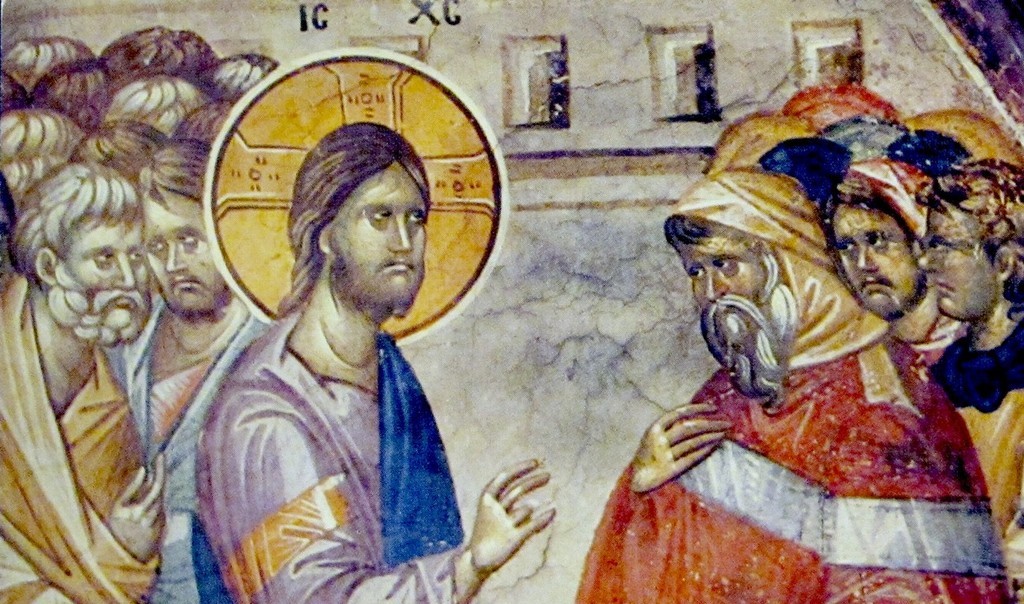
In the New Testament, Christ—in His Sermon on the Mount—changes this Old Testament law and introduces a new commandment, placing stricter boundaries on both husband and wife, thereby strengthening the institution of marriage.
Christ’s words, “Whoever marries a divorced woman commits adultery,” are explained by Chrysostom as follows:
“In this way, Christ removes any possibility for a divorced woman to marry another man. He compels her, even against her will, to remain chaste, and thereby eliminates any excuse for her husband to act with indifference. Knowing that she must either remain with the husband to whom she is married or, upon leaving his home, be left without support, she will, even unwillingly, be forced to love her husband…”
This does not mean that the entire burden of marital difficulty is placed on the woman’s shoulders. Saint John continues, speaking of the husband:
“Christ very strictly limits the husband’s freedom and instills fear in him, showing that he will be held accountable for his wife’s adultery if he dismisses her.”
Thus, the New Testament commandment limits both husband and wife.
Blessed Theophylact explains that a Christian must show great reverence for the marriages of others, no matter their state. Therefore, one should not marry a divorced woman, because she might yet be reconciled with her husband and return to him. He writes:
“The one who takes her is also an adulterer, because if he had not taken her, she might have returned to her former husband and submitted to him. A Christian must be a peacemaker, especially with his wife.”
What the Fathers speak of here is an ideal towards which all Christians should strive. We know that the Church today does permit the dissolution of ecclesiastical marriage, though it does not look favourably upon divorce. This can be seen in the document The Basis of the Social Concept of the Russian Orthodox Church, which states:
“Divorce brings severe emotional suffering to the spouses (or at least to one of them), and especially to the children.”
There is also an established list of circumstances under which the Orthodox Church permits divorce, as stated in the decisions of the Local Council of the Russian Orthodox Church from 1918. These include adultery and remarriage by either party, apostasy from Orthodoxy, unnatural vices, incapacity for conjugal life (either pre-existing or resulting from self-mutilation), attempted murder of a spouse or child, incurable mental illness, alcoholism, drug addiction, abortion performed by the wife against her husband’s will, HIV infection, and others. From this, we see that the Church exercises great discernment, and—as in Old Testament times—sometimes permits the lesser evil in order to prevent a greater one, such as physical violence or danger to the life of the wife and children.
We continue now with verses 33 to 35:
“Again you have heard that it was said to those of old, ‘You shall not swear falsely, but shall perform to the Lord what you have sworn.’ But I say to you, Do not swear at all, either by heaven, for it is the throne of God, or by the earth, for it is His footstool, or by Jerusalem, for it is the city of the great King.”
Saint John Chrysostom addresses the fact that Christ bypasses the commandment against theft and moves directly to the commandment concerning oaths. He writes:
“Why did Christ not speak next about theft, but instead about false witness, silently passing over the commandment about stealing? Because a thief may also swear; but one who does not swear falsely or lie will all the more not wish to steal. Thus, by this commandment Christ also abolishes theft—for falsehood is born from theft.”
Blessed Jerome provides the context for why the Lord Jesus spoke these words. He writes:
“In the Law, it was commanded that one should swear only by the name of the Lord our God (Deut. 6:13). The Jews, who swore by angels, by Jerusalem, by the temple, and later by the elements of the world (such as heaven and earth), showed honour and reverence to matter and physical objects that is due to God alone. Note that the Saviour does not forbid swearing by the name of God, but He forbids swearing by heaven and earth, by Jerusalem, and even by one’s own head. This reflects the condescension of the Law to the Jews, who were like children—to prevent them from offering sacrifices to idols.
Thus, they were allowed to swear by the name of God, even though it was improper, because it was better that they do so in God’s name than in the name of demons.”
Chrysostom further explains the context of the time: because idolatry was rampant, the Lord forbade swearing by such things. Over time, people might begin to regard them as sacred in and of themselves, even though their true purpose was to direct hearts towards the Creator.
Therefore, the Lord did not say that heaven is good or great, but that it is the throne of God—and likewise with Jerusalem and the earth. In this way, as Saint John notes, Christ continually urges His listeners to glorify God.
I now read the next verse, Matthew 5:36:
“Do not swear by your head, for you cannot make one hair white or black.”
In this verse, the Lord demonstrates that we have no real authority over ourselves and therefore no right to swear even by our own head. Saint John Chrysostom explains this quite convincingly:
“The Lord shows that you do not have authority over yourself, and therefore you do not have authority to swear by your head. If no one would agree to give his son away to another, then all the more will God not hand over His creation—that is, you yourself—to you. Though the head is indeed yours, it belongs to another. You have so little power over it that you cannot make even one hair on it white or black.”
Saint Chromatius of Aquileia, commenting on this passage, refers to the Apostle Paul’s words that “the head of every man is Christ” (1 Corinthians 11:3). Therefore, a person who swears by his head is, in truth, swearing by the Creator of his head. We simply cannot swear, because we belong to God—we are not our own. As the Apostle Paul says repeatedly to the Corinthians: “You were bought with a price.”
I now read verse 37:
“Let what you say be simply ‘Yes’ or ‘No’; anything more than this comes from evil.”
Regarding the oath itself, the Holy Fathers are clear that swearing is to be avoided. Saint Basil the Great writes:
“Oaths are altogether forbidden. All the more so is an oath taken in an evil matter worthy of condemnation.”
Saint John Chrysostom speaks even more forcefully about the sin of oath-taking:
“If you can prove that Christ commanded us to swear, or that Christ does not punish for this, then prove it—and I will submit…
But you may say: ‘What if someone demands an oath and even compels me to swear?’ Let the fear of God be stronger than all compulsion. If you start offering such excuses, you will not be able to uphold a single commandment…
As for the oath, you may never even be compelled to take one. Whoever has listened carefully to the Beatitudes and built himself according to Christ’s commands will not be forced to swear—for he will be respected and honoured.”
This is precisely what Blessed Theophylact of Ohrid emphasizes when he writes:
“So that you will not say, ‘How will anyone believe me then?,’ Christ says: ‘They will believe you if you always speak the truth and never swear.’ For no one inspires more distrust than the one who swears easily. But you may ask: ‘Then was the Law of Moses, which commands us to swear, evil?’ (Deut. 6:13; 10:20). Know that in those days, swearing was not evil—but after Christ, it is.”
Saint Isidore draws attention to the psychology of human behaviour, noting that for the one who tells the truth, an oath is unnecessary, while the person who is accustomed to lying will not be restrained even by an oath—it will pose no difficulty for him to break it.
This raises the question of how to reconcile Christ’s clear prohibition of oaths with the fact that certain forms of oath-taking still exist in our society—and the Church does not explicitly condemn them—for instance, the military oath, or the Hippocratic Oath taken by physicians.
Saint Justin of Ćelije offers the following answer:
“The Orthodox Church, like God once did through Moses, condescends to human weakness and permits oaths in particular cases. New Testament people still carry within them the weaknesses and limitations of Old Testament people. However, when the personal and social life of New Testament Christians becomes woven with Christ-like virtues, then oaths will no longer be needed; for confirmation, a simple ‘yes’ will suffice, and for denial—a simple ‘no.’”