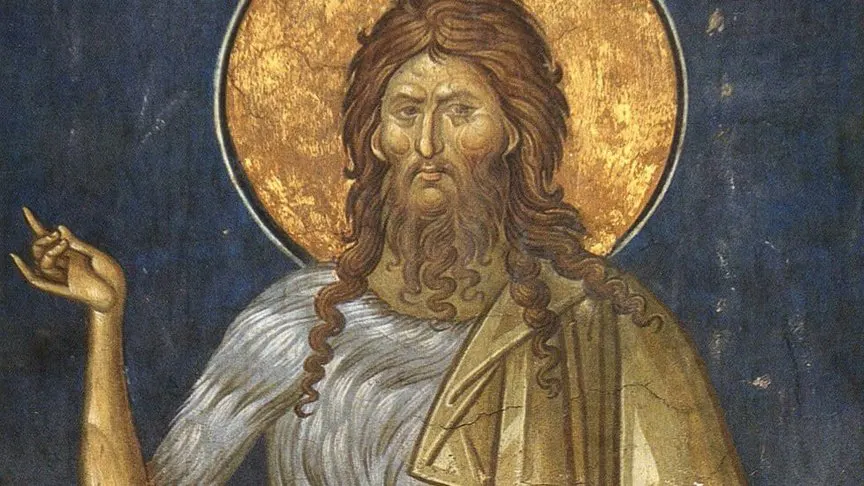
We continue with the patristic interpretation of the seventh verse.
The teachers of the Church state that in the words: “Brood of vipers, who warned you to flee from the wrath to come?” the Holy Forerunner and Baptist expressed both praise and rebuke. Saint John Chrysostom explains the words of the Holy Baptist as follows: “If someone carefully considers his words, they will find even in his rebuke a form of praise, for these words were spoken out of astonishment that they, albeit belatedly, were still able to do what once seemed impossible. Thus, the very rebuke from John implies a desire to attract and incline them toward repentance. While outwardly striking them, he reveals their previous misery, and together with this, their wondrous and unexpected present change. How could it have come to pass, says the Holy Forerunner, that they, being children of such fathers and so poorly raised, have begun to repent? From whence such transformation? Who softened their hardened hearts? Who healed the incurable? See how he strikes them from the very beginning by speaking of hell. He did not speak to them of ordinary misfortunes, for example, ‘Who warned you to flee from enemies, captivity, famine, and wounds?’ No. He threatens them with another punishment, one they did not yet clearly comprehend, saying: Who warned you to flee from the wrath to come?”
As for the expression “brood of vipers,” Saint Ignatius Brianchaninov offers a very profound observation. He writes: “The Holy Evangelist Matthew tells us that John called the Sadducees and Pharisees a brood of vipers. The very Savior of the world said of the scribes and Pharisees: ‘Serpents, brood of vipers! How can you escape the condemnation of hell?’ (Matt. 23:33). This means that the term ‘brood of vipers’ was not merely a forceful expression—it represents the judgment of God pronounced by the Son Himself, and the Word of God spoken by the Holy Spirit through Saint John. Here, the fallen angel—Satan—is referred to as the serpent and the viper. Those infected with pride, who called themselves children and descendants of Abraham, were called children and offspring of Satan by God Himself.”
Blessed Theophylact also draws attention to the very nature of these serpents, showing that even in this sense, it was by no means accidental that the Pharisees and Sadducees were called such. He writes: “He calls them a brood of vipers, because it is said that just as vipers devour their mother’s womb upon birth, so they killed their own fathers, that is, their teachers and prophets.”
Here is verse 8:
Therefore bear fruits worthy of repentance.
In these words, the Apostle Matthew presents the advice given by Saint John the Baptist to the Pharisees and Sadducees. That is, after repentance and turning to God, it is necessary to demonstrate an appropriate way of life. Saint John Chrysostom explains this as follows: “But John does not stop with rebuke—he also gives counsel: bear, he says, fruits worthy of repentance. For it is not enough merely to withdraw from evil; one must also exhibit great virtue. Do not do, he tells them, what is contrary to me and what you have become accustomed to, and do not return to former vices after briefly humbling yourselves.”
In the continuation of his commentary, Saint Chrysostom emphasizes an important point that we sometimes forget—that we live in the time of the New Testament, that far greater goods have been given to us, and thus our responsibility and punishment are also greater. He writes: “We are no longer in the same position as the prophets before us. The present circumstances differ even more from the former ones, for now the very Judge and Lord of the kingdom comes to lead us to supreme wisdom, to call us to heaven and draw us to the heavenly dwellings. Therefore I speak of Gehenna, for now both rewards and punishments are eternal. So, do not remain in your former vices, do not refer, as is your custom, to the nobility of Abraham, Isaac, and Jacob. Among other things, with these words the Holy Forerunner does not forbid them to call themselves descendants of these Saints, but he forbids them from relying excessively on that while despising a virtuous life. By speaking in this way, he reveals their present thoughts and prophesies the future. Indeed, they later still said: ‘We are Abraham’s descendants and have never been in bondage to anyone’ (John 8:33).” I believe these words of Saint John can also be instructive for us today—in the sense that it is not enough merely to call ourselves children of Saint Sava, but we must also strive that our lives in some way resemble the life of Saint Sava, in whom we place our hope.
Saint Chrysostom in his commentary on this verse also offers excellent advice for our spiritual lives: “How do we bear fruit? By doing the opposite. For example, have you stolen what belongs to others? From now on, give even of your own. Have you for a long time lived in fornication? Now, abstain even from your own wife on certain days; train yourself in self-restraint. Have you insulted or even struck those you met? Now bless those who insult you and do good to those who strike you. For our healing, it is not enough to merely extract the arrow—you must also apply medicine to the wound. Were you previously given to pleasure and drunkenness? Now fast and drink water; strive to eradicate the evil that arose from your previous life. Have you once looked with lust at another’s beauty? In the future, for your own safety, do not look at women at all. Depart, it is said, from evil and do good (Ps. 34:14), and also: Keep your tongue from evil, and your lips from speaking deceit (v. 13). But I also ask you to speak good. Seek peace and pursue it (v. 14), not only with people but also with God.”
I now read the next, ninth verse:
And do not think to say to yourselves, ‘We have Abraham as our father.’ For I say to you that God is able to raise up children to Abraham from these stones.
Saint Ignatius Brianchaninov says that this is precisely why the Holy Forerunner addressed these words to the Pharisees—because he sought to root out their chief spiritual weakness: pride. Saint Ignatius writes: “The prideful thought of themselves because of their descent from Abraham infected the whole nation with arrogance, making it incapable of accepting repentance, turning to God, and receiving the promised Messiah. The great John the Forerunner insightfully directed the first words of his preaching against the principal infirmity of the people, against the ruinous pride. ‘Do not think and do not say to yourselves: We have Abraham as our father,’ for with such pride you destroy every spiritual closeness; more than that, every closeness and every connection between you and Abraham.”
As for the meaning of the words: “God is able to raise up children to Abraham from these stones,” the Holy Fathers have seen multiple layers of meaning in the term “stones.” Saint Nikolai of Serbia summarizes it in the following way: “First, God is truly able to create for Himself people from stones, of whatever kind He wills. Therefore John points the leaders of the people from Jerusalem to the simple penitent people, whom they despised as dead and rough stones. From that simple people, God will raise apostles, evangelists, saints, and heroes above heroes, and the leaders of the people, who shine with worldly, transient, and false splendor, God will reject—unless they show fruit worthy of repentance. Thirdly, even from the pagans, who bow to dead stone and wood, God can make servants for Himself. In vain do the sages of Israel loathe them as something impure and unworthy of heaven and earth; if these same sages do not prove themselves to be truly children of Abraham, similar to the righteous and God-fearing Abraham, God will raise up believers from among the pagans, just as the pagans made gods for themselves out of stone. And finally, let the sages of this world not pride themselves solely on their knowledge of earthly and divine laws, while their hearts remain as hard as stone. Indeed, as long as their hearts are hard as stone, their minds, filled with diverse knowledge, will lead them straight into eternal fire. They have become accustomed to valuing knowledge alone, but have neglected the heart. Worse still, they boast in the hardness of their hearts. But God can make the heart the starting point of human salvation—from the heart, not from the mind—as the Lord said through the prophets: ‘I will give you a new heart and put a new spirit within you; I will take the heart of stone out of your flesh and give you a heart of flesh’ (Ezek. 36:26). Accumulated knowledge could not soften their hearts. But God can, in true penitents, soften hearts by His grace, like wax by fire, and then, through the warmth and light of the heart, the mind of the faithful will be illuminated with all necessary knowledge.”
Adapted and structured for the contemporary reader based on the patristic commentaries: Stanoje Stanković