We continue with the interpretation of verse 39.
Blessed Jerome points out the persistence of the Pharisees and also describes in detail the miracles performed by the prophets of the Old Testament: “Perhaps they wanted, as in the time of Elijah, that fire should descend from above; or perhaps, as in the time of Samuel, that in the midst of summer, contrary to the natural order, lightning should flash, thunder should roar, and rain should pour down in torrents—as though the Pharisees would not have been capable of blaspheming even such signs and claiming that they arose from various unknown movements of the air… For if they blaspheme what they see with their eyes, hold in their hands, and acknowledge to be beneficial—what would they not say about that which came from heaven?”
Saint Cyril of Alexandria in his interpretation reveals the distorted logic of the Pharisees and explains why they demanded a miracle specifically from heaven: “Since, according to their words, the miracles that had been performed were from demons—and demons can do such things only upon the earth—the Pharisees now demand: perform a sign from heaven by Your power… They spoke thus because they were blind in understanding, imagining that Jesus was incapable of doing anything worthy of God. Yet to open the eyes of the blind, to raise the dead, and to command the sea and the winds is possible only for divine authority.”
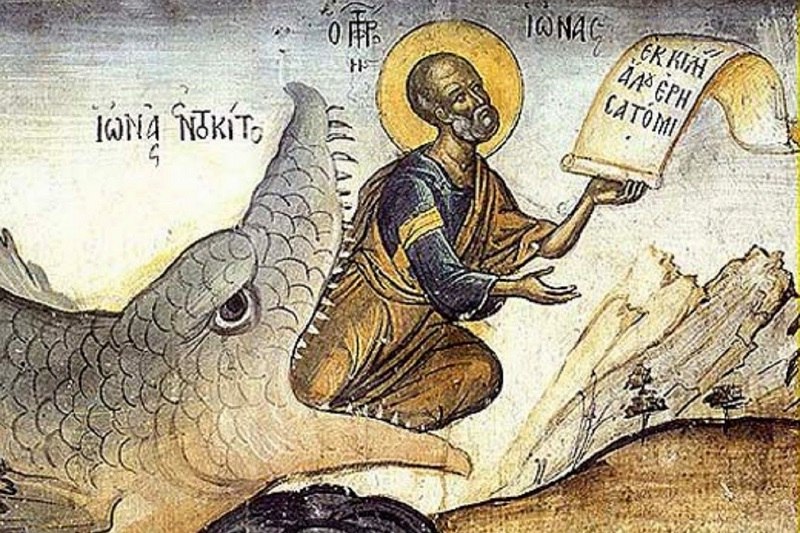
Venerable Ephrem the Syrian explains the similarity between Jonah’s ministry for the Ninevites and that of the Lord for all humanity: “The sign of Jonah was for the Ninevites both a proclamation and a warning in two ways. If they disregarded Jonah’s word, they would descend alive into Hades as he descended into the belly of the fish; but if they repented, they would return from death to life, just as the prophet himself returned to life. In the same way the Lord is for people either a cause of falling or of rising; for through the death of Jesus people either live or perish. … Since the Pharisees, seeing signs from heaven, did not believe, the proclamation came forth from the belly of the earth, just as Jonah came forth from the belly of the earth.”
Verse 40:
For as Jonah was in the belly of the great fish three days and three nights, so will the Son of Man be in the heart of the earth three days and three nights.
The Holy Fathers approach the interpretation of this verse from several different perspectives. Saint Gregory of Nyssa explains why the Lord speaks of the heart of the earth, and at the same time reveals His wisdom by showing how, during the three-day period, the Lord defeated Satan and liberated us from eternal death: “Do you wish to learn something concerning the three-day period? It is enough to know that for the almighty Wisdom dwelling in the heart of the earth even such a short time was sufficient to impoverish the great intellect that dwelt there; for in this way the prophet names the devil, calling him the great mind and the king of Assyria (cf. Isa. 10:12). Since the heart is the dwelling place of the mind, and in the heart, as they suppose, the principal power of the soul resides, the Lord descends into the heart of the earth—which represents the dwelling place of that mind—in order to render foolish its designs, as the prophet Isaiah says. The ruler of darkness could not approach the pure Light that had come unless he perceived in it some element of bodily nature. Therefore, when he saw the God-bearing body and at the same time saw the miracles performed by God Himself, the devil hoped that if through death he gained possession of the body, he might also seize the entire power contained in it. Yet in swallowing the bait of the body he was pierced by the hook of the Divinity, and thus the serpent was caught on the hook, as Job also speaks. Let us hear from the prophet what the very heart of the earth imagined when it opened its jaws against the body of the Lord. What does the prophet Isaiah say to it? You said in your heart: I will ascend into heaven; I will exalt my throne above the stars of God… I will be like the Most High (Isa. 14:13–14). Thus the evil heart of the earth imagined within itself… With such hope the devil receives Him who lovingly descended beneath the earth. But what happened to him instead of what he had hoped for is clearly expressed in the prophecy concerning the fall of Satan: How you have fallen from heaven, O morning star, son of the dawn! … Maggots are spread under you, and worms cover you (Isa. 14:11–12). For this reason the true Wisdom visits the heart of the earth, in order to destroy there the mind that is great in evil and to enlighten the darkness; that mortality might be swallowed up by life and that evil might be reduced to nothing through the destruction of the last enemy, which is death. This is what was accomplished for you, O man, during those three days…”
Venerable Ephrem the Syrian sees in these words the authority and power of Jesus, because the Lord shows beforehand that He would die voluntarily. He also reveals further parallels between the ministry of the prophet Jonah and that of the Lord Jesus Christ: “So will the Son of Man be in the heart of the earth. By these words Jesus showed them that they could not kill Him apart from His own will, for a thousand years earlier Jonah had already revealed the mystery of His death. Where Abel was slain there may have been the mouth of the earth. For it is written: The earth has opened its mouth to receive your brother’s blood from your hand (Gen. 4:11). But where the Lord was buried, there perhaps was the heart of the earth. The Son of Man will be in the heart of the earth, as Jonah was in the belly of the fish. Or just as Jonah was not destroyed or corrupted in the belly of the fish, so also the Lord in the tomb, as it is written: You will not abandon my soul in Hades, nor will You allow Your Holy One to see corruption (Ps. 16:10). Just as Jonah, coming forth from the sea, preached to the Ninevites and they, having repented, remained alive, so also the Lord, after the resurrection of His body from the tomb, sent His disciples to the Gentiles, and they, having turned to Him, received perfect and complete life.”
The Holy Fathers also draw attention to a question that can still be heard today, and to which the faithful often do not know how to respond. People ask how the Lord’s three-day stay in Hades is spoken of when only half of Friday passed, the whole of Saturday, and the Lord rose early on Sunday. The Fathers respond as follows.
Venerable John of Damascus writes the following: “Someone may ask: if Jesus suffered voluntary death on Friday and returned to life on Sunday, how then is it correct that He spent three nights in the heart of the earth? The divine Moses tells us thus: God called the light Day, and the darkness He called Night (Gen. 1:5). When the Lord was hung upon the sacred cross, there was darkness over all the land (Matt. 27:45), not because a cloud had come and hidden the rays of the sun, nor because the moon had prevented its shining like a barrier, but because the whole earth was seized by darkness much deeper than the palpable darkness that struck Egypt, for in the sun itself the luminous power that emits rays had ceased; for it was fitting that the entire earth should mourn the bodily death of the Creator. Therefore the prophet says: I will make the sun go down at noon, and darken the earth in broad daylight (Amos 8:9), and another says: On that day there shall be no light… it shall be neither day nor night, but at evening time there shall be light (Zech. 14:6–7). During this darkness the divine and holy soul of the Lord, separated from His sacred and life-giving Body, was in the heart of the earth, and this time is counted as the first night. After the darkness the Creator again established the day, and the sun returned to its usual state—therefore the prophet foretold that there would be light towards evening. Then came the night before Saturday, then Saturday itself, then the following night, and finally the radiant and luminous day of the holy Resurrection, when the uncreated Light appeared bodily from the tomb like a bridegroom shining with the beauty of the Resurrection; the end of the Sabbath is described by the Evangelist in the words: After the Sabbath, as the first day of the week was dawning (Matt. 28:1). Thus there is clearly the number of three days and three nights!”
Venerable Isidore of Pelusium continues and writes about this in the following manner: For as Jonah was in the belly of the great fish three days and three nights, so will the Son of Man be in the heart of the earth three days and three nights. Therefore the One who declares of Himself that He will fulfill the type of Jonah knew this precisely, for Jesus Himself was with Jonah when he was cast into the depths and when he was brought forth from them. Jesus undoubtedly fulfilled this, having spent in the tomb as much time as Jonah spent in the fish. If you require another explanation, here it is. In the sixth hour of Friday the Lord was crucified; from the sixth to the ninth hour there was darkness—consider this as night. From the ninth hour there was again light; this is already day. Then follows the night of Friday. Saturday is day. Then the night of Saturday and the morning of the Lord’s Day, as the Evangelist says: after the Sabbath, towards the first day of the week. If you wish to know a third explanation, listen. On Friday the Lord gave up His spirit—this is the first day; He was in the tomb throughout the whole of Saturday, and then also during the night of Saturday. When the day of the Lord dawned, Jesus rose from the tomb and this is another day, for the whole is recognized by its part, as you know. Thus even among us the commemorations of the departed are performed by custom. At whatever hour someone may have died, we pass over the following day and then on the next day we serve the third-day memorial. I believe this is the answer to the question. And if persistent inquirers demand complete three days and nights, answer them thus: if a king, taking heed of the petitions and supplications of those imprisoned in mines and prisons, promises to release them after the third day and then grants them freedom before that time, by this swiftness he most clearly proves the truth of his promise. So also the Lord, rising from the dead earlier than He promised, justly receives the worship of all… Christ said that He would rise on the third day. You have Friday, you have also Saturday until sunset, and after Saturday Jesus rose, touching the extreme days and the whole middle one. For He said that He would rise on the third day, not after three days. Destroy this temple, and in three days I will raise it up (Jn. 2:19). The prophet also poetically proclaimed that death would then lament… saying: After two days He will revive us; on the third day He will raise us up, and we shall live before Him (Hos. 6:2). If they point to the words three days and three nights (Matt. 12:40), I will answer that by touching those days Jesus fulfilled the promise. For the entire twenty-four hours are called one day. If someone is born or dies in the first or the last of these hours, it is reckoned as belonging to that same day. For example, if someone is born just before sunset and that day is the first day of the month, it is counted that he was born on that day. But if another is born after sunset, it is already counted as the second day. Why then, when the difference in time is only one hour, perhaps even less, is one said to have been born on one day and another on a different day? Because it is evident to everyone that the first touched the previous day, while the second was born in the day that followed, merely touching it. Therefore, if this is confirmed even by the exact reckoning of hours, why do those who claim that the God of Truth supposedly did not remain in truth torment themselves in vain?”
Saint John Chrysostom writes in an elevated manner that the Lord speaks in this way intentionally, because He sees all the cynicism of His opponents: “He did not state plainly that He would rise again, for they would have begun to mock it; Jesus declared this in a veiled way, yet in such a manner that they could believe that Christ knew it beforehand. And they themselves understood precisely the meaning of His saying, as is evident from their words to Pilate: that deceiver said, while He was still alive: After three days I will rise again (Matt. 27:63). Yet Christ’s disciples did not understand it because they did not possess such knowledge. Thus the Pharisees bring condemnation upon themselves. Observe with what precision the Saviour expresses even His hidden prophecy. Jesus does not say in the earth, but in the heart of the earth, in order to show more clearly His stay in the tomb and so that no one might think that His death was merely an illusion. Therefore He also specifies three days, so that no one might doubt His death; for not only the cross and the obviousness of everything, but also the very number of days had to serve as proof of it. The resurrection was to be testified by all the time that followed; yet many would not have believed in the cross had there not been a multitude of signs testifying to Jesus. And if they had not believed in the cross, they would not have believed in the Resurrection either. Therefore the Saviour calls the death on the cross a sign. Had He not been crucified, the sign would not have been given. That is why Jesus speaks of the type, in order to confirm the truth more firmly. Tell me, was Jonah’s stay in the belly of the fish a fantasy? No, you cannot say that. It follows that Christ’s dwelling in the heart of the earth could not have been a fantasy either… Jesus here says: no sign will be given to it except the sign of the prophet Jonah, thereby showing that He would suffer also for them, yet the Pharisees would gain no benefit from it. And although Jesus knew this, He nevertheless desired to die for them. So great was His love!”
At the very end we may say that in this final thought of Saint John Chrysostom—that the Lord died even for His enemies—there lies another spiritual truth. Namely, although the fruits of Christ’s redemptive sacrifice embrace the whole human race, these fruits can be received only by those who live in the Lord Jesus—people who live in the Orthodox Church and who keep the commandments of the Lord.
Adapted for the contemporary reader on the basis of patristic interpretations by: Stanoje Stanković.