We continue our reflection with verses 17 and 18 of the second chapter of the Gospel of Matthew:
“Then was fulfilled what was spoken by the prophet Jeremiah, saying: ‘A voice was heard in Ramah, lamentation, weeping, and great mourning, Rachel weeping for her children, refusing to be comforted, because they are no more.’”
In this verse, St. John Chrysostom deepens the theme of human suffering and why God permits it. He explains:
“Since the Evangelist has filled the listener with horror by recounting this violent, unjust, cruel, and unlawful massacre, he comforts them by saying that this did not happen because God could not prevent it or did not foresee it, but because He foresaw it and had announced it beforehand through the prophet. Therefore, do not be troubled or lose heart when you observe His ineffable Providence, which can clearly be seen both in His actions and in His allowance. This is what Christ made clear to His disciples during a discourse with them, when speaking of judgments, prisons, the world’s hatred, and relentless warfare, He said for their encouragement and comfort: ‘Are not two sparrows sold for a penny? Yet not one of them will fall to the ground outside your Father’s care.’ (Matt. 10:29). With these words, He wanted to show that nothing happens without His knowledge; He knows everything, even if He does not do everything. Therefore, He says, do not be troubled and do not be afraid. If He who knows your sufferings and can prevent them still does not do so, it is undoubtedly because He is caring for you.”
The mention of Rachel may cause some confusion since she was the mother of Benjamin, not Judah, whose tribe included Bethlehem. Both Benjamin and Judah were brothers among the twelve sons of the patriarch Jacob. Blessed Jerome of Stridon explains that Rachel is mentioned because she was buried near Bethlehem. He notes that since the tribes of Judah and Benjamin lived next to each other, many children from the tribe of Benjamin were also killed in this massacre.
The Holy Fathers also provide a mystical explanation of these verses. St. Philaret of Moscow states that Rachel represents a prefigurement of the New Testament Church. The Church, like Rachel, mourned the suffering, not so much for her children, the holy martyrs, as those who killed them, condemning themselves to eternal torment. St. Philaret adds:
“It is not bodily death that grieves her deeply, but spiritual death. The Church, having learned from her Divine Bridegroom and her chief members, takes pride in tribulations and sufferings, but she fears the stumbling blocks that spiritually kill those she loves as a tender mother. Let us be wary of what distresses her so deeply and be careful of her sorrow. Let us avoid everything that might cause our brothers to stumble, and like the Church, let us shed tears only because of sin and its dreadful consequences.”
The following verses, 19 and 20, read:
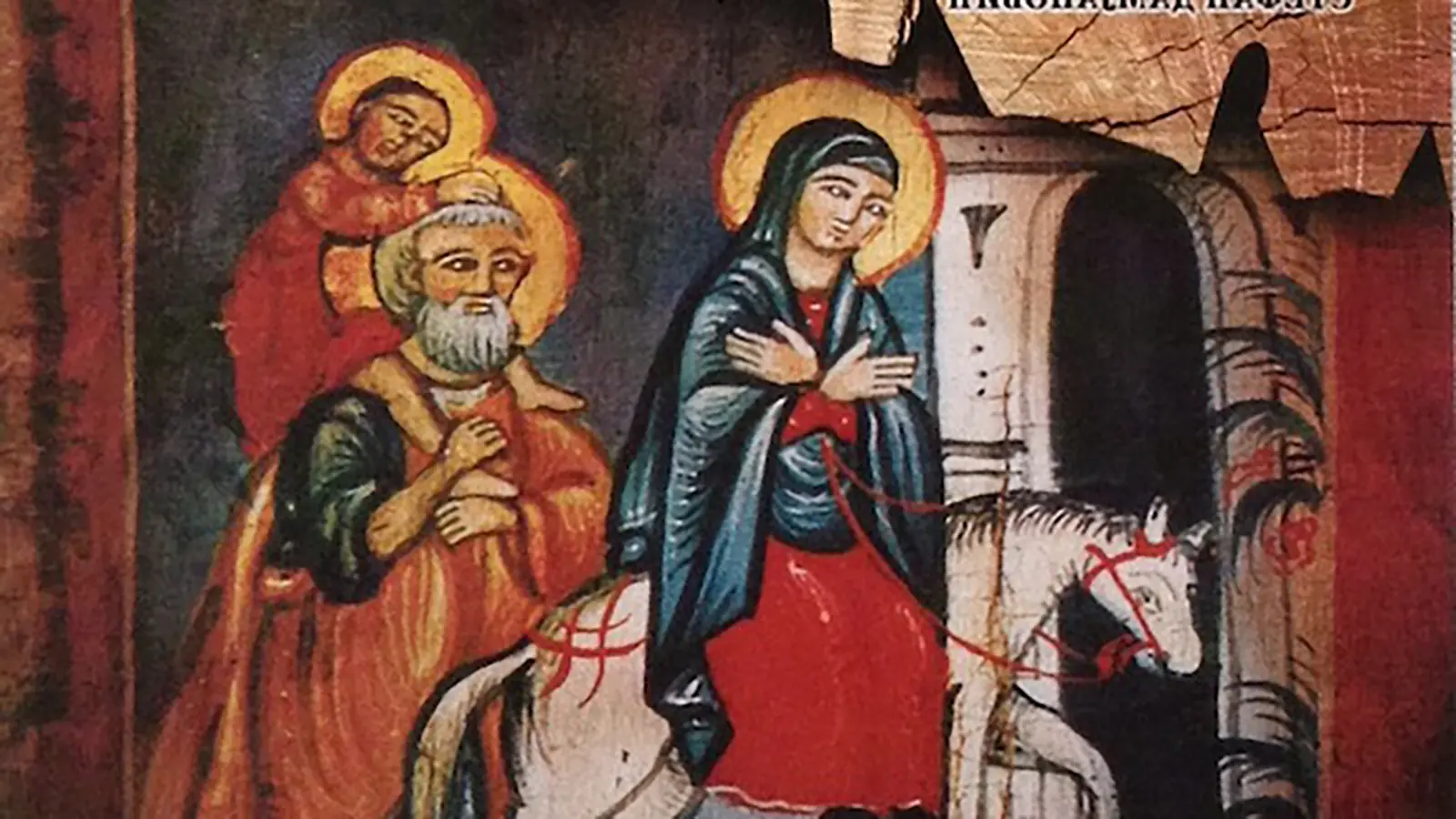
“But when Herod was dead, behold, an angel of the Lord appeared in a dream to Joseph in Egypt, saying: ‘Arise, take the child and his mother, and go to the land of Israel, for those who sought the child’s life are dead.’”
The Holy Fathers say that Herod suffered terribly from illnesses sent as a punishment from the Lord for all his wicked deeds. St. Athanasius the Great notes that Herod suffered from nine severe diseases simultaneously, and explains the inner significance of each disease in relation to Herod’s sins. St. Innocent of Kherson even states that Herod tried to kill himself several times to end his torment.
In the phrase ”those who sought the child’s life,” St. Athanasius the Great points to the dogmatic truth that the Lord Jesus Christ took on human nature in its entirety – everything of ours except for sin (which is an alien parasite). In ancient times, the Orthodox Church fiercely defended the true teaching that the Logos took on the entirety of human nature and united it with Himself for our salvation. As the Church Fathers emphasized: “What is not assumed cannot be redeemed.”
Blessed Theophylact of Ohrid reminds us that the angel first told the Holy Family to flee to Egypt, and now tells them to go back, indicating there was no longer a reason to fear. St. Athanasius the Great points to the phrase “for those who sought the child’s life are dead” and explains that this refers to more than just Herod, who killed so many children, but also his son Antipater, who was later killed in prison for attempting to murder his brothers, Alexander and Aristobulus. This highlights the extent and nature of the criminals who sought to kill the Lord. Blessed Jerome adds that the phrase could also refer to the priests and scribes of Judea.
We continue with the final verses of the second chapter, 21 to 23:
“Then he arose, took the child and his mother, and came into the land of Israel. But when he heard that Archelaus was reigning over Judea in place of his father Herod, he was afraid to go there. And being warned by God in a dream, he turned aside into the region of Galilee. And he came and dwelt in a city called Nazareth, that it might be fulfilled which was spoken by the prophets: “He shall be called a Nazarene.’”
Blessed Jerome of Stridon notes the phrase “the child and his mother” as confirmation that righteous Joseph had the role of protector and guardian, not husband, as some Protestants falsely claim. The mention of Archelaus, who ruled Judea in place of his father Herod, as explained by St. John Chrysostom, refers to the period before Herod’s kingdom was divided into four parts and before Pontius Pilate replaced Archelaus as Roman governor. Blessed Theophylact explains that Joseph feared returning to where Archelaus ruled, because Archelaus was similar in character to his father Herod. St. Innocent of Kherson mentions that Archelaus was similar in character to his father Herod. St. Innocent of Kherson mentions that Archelaus killed three thousand Jews during the Passover just because they disliked him.
St. John Chrysostom comments on the phrase “that it might be fulfilled which was spoken by the prophets: ‘He shall be called a Nazarene’” with the following explanation:
“Do not be overly curious or inquire which prophet said this. As can be seen from the Chronicles, many prophetic books were lost. The Jews, being negligent and often falling into idolatry, allowed some books to be lost, while others they tore up or burned. Jeremiah speaks of one, and the author of the Fourth Book of Kings speaks of another, mentioning that after a long time they barely found the buried and lost Deuteronomy. If the Jews were so careless with the sacred books when there were no enemies, how much more so when enemies came? Besides, in agreement with the saying of the prophets, the apostles often call Christ a Nazarene. Does this obscure the prophecy of Bethlehem? No. On the contrary, it invites careful examination of what was written about Him.”
Blessed Theophylact of Ohrid reflects on the title “Nazarene” and explains:
“The word ‘Nazarene’ means ‘holy.’ Since Christ is holy, He is rightly called a Nazarene because many prophets call the Lord the ‘Holy One of Israel.’”
With this thought from the saints, we conclude the second chapter of the Gospel of Matthew.Adapted from the Church Fathers’ interpretation by Stanoje Stanković