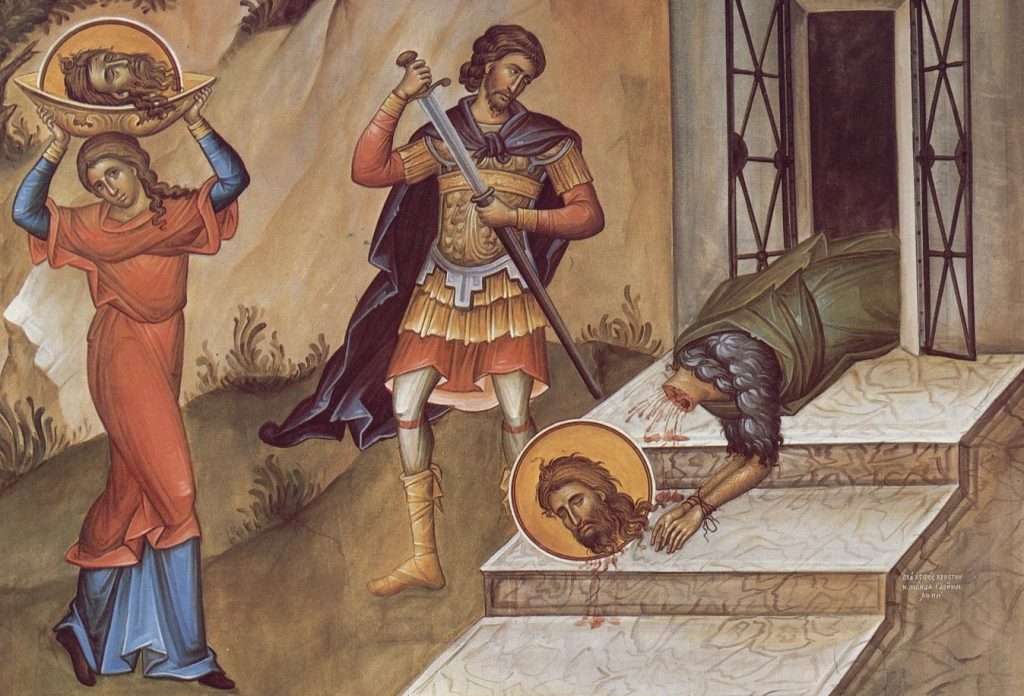
Before us are verses 10 and 11 of the fourteenth chapter:
And he sent and had John beheaded in the prison. And his head was brought on a platter and given to the girl, and she brought it to her mother. (Matt. 14:10–11)
Blessed Jerome of Stridon writes that even according to pagan legal standards such an act could only be met with condemnation:
“In Roman history we read of the Roman commander Flaminius, who, during a banquet, yielded to the request of his mistress, who remarked that she had never seen a man beheaded. He therefore agreed that one of the condemned should be executed during the feast. For this act he was removed from office by the Roman authorities, because he had mingled dining with bloodshed and had made a spectacle of a man’s death at a banquet, even though the man himself was dangerous to society. He had allowed lust and murder to be joined together.
How much more guilty, then, were Herod, Herodias, and her dancing daughter, who demanded the head of a prophet as the reward for her performance, so that she might possess the tongue that had rebuked an unlawful marriage.”
The following verses state:
And his disciples came and took away the body and buried it, and went and told Jesus. When Jesus heard it, He departed from there by boat to a deserted place by Himself. But when the multitudes heard it, they followed Him on foot from the cities. (Matt. 14:12–13)
Saint Dimitry of Rostov writes about the hatred that Herodias harboured towards Saint John. This hatred became especially evident after his death, when she buried his head in an unclean place. Saint Dimitry also describes the external circumstances that awakened fear within Herod’s soul:
“The disciples of Saint John the Baptist took his body and buried it by night in Sebaste, a city of Samaria. The head of the Holy Forerunner was buried by Herodias deep within her palace in a hidden and shameful place.
Only Joanna, the wife of Chuza, one of Herod’s stewards, whom the holy Apostle Luke mentions (Luke 8:3), knew of this location. Grieving in her heart over the murder of the great and holy prophet John and over the mockery inflicted upon his honourable head, she secretly took the head by night, placed it in an earthen vessel, and buried it on the Mount of Olives, on one of Herod’s estates.
In time, reports concerning Jesus Christ reached Herod. Together with his wife Herodias, he began to think that Jesus was John risen from the dead. They searched for John’s head, and when they could not find it, they were thrown into confusion.”
Blessed Jerome explains the reason for the Lord Jesus’ withdrawal:
“The disciples announced the murder of John, and upon hearing this, Jesus withdrew into the wilderness. He did not do so out of fear of death, as some suppose, but in order to spare His enemies from adding one murder to another.
It may also be that He postponed His own death until the day of Passover, when the lamb was mystically offered in sacrifice and the doorposts of the faithful were to be sprinkled with blood (Exod. 12).
Furthermore, He may have withdrawn in order to provide us with an example, teaching that we should avoid the reckless haste of those who voluntarily surrender themselves to persecutors. Not everyone displays the same steadfastness during suffering as they imagine they possess when offering themselves to martyrdom.
For this same reason the Lord commands elsewhere: ‘When they persecute you in one city, flee to another’ (Matt. 10:23).
Moreover, the Evangelist employs a precise expression: he does not say that Jesus ‘fled,’ but that He ‘withdrew,’ for Christ avoided His persecutors without fearing them.
This passage may also be understood in another sense: after the Jews and their king had cut off the head of the prophet, prophecy among them lost its tongue and its voice. Therefore Jesus withdrew to the wilderness—that is, to the Church which formerly had no husband.”
Saint John Chrysostom points to yet another reason for Christ’s conduct on this occasion:
“But why did the Lord not withdraw before receiving the news, since He already knew all that had taken place? It was in order to demonstrate to all the reality of the Incarnation. Not only through His appearance, but through His very actions, Jesus wished to convince people of His true humanity. For He knew the malicious cunning of the devil, who was prepared to do everything possible in order to eradicate from human minds every thought of the Incarnation.
This is why Christ withdrew. Yet the people, who were attached to Him, did not abandon Him but followed after Him. Not even what had happened to John frightened them. Such is devotion! Such is love! It conquers all things and overcomes every difficulty. Therefore, the people were soon rewarded.”
We now arrive at a Gospel passage that is, in a certain sense, unique. It concerns the first miracle of the multiplication of the loaves. This is the only miracle recorded in all four Gospels of the Church: Matthew 14, Mark 6, Luke 9, and John 6. The meaning of this miracle will now be explained by the Teachers and Saints of the Church.
Verse 14:
And Jesus, when He came forth, saw a great multitude, and was moved with compassion towards them, and He healed their sick. (Matt. 14:14)
At this point, Saint Nikolaj of Ohrid reflects upon this particular moment in the earthly ministry of the Lord Jesus Christ. He also offers a profound explanation of why the Lord withdrew to a deserted place by Himself, as mentioned in the preceding verse. Saint Nikolaj writes:
“Jesus saw a great multitude and was moved with compassion for them, and He healed their sick. This took place at the time when John the Baptist had been executed by King Herod. Upon hearing this, the Lord Jesus entered a boat and departed alone to a deserted place.
All four Evangelists record this event, some in greater detail and others more briefly. According to John, the Lord embarked near Tiberias and crossed the Sea of Galilee, while according to Luke He came ashore on the northwestern coast of the sea and ascended a mountain in the wilderness near the town called Bethsaida.
The Lord frequently withdrew into solitude, to deserted places and mountains. He did so for three reasons.
First, to make a brief pause in His intense and abundant activity, so that people might, as it were, digest all the teaching He had revealed to them and all the miracles He had shown them.
Second, to provide an example both to the Apostles and to us, demonstrating that it is necessary to withdraw into solitude, to enter one’s inner chamber (Matt. 6:6), and to remain with one’s own soul in prayerful communion with God alone. Solitude and silence purify, tame, enlighten, and strengthen a person.
Third, to show that a good and necessary man cannot truly hide anywhere—‘a city set on a hill cannot be hidden’ (Matt. 5:14)—and thereby to justify and encourage the life of the desert and monasticism.
Church history has demonstrated thousands of times that no great hermit, man of prayer, or wonderworker has ever been able to remain hidden from the people. Many ask, without understanding: ‘What is the purpose of a monk in the wilderness? Would it not be better for him to live among the people and serve them directly?’
But how can an unlit candle give light? The monk carries his soul, like an unlit candle, into the wilderness and solitude in order to kindle it through fasting, prayer, contemplation, and labour. If he succeeds in lighting it, his light will be seen throughout the world, and the world itself will seek him out and find him, even if he hides in sandy deserts, inaccessible mountains, or remote caves.
No, the monk is not useless. On the contrary, he may become the most useful person to the people of all.
This very event involving the Lord Jesus clearly demonstrates the truth of this claim. In vain did He seek solitude in the wilderness; a vast multitude streamed after Him. And when He looked upon them, He was moved with compassion, because they were like sheep without a shepherd.
Down in the towns, the synagogues were filled with self-appointed shepherds who were, in reality, wolves in sheep’s clothing. The people knew and sensed this, just as they knew and felt the immeasurable mercy and love that Christ had for them.
The people saw and perceived that Christ alone was the Good Shepherd who sincerely and compassionately cared for them. Therefore, they hastened after Him even into the wilderness.
And the Lord healed their sick.
The people felt their need for Christ and did not seek miracles out of idle curiosity, but because of their great need and suffering.”
Blessed Jerome speaks here of how the Lord, moved by His love for the human race, went forth to meet the people who were seeking Him:
“In the words of the Gospel, the letter is always united with the spirit. What appears cold at first glance, when examined more deeply, proves to be full of fire. The Lord was in the wilderness, and the crowds followed Him, leaving behind their cities—that is, their former way of life and the diversity of their teachings.
By coming forth, Jesus demonstrates that although the crowds possessed the desire to follow Him, they lacked the strength to persevere to the end. Therefore the Saviour Himself comes out from His place and goes to meet them, just as in another parable He hastens to meet the repentant prodigal son.
Seeing the multitude, Jesus had compassion on them and healed their sick, thereby showing that the reward of perfect faith is always accompanied by divine grace.”
The next two verses read:
And when it was evening, His disciples came to Him, saying: “This is a deserted place, and the hour is already late. Send the multitudes away, that they may go into the villages and buy food for themselves.” But Jesus said to them: “They do not need to go away. You give them something to eat.” (Matt. 14:15–16)
Saint Nikolaj of Ohrid draws attention here to a remarkable detail: the amount of time that the Lord devoted to teaching the people. His instruction lasted for many hours. Saint Nikolaj also highlights the genuine love for one’s neighbour that shone forth in the Apostles. He writes:
“The Evangelist Matthew does not tell us what the Lord was doing with the people for so long. He simply says that He healed their sick. However, the Evangelist Mark fills this gap when he writes: ‘And He began to teach them many things.’ See how wonderfully the Evangelists complement one another!
Therefore, the Lord taught the people until nightfall. This must have lasted for many hours. During such a period one could read the entire Gospel. On that single occasion, the Lord revealed from His divine teaching enough to fill an entire Gospel. Is not the Evangelist John therefore correct when he says that if everything the Lord said and did were written down, the world itself could scarcely contain the books?
How compassionate the disciples were! The place was deserted and the hour was already late. The people were hungry; it was time for them to disperse. Their homes were far away, and they were very hungry. There were many women and children among them. They needed to obtain food as quickly as possible. Let them go into the surrounding villages and buy provisions.
But was not Christ more merciful and compassionate than His disciples? Could He not have remembered before they did that the people were hungry and that evening had already come?
Of course Christ was more merciful and compassionate than His disciples, and He had thought of the people’s needs before they did. As the Evangelist John writes, at the very beginning, when Jesus lifted up His eyes and saw a great multitude coming toward Him, He said to Philip: ‘Where shall we buy bread, that these may eat?’
Yet after speaking with Philip, the people gathered around the Lord together with their sick. First, He healed all the sick, and then He continued teaching the people. This lasted until darkness fell.
Only then did it occur to the Apostles that the people were hungry and in need of food.
The Lord had foreseen this from the beginning, but afterwards He deliberately refrained from mentioning it, waiting instead for the Apostles themselves to raise the question. He did this for two reasons: first, to increase their compassion and mercy; and second, to demonstrate their helplessness without Him.
Therefore Christ said to them: ‘They do not need to go away. You give them something to eat.’
He knew that they could not provide food for such a multitude, yet He spoke in this manner so that they might fully recognize and confess their own inability.”
Theophan the Recluse writes about a matter of great importance for our spiritual life, one in which the devil frequently places subtle obstacles before us through deceptive thoughts:
“Before the miraculous feeding of the five thousand, the Lord’s disciples wished to send the people away. Yet the Lord said to them: ‘They do not need to go away. You give them something to eat’ (Matt. 14:16).
Let us learn these words well, so that whenever the devil whispers to us to turn away a beggar, we may answer as the Lord did: ‘They do not need to go away. You give them something to eat.’
Then let us offer whatever we have at hand.
The enemy often seeks to discourage our desire for charity by suggesting that the beggar is unworthy of receiving anything. The Lord, however, made no distinction concerning the worthiness of those present. He fed them all alike, even though not all were equally devoted to Him.
Indeed, among them there may well have been some who would later cry out: ‘Crucify Him!’
Such is God’s universal providence towards us: ‘He makes His sun rise on the evil and on the good, and sends rain on the just and on the unjust’ (Matt. 5:45).
May the Lord grant that we too might become, even to a small degree, merciful, ‘just as your Father also is merciful’ (Luke 6:36).”
Adapted for the contemporary reader based on the interpretations of the Holy Fathers by Stanoje Stanković.