We now come to verses 17–18:
But they said to Him, “We have here only five loaves and two fish.” He said, “Bring them here to Me.”
Saint Hilary of Poitiers offers a spiritual interpretation of the loaves and the fish with which the Lord fed the multitude. He writes:
“When the disciples advised Him to send the people away into the neighbouring villages to buy food for themselves, Jesus replied, ‘They need not go away,’ thereby showing that those whom the Lord had nourished by the food of His teaching—a teaching that cannot be purchased—had no need to return to Judea to buy food. The Lord then commanded the Apostles to give the people something to eat. Did Jesus not know that they possessed nothing? Did He who could read the thoughts of men not know that the disciples had only a small quantity of food? Here we must explain the matter through its spiritual significance. The Apostles had not yet been granted the privilege of receiving and distributing the heavenly Bread at the banquet of eternal life. Their reply therefore requires a spiritual interpretation. They answered that they possessed only five loaves and two fish, signifying that until then they had depended upon the five loaves—that is, the five books of the Law—and had been nourished by the two fish, namely, the preaching of the Prophets and of John the Baptist. For within the works of the Law there was life, just as there is life in bread, while the preaching of John and the Prophets, through the symbolism of water, renewed humanity’s hope.”
Saint Bishop Nikolaj draws attention to the fact that the loaves were made of barley and explains the significance of this detail. He also offers a profound reflection on an important spiritual principle: the Lord waits until a person becomes fully aware of his own weakness, sincerely asks for help, and only then does He perform the miracle:
“According to the account of the Evangelist John, even this small amount of food did not belong to the disciples but to a certain boy who happened to be there. ‘There is a lad here who has five barley loaves and two small fish; but what are they among so many?’ These words were spoken to the Lord by Andrew, the First-Called Apostle, who, although he had spent the longest time with Christ, had not yet attained perfect faith, as is evident from his question: ‘What are they among so many?’ The loaves were of barley, and this too was not without significance. From this, as the most wise Chrysostom teaches, we should learn to be content with simple food and not be overly selective, for, as he says, ‘love of luxury is the mother of all sickness and suffering.’ ‘Bring them here to Me,’ the Lord commanded His disciples. Now it was His turn to act. The people were unable to provide food for themselves, and the Apostles had likewise confessed their inability to help the multitude. Only now had the proper moment arrived; only now was the situation ripe for a miracle.”
We now come to verse 19:
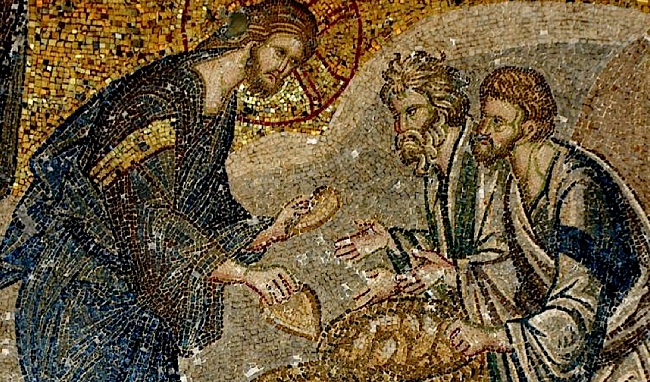
And He commanded the multitudes to sit down on the grass. Then He took the five loaves and the two fish, and looking up to heaven, He blessed and broke them, and gave the loaves to the disciples; and the disciples gave them to the multitude.
Saint John Chrysostom explains both Christ’s equality with God and, at the same time, His profound humility. He describes the miracle of the multiplication of the loaves as one comparable to the wonders of creation itself:
“Why did Christ look up to heaven and pronounce the blessing? He wished to convince the people that He had been sent by the Father and that He was equal to the Father. At first glance, the proofs of these two truths appeared to stand in tension with one another. He demonstrated His equality with the Father by acting with sovereign authority; yet people would not have believed that He had been sent by the Father had He not acted with profound humility in every respect, attributing everything to the Father and invoking Him in all that He did.
From this you should conclude that in matters of lesser importance Jesus acted in this manner not because He required assistance, but because He desired to honour the One who begot Him. When He forgave sins, opened Paradise and admitted the repentant thief into it, abolished the Old Law by His own authority, raised many from the dead, calmed the sea, revealed the secrets of human hearts, and restored sight to the blind—works that belong to God alone—we never see Him praying before performing them. Yet when He intended to multiply the loaves, an act far less significant than these, He looked up to heaven in order to confirm that He had been sent by the Father.
Why, then, did Jesus not simply create new loaves? He did so in order to silence Marcion and Mani, who denied Him as the Creator; in order to demonstrate through His deeds that He Himself had created all visible things; and to reveal that He is the One who gives fruitfulness, the very One who in the beginning declared: ‘Let the earth bring forth grass, the herb yielding seed…’ and ‘Let the waters abound with living creatures’ (Genesis 1:11, 20). The miracle now performed was no less significant than the creation of plants or living creatures. To produce such abundance from five loaves and two fish is no less marvellous than to bring forth vegetation from the earth or living creatures from the waters. This demonstrated Christ’s authority over both land and sea.
Until this moment the Lord Jesus had performed miracles primarily for those who were sick; now, however, He bestowed His beneficence upon the multitude, so that the people might not merely witness what He did for others but themselves become recipients of His divine gift.
Here we also learn another lesson: we perceive the moderation of the disciples in satisfying their own bodily needs and how little concern they had for food. There were twelve of them, yet they possessed only five loaves and two fish. So little did they concern themselves with bodily things that their thoughts were directed entirely toward spiritual realities. Even this small amount of food they did not attempt to keep for themselves but immediately surrendered it when asked. From this we learn that even if we possess little, we remain obliged to share it with those in need. When Christ commanded them to bring Him the five loaves, they did not protest, saying, ‘What shall we ourselves eat? How shall we satisfy our own hunger?’ Rather, they obeyed immediately.
The Lord also commanded the people to sit down upon the grass, thereby teaching them simplicity of life. His intention was not merely to nourish the body but also to instruct the soul. Accordingly, He chose this place, provided nothing beyond bread and fish, offered the same food to everyone, and gave no one more than another, in order to teach humility, self-restraint, and love—that all people should regard one another equally and consider all things to be held in common.
He broke the loaves and gave them to the disciples, and the disciples to the multitude. The Lord also caused an abundance to remain—not whole loaves, but fragments—in order to demonstrate that these were indeed the leftovers from the original loaves and so that those who had not personally witnessed the miracle might know that it had truly taken place. For this reason Christ allowed the people first to experience hunger, lest anyone imagine the miracle to be mere illusion. He also caused twelve baskets of fragments to remain, so that even Judas might have one to carry. The Lord could certainly have satisfied the people’s hunger without using bread at all; yet had He done so, the disciples would not have recognized His divine power, just as they had already witnessed in the days of the Prophet Elijah.”
Saint Nikolaj also points to another hidden meaning in Christ’s actions and writes:
“He offered thanksgiving to His heavenly Father and blessed the bread as a gift from God. Likewise, at every meal, no matter how modest it may be, we too should offer thanksgiving and praise to God and bless His gifts. Furthermore, as God, by multiplying the loaves—a miracle closely resembling a new act of creation—He thereby manifested the unity of the Holy Trinity in the work of creation. The Father, the Son, and the Holy Spirit—the consubstantial and indivisible Trinity—are the Creator of all that exists. The Lord Jesus Himself broke the bread with His own hands. Why did He do this? Why did He not command the disciples to break it? He did so in order to demonstrate His gracious willingness to feed the multitude and His immeasurable love for humanity. At the same time, He teaches us that whenever we perform acts of charity or offer gifts to others, we should do so with the same care and love that He Himself displayed.”
Adapted for the contemporary reade based on the interpretations of the Holy Fathers by Stanoje Stanković.