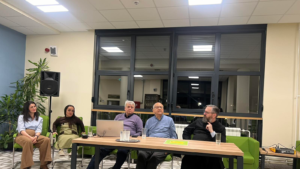
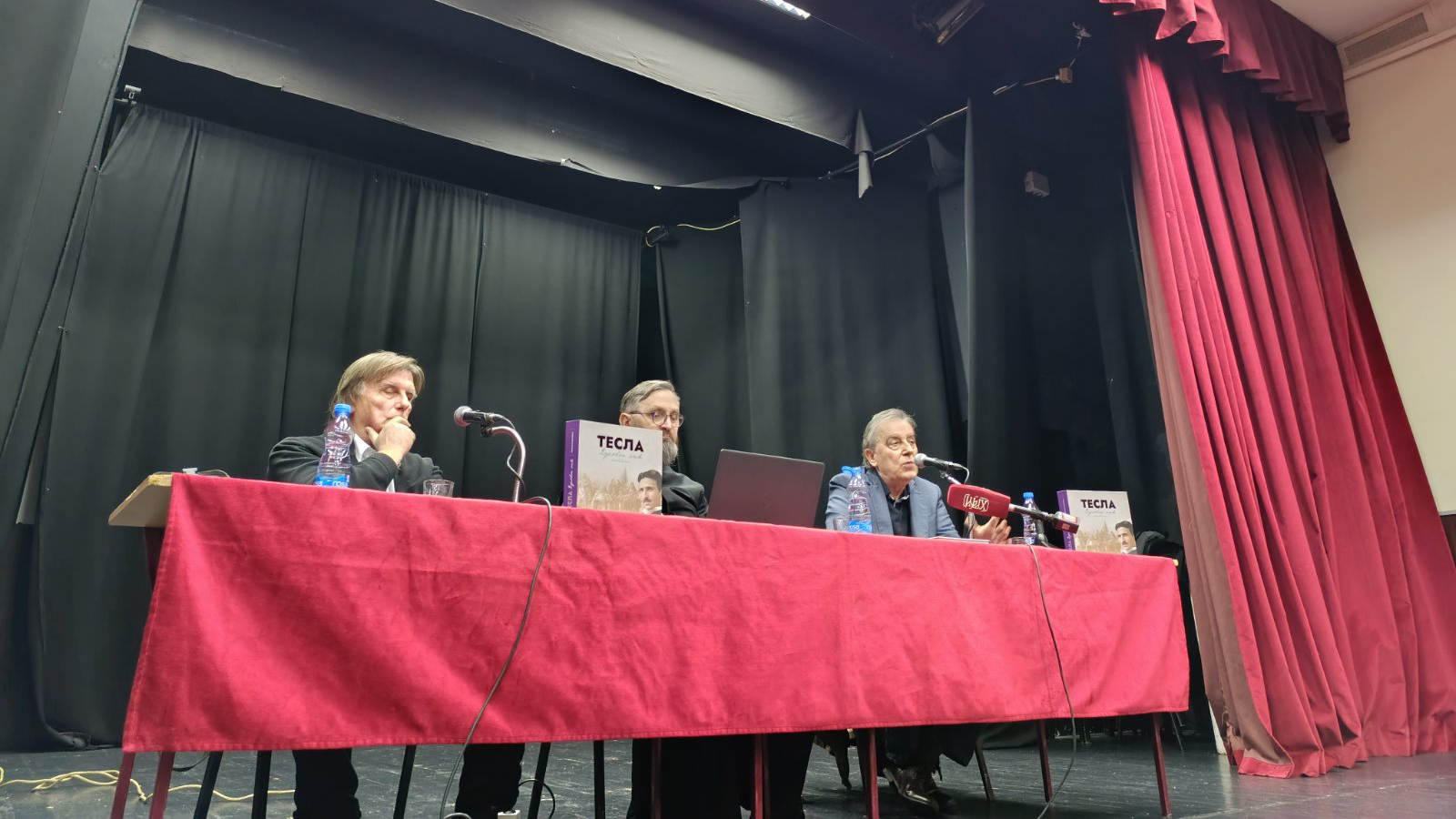
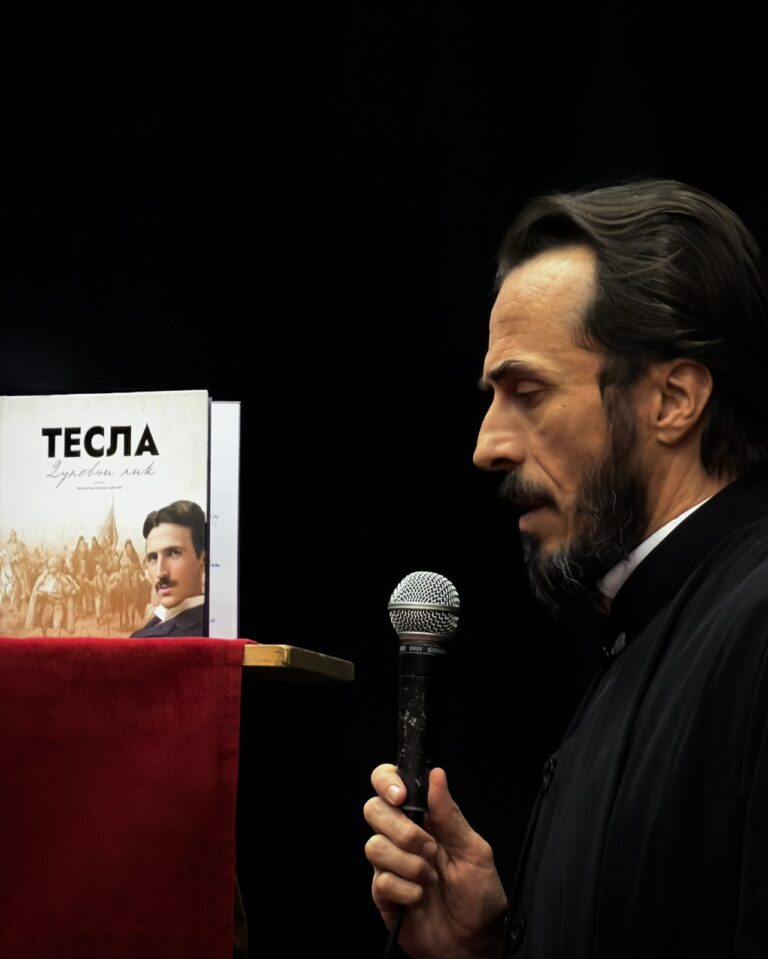
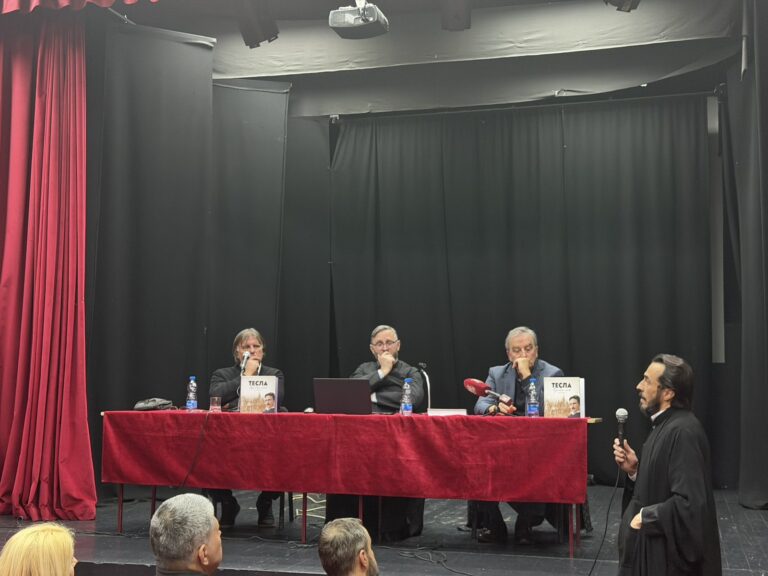
As part of the project A Book – A Reason for Conversation, organized by the Section for Dialogue in the Public Sphere of the Missionary Department of the Archdiocese of Belgrade–Karlovci, a public discussion entitled On Tesla as a Christian and a Philosopher was held on Tuesday, 24 February 2026, at the Cultural Centre Čukarica in Belgrade. The occasion was the publication of the second, revised and expanded edition of the book Tesla: A Spiritual Portrait by Presbyter Dr Oliver Subotić.
The panel was moderated by Presbyter Dr Aleksandar Milojkov, Coordinator of the Section for Dialogue in the Public Sphere of the Missionary Department of the AEM. Participating in the discussion were two of the pre-eminent Serbian scholars of Nikola Tesla’s life and work, Dr Branimir Jovanović and Vladimir Jelenković, erstwhile directors of the Nikola Tesla Museum and authors of significant publications on the subject.
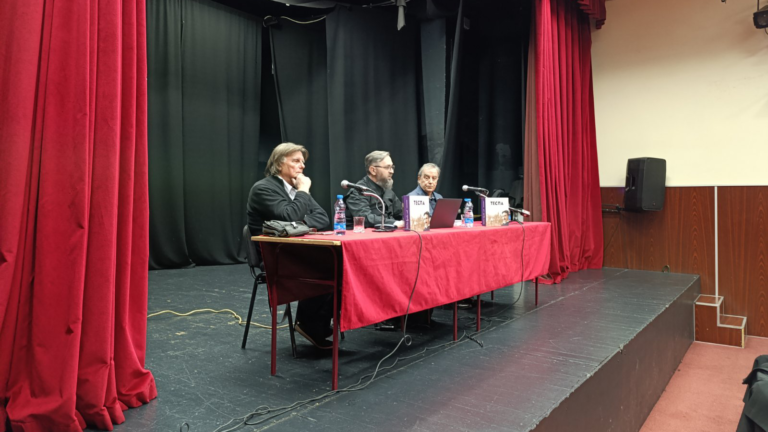
In his introductory address, the moderator recalled Nikola Tesla’s own words about science as a form of benefaction to humanity, as well as the words of His Eminence the Metropolitan of Bačka, Mr Irinej, delivered at the memorial service for Nikola Tesla twenty years ago, in which he emphasized that science and technology, if they are to be a blessing rather than a curse, must be grounded in an ethic of love. The moderator further stressed that the new edition of Fr Oliver Subotić’s book avoids the extremes of both idealizing and caricaturing Tesla’s spiritual identity, offering instead an argument-based, factually grounded, and balanced approach to this complex subject.
The discussion was divided into three thematic segments.
The first segment examined the apparent contradiction between Tesla’s references to a Creator on the one hand and his cosmological views on the other. Taking as a starting point his 1935 statement that “the universe is a giant machine,” “without beginning and without end,” the participants raised the question of whether this formulation should be understood as a scientific metaphor or as a metaphysical conviction, agreeing in principle that it represented a scientific assertion. Questions were also posed as to whether Tesla’s worldview was closer to deism, pantheism, or Christian theism, and to what extent there existed an internal tension between his mechanistic language and his personal Christian faith and identity, which he acquired by birth and never renounced.
The second segment was devoted to Tesla’s anthropological views, with particular attention given to the problematic claim that the human being is an “automaton” and, consequently, to the issue of determinism in his thought. The participants pointed to the complex relationship between Tesla’s scientific naturalism and his pronounced ethical sense of responsibility, which presupposes the existence of free will. Consideration was also given to Tesla’s understanding of the soul and of death, as well as to the possibility that his conception of the human person was more complex than the superficial materialism often attributed to him.
The third segment of the lecture addressed Tesla’s religiosity. As the son of an Orthodox priest, Tesla bore a strong familial and cultural heritage, yet he simultaneously asserted that he was “religious in his heart,” though not necessarily in the conventional sense. This opened questions regarding his relationship to the Orthodox tradition, to Saint Nicholas as his personal patron, and to the possibility that in the final years of his life there occurred a certain return to the spiritual framework of Orthodox Christianity—a theory advanced by Fr Oliver in his book, supported by several documentary sources.
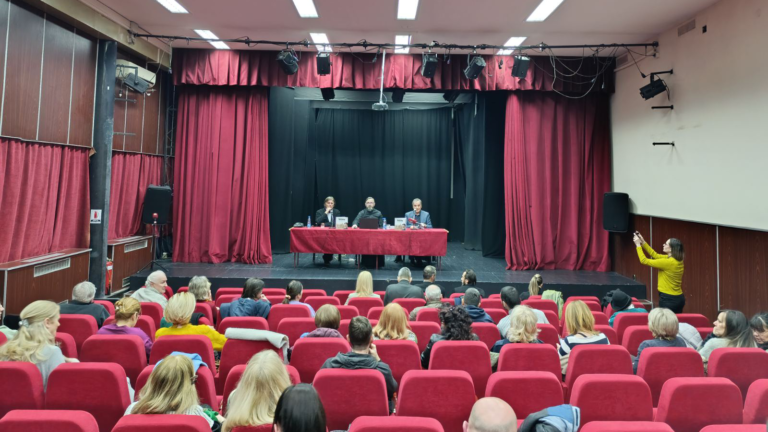
The exchange of views between two internationally recognized experts on this subject, under the moderation of Fr Aleksandar, unfolded in a lively and informative atmosphere. At the conclusion, Presbyter Oliver Subotić, who had followed the entire event from the audience, addressed those present, commenting on several of the viewpoints expressed. He emphasized that Nikola Tesla, although unquestionably a self-avowed Christian, did not live a liturgical life and therefore cannot be taken as a model of Christian confession of faith due to various heterodox elements in his thought. Nevertheless, in terms of his personal ethos, he followed faithfully Christian principles, especially with regards to charity. Fr Oliver also presented arguments supporting his theory that Tesla maintained a form of prayerful relationship with Saint Nicholas of Myra—an issue that had been called into question during the preceding discussion—as well as his view that in the final years of Tesla’s life one can discern a return to the God of his fathers.
The discussion demonstrated that the spiritual identity of Nikola Tesla remains an open and challenging field of inquiry, requiring sobriety, scholarly responsibility, and theological as well as philosophical sensitivity towards delicate subjects. This event represents a contribution of the Missionary Department of the Archdiocese of Belgrade–Karlovci, on the occasion of the 170th anniversary of Nikola Tesla’s birth, to fostering a serious, well-argued, and factually grounded public dialogue about the personality and work of this brilliant Serbian figure—not only as an inventor, but also as a man whose spiritual horizons merit careful and comprehensive consideration.
As usual, the event was recorded by Hram Television, which regularly follows the activities of the Department. The recording will be shared as soon as it becomes available.