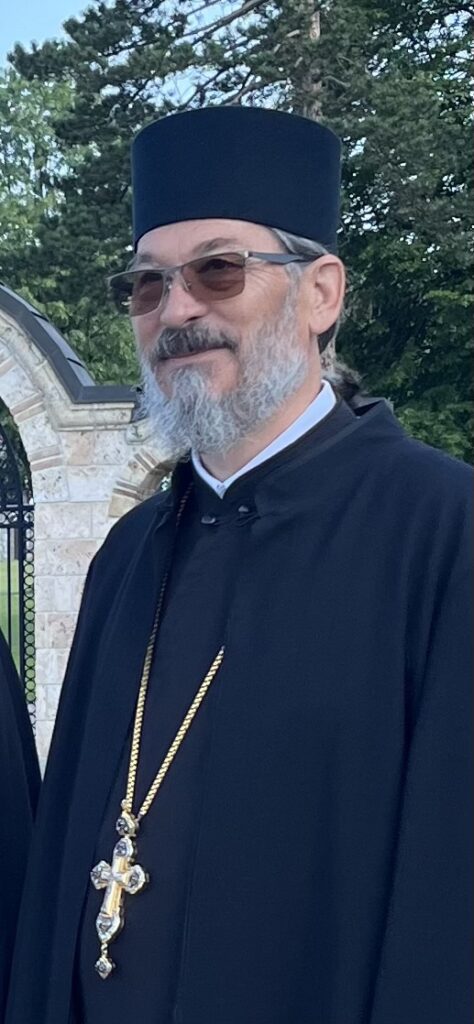
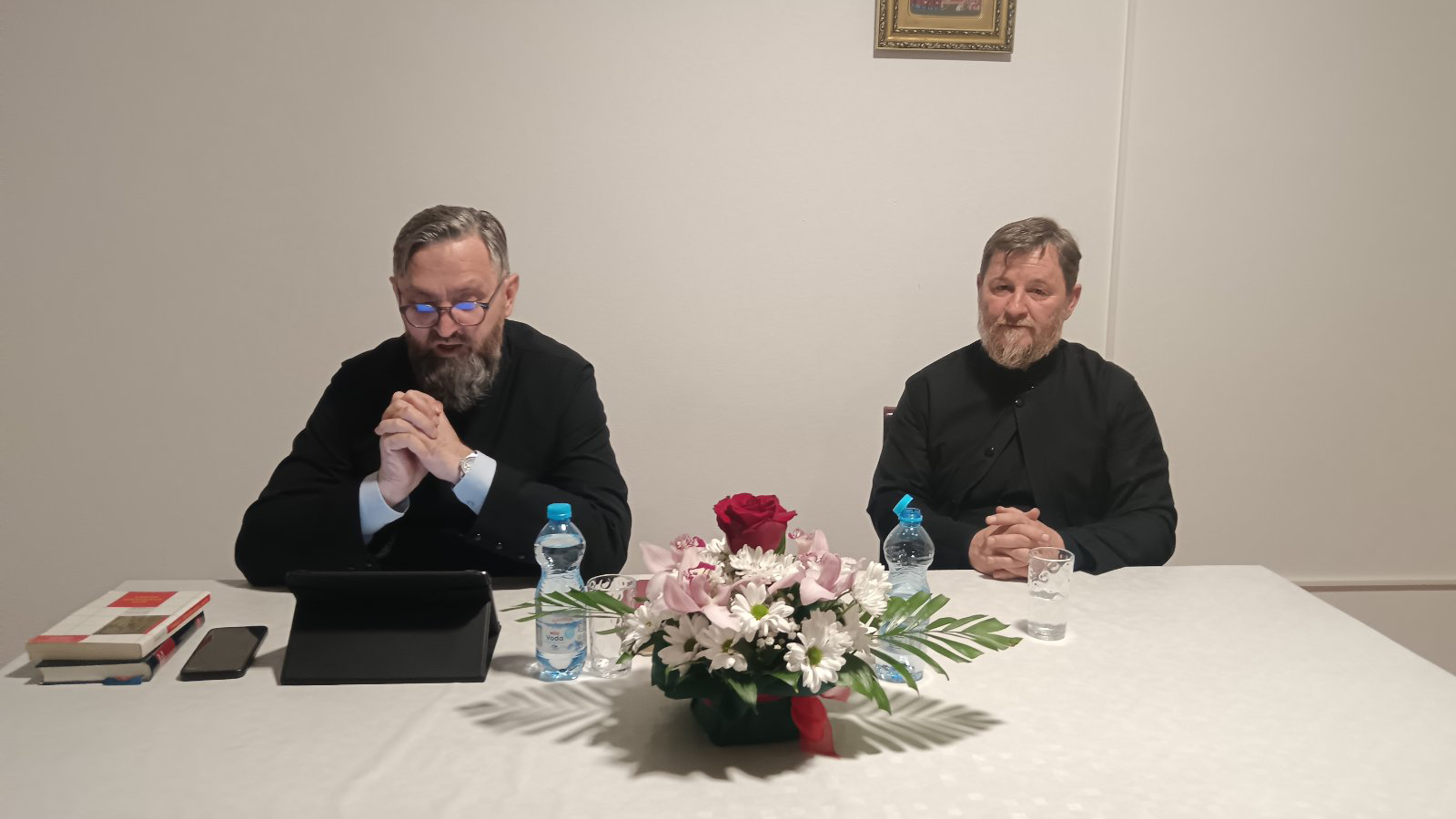
On Tuesday, 31 March 2026, within the Lenten lecture series organized by the Church Municipality of Bogatić, a lecture entitled “Fasting as a Pedagogy of Love” was delivered, attracting considerable interest among the faithful. The lecture was given by Presbyter Dr Aleksandar Milojkov, Coordinator of the Dialogue in the Public Sphere Section of the Missionary Department of the Archdiocese of Belgrade-Karlovci.
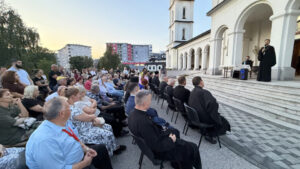
The hall in which the lecture was held was filled to capacity, bearing witness to a vivid interest in spiritual themes and issues concerning the meaning of fasting in contemporary life. According to the organizers, this lecture ranks among the most successful within this year’s series.
In his presentation, the lecturer emphasized that the meaning of fasting cannot be reduced to external abstinence from food; rather, in its deeper sense, fasting is a pedagogy—a path and a way of guiding the human person towards love as the true mode of existence.
Proceeding from the etymology of the term “pedagogy” itself (παιδαγωγία – the guidance of a child), it was highlighted that fasting has the role of spiritually guiding the human person towards his original calling—communion with God and with others.
The lecture further illuminated biblical anthropology, indicating that the human being is created “in the image and likeness of God,” that is, as a being of relationship and love. The Fall of man was interpreted as a rupture of this relationship, as a turning inwards and a movement towards self-love, which results in estrangement both from God and from one’s neighbour.
Drawing upon the evangelical message, the lecturer recalled the two greatest commandments—love for God and love for one’s neighbour—as well as Christ’s “new commandment” of love, which becomes the measure of authentic Christian life.
The central part of the lecture was devoted to understanding fasting as a spiritual school: as obedience to the Church, as a struggle against self-love, and as an opening up towards the other.
It was particularly emphasized that fasting without love loses its meaning, a point confirmed by the words of Saint John Chrysostom, who teaches that true fasting encompasses not only abstinence from food, but also the transformation of one’s entire life.
In conclusion, summarizing the presented insights, the lecturer pointed out that fasting is not an end in itself, but a means of spiritual transformation—a path by which the human person learns to emerge from self-isolation and self-love and to live for the sake of the other, which is precisely the path towards love as a mode of existence. The realization of this goal serves as an indicator of whether our fasting, as a pedagogical means of turning away from self-love and being guided towards love itself, has been fulfilled in its fullest and truest sense.