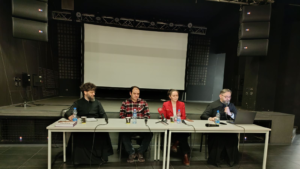
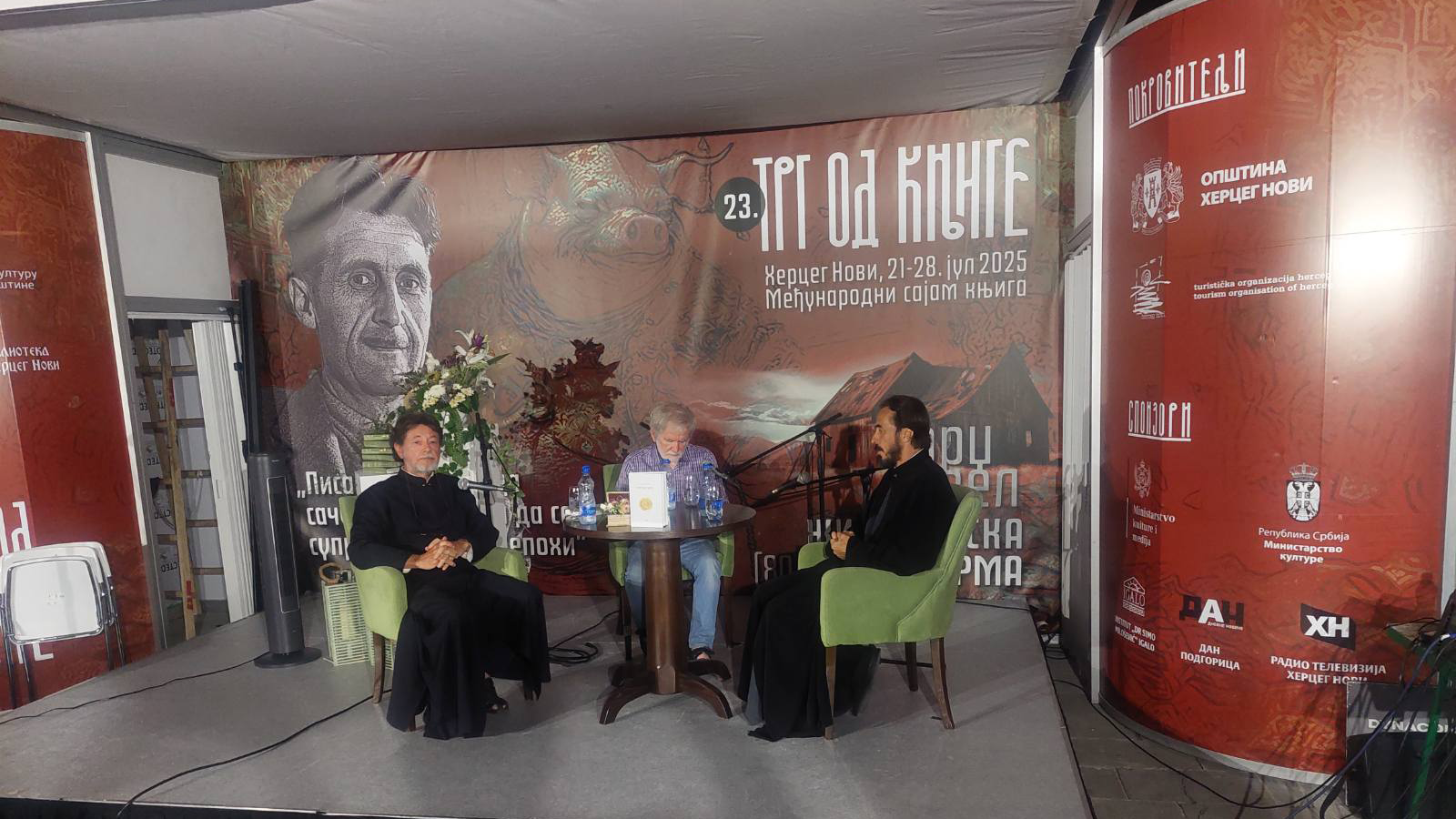
With the blessing of His Holiness Serbian Patriarch Porfirije, and at the request of the City Library of Herceg Novi, the 2025 edition of “The Book Square” (“Trg od knjige”) literary event featured the participation of the Reverend Dr Oliver Subotić, Head of the Missionary Department of the Archdiocese of Belgrade and Karlovci, on 24 July. He was one of the presenters at the launch of the book Light to the World (Svetlo svetu) by Professor Dr Bojan Jovanović, a prominent Serbian ethnologist and anthropologist. The other introductory speaker was Deacon Dr Dragan Stamenković from Niš, followed by an address from the author himself.
Fr. Oliver began his presentation by noting that the book Light to the World is founded on the idea of building a bridge between secular social sciences (particularly ethnology/ethno-psychology, anthropology, and sociology) and Orthodox theology, anthropology, and ascetics. He characterised the genre of the book as akin to works previously published by academician Vladeta Jerotić. In this sense, Fr. Oliver emphasised that the book exhibits the strengths of this thematic genre popularised by Jerotić—encyclopaedic scope, multidisciplinarity, and breadth of insight—while also bearing some of the typical weaknesses that arise when scientific inquiry attempts to transcend the framework of methodological naturalism when addressing matters of Christian faith.
Among the book’s strengths, Fr. Oliver highlighted the author’s ethnopsychological insights regarding the Serbian people, as well as Jovanović’s sharp critique of the commercialisation of religious symbols, the phenomenon of dechristianisation in Western societies, and the influence of neoliberal concepts on public life (e.g., the promotion of Halloween). He also commended Professor Jovanović’s persistent effort to stress that Christians should not be merely formal or nominal in their faith but should instead seek a deeper identity and understanding through Christian doctrine. The presentation further praised the book’s astute reflections on certain aspects of Christian customs and the theological meanings conveyed therein. Particularly noteworthy was Professor Jovanović’s forthright approach to addressing the totalitarian nature of the post-war communist regime and his precise terminology when discussing the suffering of the Serbian people in the so-called Independent State of Croatia (NDH) and later during the ethnic cleansing of the 1990s in the Republic of Croatia.
On the other hand, Fr. Oliver expressed disagreement with some of the views presented in the book regarding the degree of influence that various pagan traditions had on Christianity—views Professor Jovanović holds as an ethnologist. He especially addressed the author’s claim that the biblical story of Eve’s creation from Adam’s rib originated from Sumerian-Babylonian myths dating 3000 years before Christ. In response, Fr. Oliver stated that the existence of similar religious narratives in other cultures—such as the story of a great flood—does not necessarily indicate borrowing, especially when such cultures were geographically and communicatively isolated. Rather, he suggested, such similarities may point to events embedded in the collective memory of all humanity.
The Head of the Missionary Department also commended some of the psychological insights in Professor Jovanović’s book, especially those influenced by Viktor Frankl, whose work is mentioned in passing. He noted that Professor Jovanović tends to favour Carl Jung and consequently addressed the concept of individuation, frequently used in the book and likely influenced by academician Jerotić. While acknowledging certain valuable insights—such as the idea that a person must transition from being a mere individual to becoming a true person, and that one may individuate without Christ but not achieve theosis without Him—Fr. Oliver openly criticised the application of the concept of individuation to the Person of Christ. He refuted the claim that Christ only became an integrated personality capable of performing miracles after overcoming temptations on the Mount, as suggested by Professor Jovanović drawing on Jungian tradition. Instead, Fr. Oliver asserted that the Incarnate Logos hypostasised human nature into His Divine Hypostasis and that it is entirely inappropriate to project psychological concepts onto the Person of the Logos.
In his concluding remarks, Fr. Oliver praised Professor Jovanović for never concealing his Orthodox Christian provenance and for thus serving as a missionary influence among other Serbian intellectuals. He particularly commended the author’s inclusion of thoughts from leading figures in Orthodox anthropology, such as St Gregory Palamas, St John Climacus, and St Anthony the Great. At the same time, remaining true to his priestly and missionary duty, Fr. Oliver openly pointed out certain theological inaccuracies found in the book—ranging from nuanced but less serious errors, such as failing to distinguish between linear time (characteristic of the Old Testament faith) and synthetic (cruciform) time (characteristic of Christianity), to serious doctrinal mistakes of a heterodox nature.
As a major example of doctrinal error, Fr. Oliver highlighted the author’s assertion that only God the Father has the power to resurrect, acting through the Holy Spirit, whereas the Son merely has the power to raise the dead. Professor Jovanović grounds this assertion in the teaching that the Holy Spirit proceeds only from the Father, leading to an erroneous conclusion. Fr. Oliver responded by stating that the Holy Trinity possesses one common nature, will, energy, and power, with distinctions existing only at the hypostatic level. Thus, in every miraculous act performed by the Son, both the Father and the Spirit are also present. Furthermore, in relation to the author’s argument that the Son lacks the power to resurrect (illustrated by the case of Lazarus the Four-Days-Dead, who died again after being raised), Fr. Oliver referenced the Gospel passage in which the Lord Jesus Christ declares: “The dead will hear the voice of the Son of God, and those who hear will live” (cf. John 5:25). He hypothesised that Professor Jovanović may have been influenced by verses such as Romans 8:11, which states that God the Father raised the Son through the Holy Spirit. However, he stressed that such passages do not imply a lesser power in the Son, but rather affirm the unified action of the entire Holy Trinity in the economy of salvation.
In concluding his review, the Head of the Missionary Department commended Professor Jovanović’s contributions and efforts, noting that the principal value of the book lies in its opening of space for dialogue with Serbian intellectuals. However, he also emphasised the need for a thorough theological review of the work from the standpoint of Orthodox dogmatics and proposed that such a review be undertaken by a recognised Serbian authority in the field of dogmatic theology.