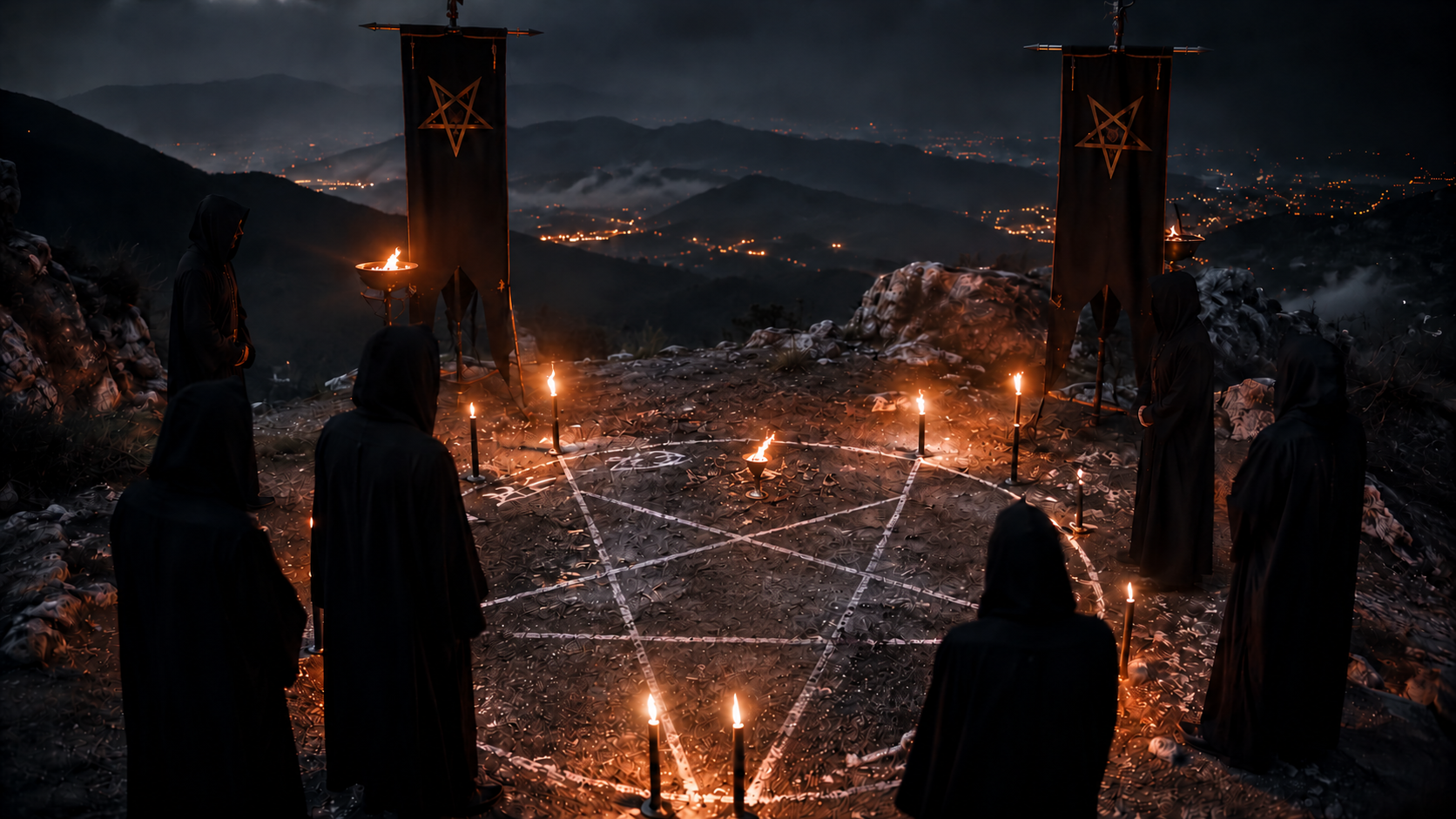
Satanism: Basic Concepts and Classification – Part 2
Satanism in the narrow sense, or overt, visible Satanism, entails the conscious, intentional, and direct service of Satan; that is, the visible, open, and undisguised veneration and worship of Satan, together with opposition to Christ and the Church.
This form of Satanism is frequently divided into theistic and atheistic Satanism.
In brief, adherents of theistic Satanism believe in the existence of Satan (the Devil) and worship him, whereas atheistic Satanists interpret Satan as a metaphor and symbol of the “Eternal Rebel”. According to Malcolm Jarry, co-founder of The Satanic Temple, Satan is “a heroic figure who struggles against tyrannical authority and for humanity, even if it is a losing battle”.
Naturally, it is not difficult to conclude that this classification is merely another in the endless succession of the Devil’s deceptions, intended to broaden the range of lures and appeal to as many different human tastes as possible. Nevertheless, behind all these diverse and colourful lures lies a single, ever-identical, and deadly hook. In this particular case, the portrayal of the Devil as a metaphor is undoubtedly intended to quiet the conscience and deceive those for whom acknowledging that they serve Satan as a real spiritual being might constitute an obstacle.
Satanist groups in the narrow sense include Joy of Satan, which is also active in Bosnia and Herzegovina; the Church of Satan; The Satanic Temple; the International Satanist Movement (Международное движение сатанизма); the Russian Church of Satan (Российская церковь сатаны); the Southern Cross, also known as the Moscow Church of Satan (Южный крест, Московская Церковь сатаны); the Black Angel (Черный ангел); and others. Among the Satanist groups that have been or remain active in our region, we may mention, for example, the Black Rose, Bad Faith, and the Followers of Satan.
It is impossible to provide an exact number of followers of Satanist groups, either globally or for any individual country. Moreover, it is difficult to provide even an approximate estimate. For example, Roman Silantyev, a researcher specialising in destructive cults, estimates that the number of Satanists in Russia amounts to several tens of thousands. According to him, there are no large Satanist structures in Russia; instead, Satanists generally form groups of fewer than ten people or even operate individually.
Although it has been claimed that the Church of Satan has hundreds of thousands of formal members, according to LaVey’s daughter Zeena and several other people close to him, its membership has never exceeded three hundred.
According to Malcolm Jarry, co-founder of The Satanic Temple, the organisation has a total of 700,000 members worldwide. Naturally, without further verification, it is impossible to determine whether this figure is accurate or whether it constitutes a deliberate exaggeration, as in the case of the Church of Satan.
According to Zoran Luković, a retired colonel of the Ministry of Internal Affairs and Coordinator of the Apologetic Mission Section, there are no seriously organised Satanist groups in Serbia; rather, they are most commonly informal groups of young people gathered around a particular individual.
Roman Silantyev has stated that numerous cases are known of ritual killings of human beings and animals, as well as the desecration of graves and the bodies of the deceased, committed by Satanists. According to him, typical Satanist crimes include the ritual killing of human beings, for which he cites a figure of approximately 300 victims since 1993. He also states that ritual killings of animals, particularly cats, as well as cannibalism, rape, and the incitement of religious hatred, are present.
According to Zeena LaVey, daughter of Anton Szandor LaVey, the founder of the Church of Satan, he beat and abused the female followers with whom he had sexual relations, coercing them into prostitution as part of his “Satanic Counselling” and taking their earnings.
Naturally, when it comes to the aforementioned practices, Satanists will present themselves to the public in an entirely different light—as angels of light (2 Cor. 11:14).
Thus, for example, on the official website of The Satanic Temple, in the section entitled “Fundamental Tenets”, we may read that “one should strive to act with compassion and empathy towards all creatures”, as well as that “the spirit of compassion, wisdom, and justice should always prevail over the written or spoken word”.
“The Devil persuades people to believe that hell does not exist precisely in order to cast them into hell,” writes Saint John Chrysostom. Anton Szandor LaVey states this explicitly in The Satanic Bible: “There is no heaven of glory bright, and no hell where sinners roast.” In connection with these words, we may also cite the example of Oleg Sataninsky, founder of the Satanic Church of the Russian Federation (Сатанинская церковь РФ), who goes so far as to attempt to convince the public that Satanists are not worshippers of the Devil! “Ritual killings of animals or human beings, vandalism, and other similar crimes are the work of Devil worshippers. Satanists despise Devil worship and its followers. The Satanic Church of the Russian Federation is not an association of Devil worshippers, but an association of Satanists. The Satanic Church of the Russian Federation has an extremely negative attitude towards Devil worshippers who call themselves Satanists,” Oleg Sataninsky states, among other things.
Finally, a completely unambiguous example of the frequently cited warning that the Devil transforms himself into an angel of light may be found in David Spangler’s book Reflections on the Christ, in which the author explicitly presents Lucifer as an angel of light. More specifically, Spangler writes that Lucifer—which means Satan—is the angel of human evolution and that he is the spirit of light within the microcosm, whereas God is the spirit of light within the macrocosm.
When it comes to individuals, we may mention, as one of several possible examples, La Carmina, author of The Little Book of Satanism, for which Lucien Greaves, co-founder of The Satanic Temple, wrote the foreword. Here too, the cunning of the Devil is evident. “Modern Satanists are non-violent and interested in the pursuit of reason, justice, and truth. Many Satanist groups organise community events such as charity drives and beach clean-ups,” La Carmina states, portraying devotees of the Devil as humanitarians and socially responsible individuals.
Since our aim in this text is not to provide an exhaustive list of Satanist groups and individuals, we shall mention only one further example—the Serbian Satanist Miloš Dimitrijević.
In an article entitled “Milos Dimitrijević”, published on a Polish news portal, the journalist describes Miloš Dimitrijević as “the kindest Satanist he had ever met” and then recounts a Satanist ritual through which Dimitrijević prepared an amulet for him in his temple, Akademia Hermetica, in Belgrade.
“When, a year later, I descended into a basement in Belgrade where I was to meet Miloš, I saw a large table upon which tarot decks, secret books, amulets, and other mysterious objects whose meaning I was unable to understand had been arranged. A hundred candles were burning all around, and Miloš was waiting for me, dressed in a robe with red crosses sewn onto it. It looked impressive and magnificent. He announced that the tarot cards, astrological calculations, and his intuition indicated that I could make use of an amulet and that he knew what kind of amulet I needed. He then drew a dagger… He told me to kneel, and his dagger cut through the air around my head as he invoked Lucifer in a beautiful, deep tenor voice. The Prince of Darkness was supposed to assist him in properly attuning the amulet. When Lucifer and Miloš had completed their work on my amulet, I was permitted to rise,” writes the Polish journalist.
Whether they are Satanist groups or individuals, their teachings and rituals differ.
In many countries, the aforementioned Satanic Bible by Anton Szandor LaVey is used as a source of Satanist teaching. According to certain estimates, more than one million copies have been sold to date. Unfortunately, this book is also available in Serbia, as it is offered by certain domestic bookshop chains.
The Satanic Bible also discusses Satanist rituals. For example, the section of the book entitled “The Book of Lucifer” discusses the Black Mass, while “The Book of Belial” deals with the theory and practice of Satanic magic, the three types of Satanist rituals, the components and implements used in Satanic magic and rituals, and so forth. However, as a supplement to The Satanic Bible, LaVey also wrote a book entitled The Satanic Rituals, devoted specifically to rituals, which begins with a chapter on the Black Mass.
Videos are available online showing the initiation—or anti-baptism—of Zeena, the three-year-old daughter of Anton Szandor LaVey, into a Satanic temple. The ritual begins with the words of the Black Mass in Latin, In nomine Dei nostri Satanas Luciferi Excelsi—that is, “In the name of our god, Satan, Lucifer the Most High”—and is performed over a naked woman who serves as the sacrificial altar, or anti-altar. Above her is a Satanist symbol—the Sigil of Baphomet—in the form of an inverted pentagram containing a horned goat’s skull. The pentagram is enclosed within a double circle, with the word “Leviathan” inscribed in Hebrew between the two circles. In Đura Daničić’s translation of the Old Testament, used in our country, the word “crocodile” appears instead of “Leviathan”. The ritual of initiation, or anti-baptism, was performed by LaVey himself, dressed in a black robe, his head covered by a cap bearing Devil’s horns, and holding a sword in his hand. The child was likewise dressed in a black hooded robe, with the aforementioned Satanist symbol upon her chest.
It is important to note that the open and undisguised service of Satan may also include the use of symbols recognised as Satanist, without any verbal expression of one’s views concerning Satan.
The principal symbols of Satanism are considered to be Baphomet; the Sigil of Baphomet; an inverted pentagram containing a horned goat’s (kid’s) skull; the pentagram or, more frequently, the inverted pentagram; the inverted cross; and the number 666. Although it is often disputed that the so-called “Satanic horns” gesture—formed by extending the index finger and little finger while folding the remaining fingers against the palm—is a Satanist symbol, we see that it is used by members of The Satanic Temple. The Satanic Temple also uses an upright—that is, non-inverted—pentagram positioned upon the forehead of a horned goat. An identical pentagram, together with a bloodied horned goat’s (kid’s) skull, is also used in the performances of a globally renowned artist who simultaneously denies any connection with Satanism. This is one example of the use of symbols recognised as Satanist without any verbal expression of one’s views concerning Satan.
When it comes to observances, no holidays are universally accepted among all Satanists; rather, each group or individual determines its own. For example, The Satanic Temple has designated Lupercalia, observed on 15 February, as a holiday described as “a celebration of bodily autonomy, sexual liberation, and reproduction”. By “bodily autonomy”, of course, is meant the right to abortion—that is, the right to infanticide. It is very important to bear this in mind because of the second part of the text, in which we shall address Satanism in the broader sense. Their next holiday is Hexennacht, or Witches’ Night, on 30 April, followed by 25 July, the day commemorating the unveiling of the Baphomet statue in 2015; Halloween on 31 October; and, finally, the Feast of the Unconquered Sun (Sol Invictus) on 25 December.
Interestingly, the official register of deaths lists 31 October—Halloween—as the date of Anton Szandor LaVey’s death, although his daughter claims that the correct date was 29 October. She also gave this date in a document several pages long in which she addressed all the falsehoods concerning him and his life.
It is also important to draw attention to the fact that The Satanic Temple organises a gathering of Satanists in the United States in the form of a conference called SatanCon. The programme of this Satanist conference in 2022 included, among other things, such topics as TheSatanicTemple.TV, or How to Start Your Own Satanic Television Network; Using the Freedom of Information Act to Combat Satanic Panic; Abortion as a (Religious) Right; Raising Children in a Satanist Household; and The After School Satan Club. At the opening ceremony of the 2023 Satanist conference, the Bible was torn apart; a ritual of unbaptism was performed, evidently involving a member of one of the Christian denominations; and a Satanist rite for the renewal of marriage vows was conducted, among other activities. “Our opening ceremony included the tearing apart of the Bible as a symbol of oppression, particularly the oppression of the LGBT community,” stated Dex Desjardins, spokesperson for The Satanic Temple.
Satan is promoted not only through books and Satanist conferences, but also through film, music, and various other means. For example, the official website of the Church of Satan contains a list of films that it recommends. It is particularly important to note the introductory section, which explains what makes a film Satanic. “What makes a film Satanic? Such a film does not require an overt depiction of the Devil and demons. It may be a musical, a crime drama, or even a comedy. Satanic films often possess a particular evocative atmosphere,” the Church of Satan’s website states.
When it comes to music, we may note that one of the albums by the heavy metal band Black Sabbath was entitled Their Satanic Majesties Return, while the album cover depicted a skull inscribed with the number 666. The number 666 also appeared between the words in the band’s name: Black 666 Sabbath.
Dimitrije Marković