
1.0 The Biblical Understanding of the Curse and the Etymology of the Term
“Then God saw everything that He had made, and indeed, it was very good.” (Gen. 1:31)
As the Creator of the entire cosmos, God brings all things into existence as good. Light is good, as are the sun, the moon, plants, animals, and humanity itself. The key word in this verse is was, precisely because everything was very good. Everything was indeed good; however, one of God’s creatures cast the whole creation into a state of temporary corruption, so that what once was good, tragically became associated with evil.
In the Garden of Eden, humanity lived as the freest of all created beings, existing in perfect synergy with nature and with every other living creature. Adam exercised dominion over all the animals, yet he still lacked one who would truly be his own. Bone of his bones and flesh of his flesh (Gen. 2:23)—that is, his rib—became the woman. The Lord could have fashioned woman from any part of Adam’s body; nevertheless, He deliberately chose the rib, the part of the human body that protects the heart. The rib shields the heart from external influences.
Tragically for all humanity, it was precisely “his heart” that led Adam into sin. He tasted the fruit of the only tree in Paradise from which he had been forbidden to eat, thereby separating himself from God. Yet the tasting of the fruit could not occur without a tempter. It was the ancient serpent that deceived both the woman and the man, leading them into sin and destruction. Sin was not inevitable; rather, it arose as the consequence of humanity’s free consent to deception. The concept of the curse first appears in Holy Scripture when the Lord addresses the serpent because of its wicked deed and pronounces the following judgment upon it:
“Then the Lord God said to the serpent: ‘Because you have done this, cursed are you above all livestock and above every beast of the field; on your belly you shall go, and dust you shall eat all the days of your life.'” (Gen. 3:14)
The cunning serpent had once been the most radiant of the angels. Formerly the bearer of divine light, through his fall he became the very opposite of God’s light and thus the very symbol of darkness. Satanail fell and became Satan, drawing with him a third of the heavenly host, who became demons; following his own fall, he sought not merely to draw away a third, but the whole human race. Here, the curse appears as an expression of the disruption of the divine order.
The first fall into sin was the fall of the angels through pride and delusion. The second was the fall of humanity through disobedience to God’s commandment concerning fasting. Accordingly, the first curse encountered in Holy Scripture is directed precisely against the devil, that is, against the one who seeks to lead humanity into the abyss. Throughout human history, the devil’s activity has never proceeded from ignorance of God’s existence, but rather from direct knowledge of and belief in God, accompanied by conscious rebellion against Him. For this reason, the Evil One is frequently referred to as the Adversary—the adversary of the communion between God and humanity.
The principal biblical terms from which the scriptural etymology of the word curse may be traced are ḥerem (Heb. חֵרֶם), ʾārûr (Heb. אָרוּר), and anathema (Gr. ἀνάθεμα).
- ʾĀrûr (curse) primarily denotes a personal curse, referring to one who exists outside divine grace, one who has been excluded from communion. An example is the curse pronounced upon the serpent in the Book of Genesis. This term primarily conveys the notion of a spiritual curse.
- Ḥerem (curse) in Hebrew signifies something devoted to complete destruction, that is, something consigned to the judgment of God—something accursed. Numerous biblical curses are associated with this term; however, by its very nature, ḥerem is directed exclusively against those who oppose God and those who strive to prevent the salvation of humanity. It possesses a distinctly formal character and, interestingly, remains in use within rabbinic tradition to this day. The term carries several meanings and may even have a positive connotation when an offering is consecrated and dedicated entirely to God. Accordingly, ḥerem may denote: (1) military ḥerem—total destruction; (2) priestly ḥerem—an object consecrated to God and therefore no longer available for ordinary use or redemption; and (3) excommunication ḥerem—expulsion from the religious community, representing the gravest form of curse.
The concept of anathema develops from this tradition and denotes separation or apostasy from God. In the ancient world, the term referred to an object devoted to destruction as an offering associated with divine judgment, while in the Christian context it signifies excommunication—that is, deprivation of communion with the Creator.
The Creation of Adam — Michelangelo, Sistine Chapel, Vatican.
From this, it may be concluded that whenever curses are mentioned in Holy Scripture, they are directed against the enemies of God and against those who oppose the salvation of all people and their coming to the knowledge of the truth. The subsequent course of history gave rise to various interpretations of this concept; nevertheless, it is important to emphasize that the term anathema has remained in frequent use throughout the New Testament period and continues to occupy an important place in contemporary ecclesiastical language. In this context as well, it refers to those who have fallen away from God.
2.1 The Concept of the Curse among the Ancient Slavs
Over time, through the activity of the devil in the world, humanity underwent profound moral change. Although human nature remained inherently good, continual submission to demonic temptation and deception gradually led people towards evil. The world became increasingly permeated by wickedness, giving rise to numerous acts of divine purification throughout history, including the Great Flood. Yet even after these great purifications, many postdiluvian civilizations failed to pursue the good. Instead, they drifted away from the true source of spirituality, developing various cultic practices. Certain peoples even came to venerate the fallen angels, worshipping them as gods.
Historically, the concept of the curse underwent a significant transformation, gradually losing its essential meaning and acquiring an exclusively magical character. This tendency is particularly evident in Slavic studies and, more generally, among the Serbian population today. The lexical structure of the Serbian word prokletstvo (“curse”), consisting of the prefix pro- and the root -kleti (“to curse”), indicates the act of pronouncing a negative fate upon someone, yet often without any deeper understanding of its spiritual essence.
The ancient Slavs were a pagan people who lived under various historical circumstances prior to their acceptance of Christianity. Today, the Slavs are Christians, and a considerable proportion of them are predominantly Orthodox Christians. Every aspect of their—and our—ancient mythology, including the belief in curses, should therefore be approached with appropriate caution and spiritual maturity. Whatever belonged to the pre-Christian past and was harmful should be entirely forgotten or, more precisely, eradicated. The consequences of ignorance and of “playing” with such matters may pose a serious danger to a person’s spiritual condition.
An Artistic Depiction of the Everyday Life of the Ancient Slavs
In their ancestral homeland in the region of the Urals, the ancient Slavs were surrounded by a great diversity of natural phenomena, which enabled the development of a rich mythology and various magical practices. Among the ancient Slavs, the concept of the curse represented both a psychological and a social category, primarily involving the wish that evil should befall another person. Their attitude towards curses was not limited to regarding them as mere insults; rather, the pronouncement of a curse was often accompanied by a particular magical ritual. They believed that every spoken word possessed its own weight and power, including evil words, whose force could supposedly be intensified through magic. According to this understanding, a word could create, a word could destroy, and a word could even alter a person’s destiny. Among the Slavs, a curse commonly relied upon the invocation of a particular force or entity, frequently conceived as a deity or as some power associated with nature or the cosmos. It represented a particular form of judgment pronounced upon a person. For this reason, mythological beings such as Perun and Veles were invoked as ancient gods and judges among the Proto-Slavic peoples.
They believed that a curse could bring misfortune upon an individual, upon that individual’s family, or, if it were particularly powerful, upon all subsequent generations. The curses of parents were considered the most severe; however, since the Slavs were frequently organised into tribal communities, the curses pronounced by tribal elders were also regarded as highly authoritative. Curses were most commonly uttered in response to moral transgressions, violations of the communal code, or harm inflicted upon another person. It is probable that a particular form of sacred or ritual speech was also employed, which further contributed to the perceived power of the curse.
2.2 Superstitions as a Cultural Phenomenon among the Ancient Slavs
In addition to their belief in curses, the Slavs were also a highly superstitious people. Belief in curses represented only the culmination of a wider belief in fortune, whether good or bad. If a person committed an evil act, it was believed that something evil would inevitably happen to that person in return. In ancient India, the term most frequently used to describe such a principle was karma. Superstition develops out of a belief in fate. It denotes an assumed relationship between a particular event, person, object, being, or phenomenon and certain future events or outcomes. The ancient Slavs believed that the human person was profoundly spiritual and that spiritual beings therefore exercised a significant influence upon human life.
According to their understanding, spiritual balance was attained both in the visible and in the invisible world—that is, through the harmonious relationship between these two realms. A good relationship between them resulted in balance and harmony, whereas a disturbed relationship produced chaos. It was precisely from this type of belief that superstition emerged as a distinct mode of relating to reality, intended to preserve spiritual balance within the community. Unusual events, natural phenomena, and encounters with animals were interpreted in various ways. People sought signs and omens in such occurrences in an attempt to gain a sense of control over future events. Owing to their tribal form of social organisation, their legal system was not highly developed. Superstitions therefore emerged as an effective means of regulating relationships within society. Collective consciousness was of great importance among the Slavs, and superstitions consequently played a significant social role, since certain forms of behaviour and belief were conditioned by fear of the supernatural.
Superstition also gave rise to various combinations of magical protective practices. The veneration of oak trees, the use of magic for the supposed protection and sanctification of homes, incantations, and similar practices were among the consequences of such beliefs. It is also noteworthy that the Slavs believed certain mythological beings could influence the future or atmospheric phenomena. In this context, the Polabian Slavs worshipped a deity known as Pogoda, or Pion, whose cult may likewise be regarded as a product of superstition.
They did not submit their actions to the judgment of their own conscience but, as may be observed, attributed considerable importance to other forces because of their spiritual negligence. Insecurity, expressed as fear of future events, emerges as a manifestation of a person’s disordered spiritual condition. Such a person begins to interpret various signs in the surrounding environment, which later influence his or her behaviour, gradually distancing the individual from reality and from a rational perception of the world.
3.0 Belief in Curses as a Widespread Form of Superstition among the Serbs
Superstitions are highly prevalent among our people. The characteristics described above belonged primarily to the ancient Slavs. They were erroneous then and are entirely unacceptable today for us as Orthodox Christians. They originated in ignorance and were the fruit of demonic temptations among the majority of pagan peoples. Although all of this forms part of our ancient cultural heritage, the Slavs subsequently accepted Christianity. Christianity brought about the flourishing of unity of faith in our lands and led many people to abandon and forget such mistaken ways of thinking and living.
Nevertheless, we are witnesses to the fact that certain regions of the Balkans, including parts of Serbia, have retained various superstitious beliefs and practices. Some of these have even been transferred onto, or associated with, particular Church feast days, which is entirely erroneous. Such practices may become spiritually destructive and even blasphemous. By accepting Christianity, we undoubtedly rejected everything harmful and spiritually ruinous. Yet certain pagan beliefs remained present among the people, frequently interwoven with elements of older traditional culture. In such cases, faith in God is often confused with belief in signs, the evil eye, magical spells, and curses.
They arise primarily from ignorance and, at certain moments in our history, from the tendency to seek seemingly convenient solutions to particular problems without the blessing of a priest. Certain ideologies exerted an additional influence upon this phenomenon, as did the transmission of superstitious beliefs from one generation to another. It is deeply regrettable that we, as an Orthodox people, attribute such importance to matters that are entirely irrelevant to our salvation. Through His example and His life, Christ exposed the erroneous teachings of the Pharisees, who were excessive in every respect. At times, we too may resemble them, becoming preoccupied with whether we should turn on the washing machine or prepare a meal on a major feast day marked in red in the Church calendar, while at the same time failing to attend the Divine Liturgy in the house of God—which is, paradoxically, the far more serious matter.
In the Serbian language, the term sujeverje denotes belief in something empty, meaningless, and false; for this reason, it is also frequently referred to as praznoverje, that is, “false belief” or “empty faith.” In Latin, the term superstitio denotes superstition, understood as something that stands beyond logic or exceeds the boundaries of sound reason. Viewed more broadly, superstition among our people generally arises from weak faith and ignorance. At times, it may even assume the character of idolatry, since a person begins to place faith in signs, energies, and objects rather than in God.
The following are examples of some typical superstitions among the Serbs
| Superstition | Traditional Belief | Origin | Orthodox Christian Assessment |
| A black cat crosses one’s path | It brings bad luck. | Pagan tradition; medieval Europe | A black cat possesses no spiritual power. |
| Knocking on wood | It prevents misfortune or the evil eye. | Magical practice; possibly of Turkish origin | Protection comes from God, not from objects or ritual actions. |
| Spilling salt | It foretells a quarrel in the household. | Ancient folk belief in omens | A coincidence rather than a spiritual sign. |
| The evil eye | A person can inflict harm through a glance (especially upon unbaptized children). | Pagan tradition | It is rooted primarily in fear and suggestion rather than in an independent spiritual power. |
| Incantations and the removal of spells | They can heal illness, remove misfortune, or break magical spells. | Pagan magical practice | Spiritually harmful, since they involve recourse to demonic powers rather than trust in God. |
| Curses | They can ruin a person’s life and even affect future generations. | Pagan and folk tradition | They possess no power apart from God’s permissive will. |
| A haunted house | The house is believed to be cursed, bringing misfortune to its occupants for generations. | Folk tradition | Christians are called to trust in the Lord, who is greater than every fear. |
| A broken mirror | It brings seven years of bad luck. | European superstition | It has no spiritual foundation whatsoever. |
| An itchy palm | It signifies that money is coming. | Folk tradition | It has no spiritual significance or efficacy. |
From the Orthodox Christian perspective, there are no meaningless coincidences; rather, everything occurs according to God’s providence and for a particular purpose. Consequently, an Orthodox Christian does not live in fear, does not place faith in chance occurrences, and does not attribute spiritual significance to external signs or phenomena, but instead places complete trust in the Lord. Why, then, is fear of superstitions a sign of deficient faith? Precisely because, as the Apostle John teaches, “perfect love casts out fear” (1 John 4:18).
Throughout history, the Orthodox Church has faced a significant pastoral challenge arising from the blending of popular superstitions with authentic ecclesiastical Tradition. In many instances, superstitious customs have come to assume greater importance in the lives of believers than genuine reverence for God and faithful participation in the life of the Church.
The following are examples of some superstitions among the Serbs associated with Church feast days:
| Superstition | Traditional Belief | Orthodox Christian Perspective |
| No work whatsoever should be done on a major feast day (red-letter day). | “It is sinful to do any kind of work.” | Moderate and necessary work is permissible. The day is primarily dedicated to participation in the Divine Liturgy, prayer, and communion with God, not to fear or idleness. |
| If you work, you will be punished. | Misfortune will inevitably follow. | God does not punish people mechanically or superstitiously. |
| Laundry must not be washed or clothes ironed. | “It brings evil upon the household.” | This belief has no theological or spiritual foundation. |
| Sewing or using scissors is forbidden. | “It cuts off one’s good fortune.” | This belief has no rational or theological basis. |
| Garbage must not be taken out. | “One throws away the household’s good fortune.” | This is a superstitious belief without any spiritual foundation. |
| Bathing is forbidden. | “One may become ill or drown.” | This belief has no connection with Orthodox Christian teaching. |
| Agricultural work must not be performed. | “The crops will fail, or someone will die.” | Blessing comes from God rather than from refraining from work itself. |
| Peace should be maintained on a major feast day; quarrelling is forbidden. | “The day is spiritually dangerous.” | A feast day is dedicated to the Divine Liturgy, prayer, peace, and Christian joy, not because the day itself possesses mystical or dangerous powers, but because it is consecrated to God. |
“There is no fear in love, but perfect love casts out fear; for fear has to do with punishment, and whoever fears has not been perfected in love.” (1 John 4:18)
Throughout Holy Scripture, Christ repeatedly exhorts His followers: “Do not be afraid.” Accordingly, we who place our trust in the Lord should neither waver nor attach undue importance to insignificant matters that distract us from our ultimate goal. This is precisely what Scripture identifies as sin—hamartia (Gr. ἁμαρτία), a term which literally signifies “missing the mark.” The one who truly believes in God does not live in fear of omens or superstitious signs. As people of the twenty-first century, if we were to examine these matters rationally, we would recognize that such beliefs are entirely devoid of meaning, for they contain no participation in the Logos. Rather, they constitute a distortion of reality and stand in direct opposition to the Logos, Christ Himself, who, according to St. Justin of Ćelije, has delivered humanity from bondage to sin, death, and the devil.
One of the most widespread superstitions among the Serbian people is the belief in curses. Such beliefs create a serious spiritual problem because, out of ignorance, many people who fear curses seek help from fortune-tellers, sorcerers, or practitioners of occult rituals instead of turning to their parish priest. As previously noted, in their biblical sense, curses are directed against the enemies of God. However, as a Slavic people, we have inherited a different understanding of curses from our pre-Christian past. Although the Serbs embraced Christianity and came to the knowledge of the truth, remnants of ancient Slavic beliefs have persisted to the present day. Consequently, belief in curses has also survived—not as a rational or theologically grounded concept, but rather as a deeply rooted form of superstition.
According to this inherited Slavic understanding, a curse is believed to be an utterance capable of influencing individuals and the course of events, and it is often regarded as something that may even be transmitted from one generation to another. In this way, the curse assumes the character of fate, placing the individual under the supposed influence of invisible forces and mysterious energies, while the fear of God is gradually replaced by fear of these imagined powers. As with every other form of superstition, belief in curses rests upon confidence in supernatural forces, unexplained phenomena, and invisible energies that typically give rise to profound fear. Instead of entrusting their lives to the Lord and Creator, those who believe in curses subordinate their lives to the supposed power of spoken words and omens, which possess no inherent power whatsoever, since everything occurs either through God’s blessing or by His permissive will. Thus, fear of curses primarily affects those whose faith is weak—those who, through the manner of their lives, lose sight of God and become imprisoned within themselves and their own thoughts.
According to the teaching of the Church, no created thing—not even another human being—can determine or govern another person’s destiny, for all authority belongs to God alone. Words may possess authority, but they do not carry any magical power. Where there is genuine repentance and a sincere longing for the Kingdom of Heaven, there is no room for fear of human words, threats, or empty pronouncements. As a Serbian proverb wisely states, “The dogs bark, but the caravan moves on.”
Likewise, as citizens of the Heavenly Jerusalem, we should pay no attention to curses, incantations, or magical practices performed by those who have no communion with the Church. Too often we attribute our failures to invisible forces, forgetting that we ourselves have frequently contributed to them through our own choices. As beings endowed with free will, we choose either to enter into a communion of love with Christ or to turn away from Him. By placing our trust in curses and similar superstitions, we distance ourselves from Him through our own voluntary choice.
We effectively deny Christ whenever we believe that another person’s curse can truly bring us harm, forgetting that God alone exercises sovereign authority over every event and every creature. Throughout the Holy Scriptures, Christ repeatedly exhorts us not to be afraid, and the Apostle teaches that “perfect love casts out fear.” Therefore, we too are called to place absolute trust in His holy will. In the light of His Resurrection, Christ overthrows every superstition, every curse, and every evil thought, destroying the greatest enemies of the human race. “O Death, where is your sting? O Hades, where is your victory?” (1 Cor. 15:55–56). If God reigns in our hearts, who can stand against us? Where faith dwells, superstition disappears; where a person places complete trust in God, there the Holy Spirit comes to dwell.
A distorted understanding of spiritual reality has inevitably led to distorted interpretations of superstition. This has given rise to fortune-tellers, sorcerers, and practitioners of the occult, who, through demonic deception, claim either to invoke or to remove curses from individuals and even from entire nations. Yet these evil powers have no authority over a faithful Christian—or indeed over anyone else—apart from God’s permissive will. As a consequence of such superstitious thinking, many people also place their trust in numerology, astrology, and similar systems, allowing these practices to shape the course of their lives. Our faith, however, is not in curses, astrology, or numbers, but in the Risen Lord. Orthodoxy itself, whose very name signifies the right glorification of God, possesses incomparable spiritual power in contrast to the empty forms of worship embodied in superstition.
According to the teaching of the Church, a person may properly be regarded as being under a curse only insofar as he or she sets himself or herself in opposition to God or becomes an enemy of his or her own people. A well-known example is the curse of Tsar Lazar, directed against anyone who renounces the Kosovo Covenant. The meaning of this curse is clear: grave consequences await the one who abandons the Orthodox faith and the spiritual heritage of the Serbian people. True Serbs do not place their trust in superstitions but in the Risen Christ. They strive for the Kingdom of Heaven, for, as Tsar Lazar proclaimed, “The earthly kingdom is but for a little while, whereas the Heavenly Kingdom is forever and ever.”
Patriarch Pavle often reminded the faithful: “If God is with you, what is there to fear? And if He is not, what is there to hope for?” These words should remain a perpetual reminder that our trust must rest in God alone, for “It is better to take refuge in the Lord than to put confidence in man” (Ps. 118[117]:8). In order to free ourselves from such delusions and from the belief that someone has inflicted evil or a curse upon us, the proper course is to seek guidance from one’s parish priest, to observe the Church’s fasting discipline, to confess regularly, and to partake of Holy Communion. Let us cease to be slaves to sin, deception, and the passing words of men. Only the words of the Lord endure forever.
“Heaven and earth will pass away, but My words will never pass away.” (Luke 21:33)
It is fitting to conclude this brief chapter on curses and belief in fate with the words of one of the wisest Serbian saints, St. Nikolaj Velimirović. In his Missionary Letters, Bishop Nikolaj responded to numerous questions concerning matters of faith and Christian life. On one occasion, a certain Mr. Toma asked him to comment on superstitions, to which St. Nikolaj replied:
“You write that you have reached the age of eighty and yet remain physically strong and youthful in spirit. Many, many times death came closer to you than your own shirt, yet each time you were unexpectedly delivered by what you call fate. Therefore, you ask: Does fate exist, and how does the Orthodox Church understand it?”
You therefore ask: Does fate exist, and how does the Orthodox Church understand it? If by fate one means blind chance or impersonal fatalism, the Church decisively rejects such a notion, denying the existence of any such fate. The Church is founded upon Reason, proceeds from Reason, and exists through the Logos. It attributes nothing to blind chance or blind fatalism, but everything to the providence of the almighty and all-seeing God, who acts according to a higher purpose, taking into account the hidden thoughts, feelings, and deeds of every human person.
The very word fate is derived from the word judgment—in this case, the judgment of God. The Psalmist declares: “I remember Your judgments of old, O Lord, and I am comforted.” That is, he remembers how the Lord rewarded the righteous and punished sinners even in this present life. Elsewhere he says: “I am afraid of Your judgments,” and again, “Give me life according to Your judgment” (Ps. 119 [118]). In the Church Slavonic text, the word sudba (“fate”) appears in each of these passages in place of judgment. Even in ordinary speech we often ask, “How do you judge this matter?”, meaning, “What do you think about it?” Thus, fate is nothing other than God’s thought concerning all that comes to pass—not a passive and powerless thought such as that of human beings, but one that is active, sovereign, and decisive.
A man prepares in the evening to travel the following day to a nearby city, yet during the night death overtakes him and carries him instead to the distant heavenly city. People then say, “Such was his fate.” Another intends to marry one woman, yet on his wedding day he is joined to another. Again they say, “It was fate.” A soldier leaves the trench for what appears to be the safety of the rear lines, only to be struck by a bullet beneath his own tent. Once more people say, “It was fate.” Yet nowhere and never is this a matter of blind fate, but rather of a fate that is guided by the all-seeing God—the supreme Thinker and Provider—who knows the reason for everything. Whoever speaks of blind fate merely confesses his own inability to understand the cause and purpose of a particular event.
Nothing befalls humanity apart from the righteous and merciful God. Let us recall once more the words of the Saviour: “Not one sparrow falls to the ground apart from your Father… and even the hairs of your head are all numbered” (cf. Matt. 10:29–30; Luke 12:7). Therefore, no person’s fate is either blind or accidental; rather, it is governed by divine wisdom and providence. According to such an intelligent and all-seeing providence, you have escaped death on many occasions and have even outlived the judges who signed your death sentences. From God come both your life and your salvation.
Letter 185 of St. Nikolaj Velimirović, addressed to Mr. Toma on the question of fate.
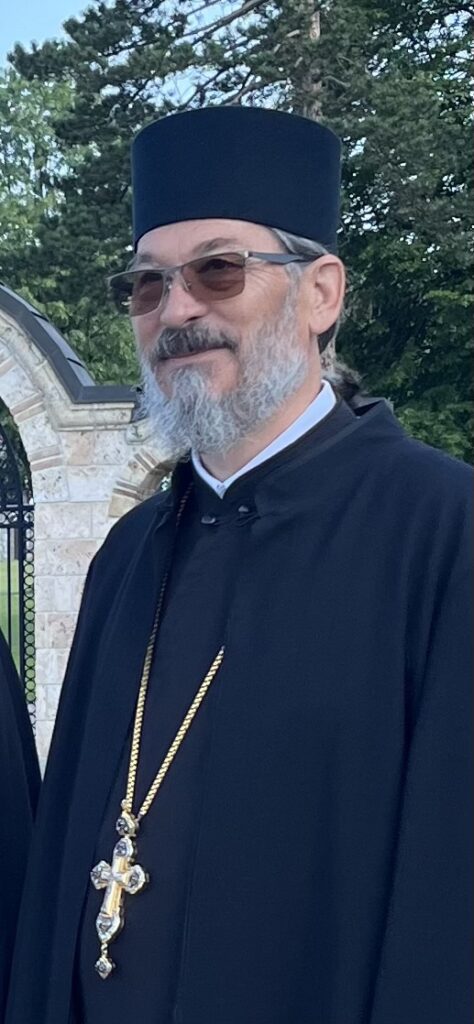
Lazar Katić
Student of the St. Sava Orthodox Theological Seminary