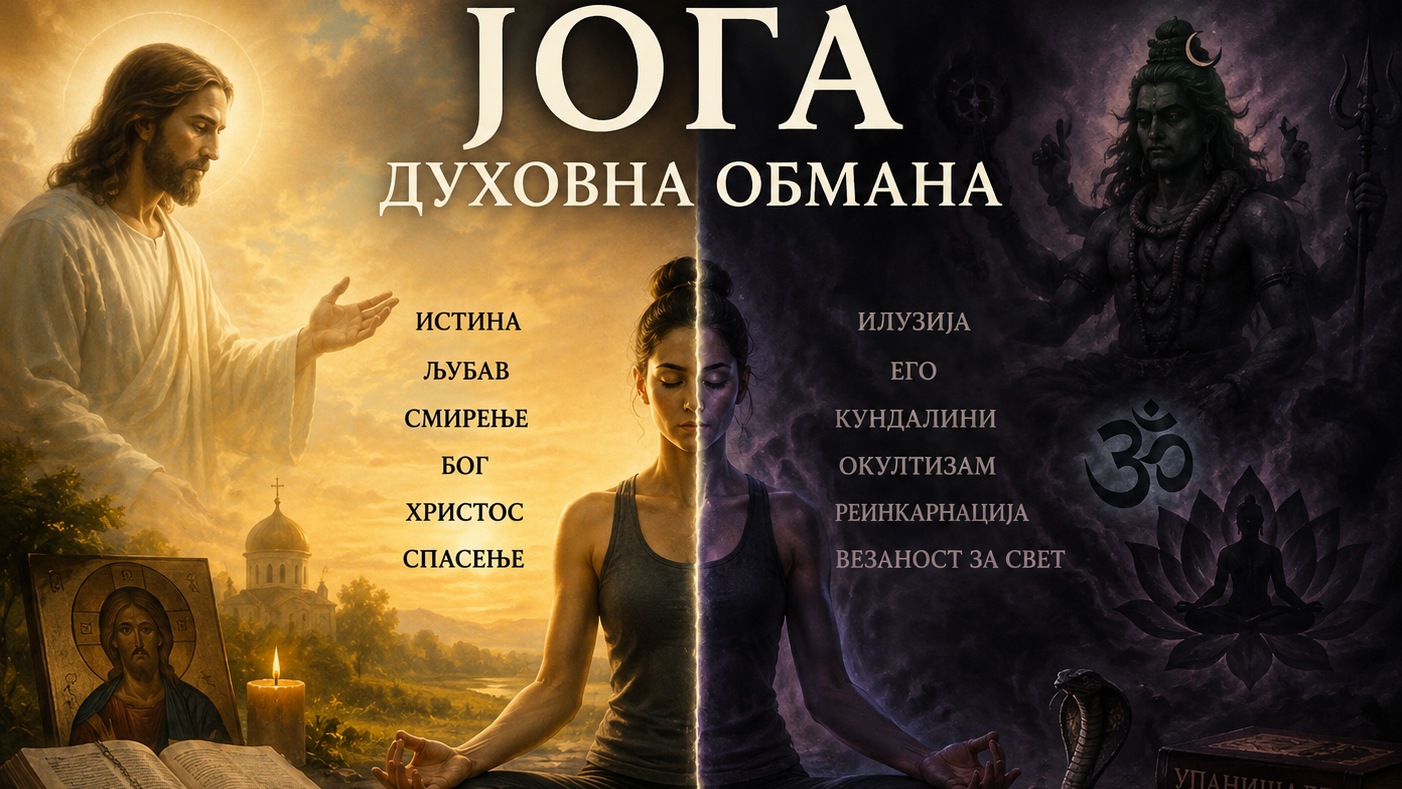
In contemporary society, many of our fellow citizens of the Orthodox Christian faith are living under the illusion that it is possible to lead a Christian life while simultaneously practicing yoga—that is, performing only the physical exercises without the repetition of mantras (short prayers that are repeatedly recited in order to supposedly attain purity of mind and spiritual enlightenment). In doing so, they fall into a serious spiritual deception. Regrettably, this occurs despite the official warnings issued by Local Orthodox Churches (such as the Holy Synod of the Church of Greece, which cautioned the faithful in its Encyclical of June 16, 2015), stating that the practice of yoga is incompatible with Orthodox Christianity and has no place whatsoever in the life of a Christian. Nevertheless, many continue to practice yoga, convinced that the Church is insufficiently informed and that they possess greater insight than the official scholarly commissions of the Orthodox Church dedicated to the study of cults and sects. Through such distrust of the Church, they become easy prey to foreign religious teachings, among which yoga occupies a prominent place, being an inseparable spiritual component of both Hinduism and Buddhism.
Hinduism itself is a religious-philosophical construct that expresses its religious worldview through numerous deities, the best known of which are the guna avatars and the Trimurti, that is, the triad of deities consisting of Shiva, Vishnu, and Brahma. It is certainly not accidental that these three deities are represented as one god, for the one who inspired such a conception (the demon) knows full well that the true God is the Holy Trinity; consequently, he fashioned a false, pagan image of a triune deity among the Hindu peoples. Within Hinduism, Brahma is regarded as the supreme deity and creator; Shiva was originally the deity of fire, who both gives life to and destroys the universe, and is at times depicted as male and at other times as female, with two faces symbolizing fertility and mercy; Vishnu is believed to govern human destiny and is manifested through his ten avatars, or incarnations, the most famous of which are Rama, Krishna, and Buddha.
Buddha (literally, “the Awakened One”), Siddhartha Gautama, who was of Indian origin, is regarded by Hindus as the Avatar, or ninth incarnation, of the god Vishnu. Theravāda Buddhism, however, does not accept this understanding, considering him instead to be the last in the succession of twenty-eight Buddhas. The central teaching of the Buddha concerns karma, namely, that humanity is bound to the cycle of good and evil deeds and that, through reincarnation, every individual bears the consequences of his or her previous existence. Liberation from the external world is understood as a gradual immersion of the mind into the inner world, culminating in the union of the individual consciousness with the Ātman and, through it, with Brahman, the supreme divine reality. This very process of progressive withdrawal from the external world and union with Brahman constitutes the spiritual dimension of yoga.
The Buddha’s teaching on liberation from suffering is centred upon the attainment of Nirvana, a supposedly blissful state achieved through complete emancipation from all earthly afflictions, above all suffering and pain, by extinguishing desire, which is regarded as the driving force behind the operation of karma. This goal is pursued through the so-called Noble Eightfold Path, which consists of right view, right intention, right speech, right action, right livelihood, right effort, right mindfulness, and right concentration. Through this process, one is said to enter a state that is neither being nor non-being, neither being-nor-non-being, and finally neither neither-being nor neither-non-being—that is, Nirvana.
Without yoga, the essence of Hinduism and Buddhism would amount to little more than abstract philosophy or purely theoretical systems of belief. Yoga is generally divided into classical (Aṣṭāṅga) Hindu yoga and Buddhist yoga. The best-known form of Hindu yoga is Rāja Yoga, which is regarded as the path through which one acquires mastery over the processes of the mind in order to attain higher levels of consciousness. Also well known is Bhakti Yoga, the path of loving devotion to a personal deity. Karma Yoga is the yoga of action, Jñāna Yoga is the yoga of knowledge, and Tantra Yoga incorporates sexual rituals. Finally, there is Hatha Yoga, now widespread throughout the world, which, through its system of gymnastic exercises, deceives many people—including some Orthodox Christians—by offering the illusion of physical and mental well-being.
Buddhist yoga gradually developed into various traditions corresponding to the principal schools of Buddhism, namely Theravāda, Mahāyāna, and the Tibetan Buddhist system of yoga.
Throughout the world, including the Balkans, the most widely practiced form is Hatha Yoga, which is commonly presented merely as a system of physical exercise and relaxation, under the misleading claim that it has no religious character whatsoever. Hatha Yoga is practiced through bodily postures known as *āsanas*, accompanied by breathing techniques (*prāṇāyāma*). In addition, Hatha Yoga includes various purification practices, such as cleansing the esophagus and stomach, intestinal cleansing, sinus purification, abdominal muscle rotations, and concentration upon a fixed point or the flame of a candle, all of which are intended to cultivate focused attention through meditation.
According to Hindu teaching, Hatha Yoga represents the balance between positive and negative energy. The syllable *ha*, in Sanskrit, signifies the Sun and thus symbolizes positive energy and the masculine principle, whereas *tha* signifies the Moon, representing negative energy and the feminine principle. Hatha Yoga is therefore understood as the harmonious union of opposites—positive and negative, light and darkness, activity and passivity. These opposing forces are believed to unite within the human body through the vital energy known as *prāṇa*. *Prāṇa* is said to flow throughout the body, activating the energy centres known as chakras. The channels through which this vital energy flows are called *nāḍīs*, and it is within the central *nāḍī*, known as *Suṣumṇā*, that these opposing principles—*ha* (positive) and *tha* (negative)—are united. According to this teaching, such union is achieved through the exercise of the human will.
In every form of yoga, including Hatha Yoga, all bodily postures (*āsanas*) are dedicated to particular Hindu deities. Consequently, according to this understanding, every yogic posture constitutes an act of communion with one of the Hindu gods (or, from the Orthodox Christian perspective, demons). It should therefore be emphasized that just as mantras are not merely empty words, so *āsanas* are not spiritually neutral bodily postures within Hinduism. In this regard, the Orthodox publicist Vladimir Dimitrijević writes that “yoga is a religious practice whose goal is the union of the human spirit with Brahman, the supreme Hindu principle, the Absolute. The aim of yoga is to produce an altered state of consciousness that unites male and female, light and darkness, good and evil, gods and human beings.” Dr. Ed Hird likewise observes concerning the supposedly “harmless” and “purely physical” Hatha Yoga that it “systematically works to alter biochemical functions, including hormones and the endocrine system. The so-called physical activity of Hatha Yoga is intended to produce altered states of consciousness while simultaneously eliminating the distinction between the subject (the self) and the object. Yoga is the primary technique used by yogis in their attempt to become gods. Through the chanting of mantras and the practice of *āsanas*, the mind experiences both sensory exhaustion and overload, resulting in a ‘closing off’ of the mind.” Similarly, the Orthodox author Janja Todorović states: “The initial and lowest stage encountered by practitioners of yoga, commonly known as Hatha Yoga, presents itself as a simple system of physical exercises with an apparently straightforward objective: good psychophysical health, a well-shaped body, physical fitness, and overall well-being, all of which are generally attained through prolonged practice. Those who are unfamiliar with the true nature and purpose of yoga readily accept this attractive Eastern discipline as little more than a form of aerobics or gymnastics. They fail to realize that the essence and purpose of yoga is the acceptance of the polytheistic cults of the East, which are subtly introduced under the guise of a scientific approach to the mystery of human nature.”
Thus, dear brothers and sisters, we arrive at the conclusion that, in practice, it is impossible to reconcile the Orthodox Christian faith with any form of yoga, including Hatha Yoga. By engaging in these practices, whether consciously or unconsciously, we participate with our bodies in idolatry, rendering homage to false gods—that is, to the demons associated with Hinduism and Buddhism. Our bodies, however, are called above all to be temples of the Holy Spirit, as the Holy Apostle Paul teaches in his First Epistle to the Corinthians, rather than being conformed to the distorted and demonized images of Brahma with his four heads, Vishnu with his incarnations, Shiva with his many arms, or Buddha absorbed into non-being, that is, Nirvana.
Most tragic of all is the fact that Orthodox Christians who experience physical ailments—whether due to the nature of their work, illness, or old age—often do not first consult their spiritual fathers to learn the Orthodox Church’s teaching concerning yoga. Instead, they determine for themselves what they believe to be beneficial, influenced by the advertising of various yoga and personal development centres or by invitations from yoga studios encouraging them to practice yoga, breathe properly, and relax. It is as though we have forgotten that we are capable of breathing and finding genuine rest without yoga.
The Holy Fathers of the Church lived—and continue to live, in the witness of the saints—to an advanced age, employing as their foremost means of inner repose the Jesus Prayer (“Lord Jesus Christ, have mercy on me, a sinner”), participating actively in the Holy Mysteries (Sacraments) of the Church, and practicing moderation in their diet, thereby preserving their bodily health and avoiding the accumulation of excess bodily fat. In this regard, the Church’s annual cycle of fasting has played a particularly significant role, as ordained by the Church herself. Orthodox Christians also preserve the health of their bodies through the practice of metanias (full prostrations). Saint Porphyrios taught that these constitute the most complete form of bodily exercise, engaging the entire body, although they are neither performed for that purpose nor should they ever be understood in merely physical terms. Furthermore, one may also consider the healing mineral spas with which God has blessed Serbia, as well as the beautiful seas throughout the world, likewise bestowed by God for the renewal and restoration of the human body.
Therefore, dear brothers and sisters, let us first seek spiritual guidance from our priests concerning yoga and every other contemporary method of bodily renewal (such as Hatha Yoga or Tai Chi Chuan), as well as modern forms of esotericism and exotericism (such as the practices of Feng Shui or Reiki therapy), all of which claim to free us from stress while in reality offering only a false sense of inner peace. There can be no true peace apart from the Prince of Peace—the Lord Jesus Christ. A single humble act—seeking counsel from our spiritual fathers—will bring to our souls the genuine peace bestowed by the grace of the Holy Spirit, while medical professionals can advise us regarding what is truly beneficial for our physical health. In this way we shall be protected from the many spiritual wolves whose aim is to destroy us spiritually and psychologically while impoverishing us materially through their yoga studios and Reiki centers.
May the grace of the Holy Spirit preserve and protect us all from every ancient and modern sect, from yoga gurus, from various practitioners of so-called bioenergy, and from all those who seek to lead us away from the path of salvation found in our Orthodox Christian faith.
Archimandrite Eusebius Meandjia