

“Tongues shall cease, knowledge shall pass away.” (1 Cor. 13:8)
“I am the light of the world.” (Jn. 8:12)
Light and knowledge stand in an intriguing relationship, both in contemporary cosmology (science) and in Christian theology. In the contemporary cosmological model of the Big Bang, in a strictly empirical sense, light represents the first directly observable reality. This, of course, does not mean that light is also the first reality in the ontological sense, nor that nothing exists prior to it. Rather, light is the first bearer of observability, that is, of what in science we call knowledge. In the biblical account of creation, light is, so to speak, the first definable reality—known to us even today precisely as light. “And God said: Let there be light. And there was light” (Gen. 1:3). Interestingly, even in the biblical account, this does not imply that light is the first created reality in the ontological sense. For it is preceded by: “In the beginning God created the heavens and the earth. And the earth was without form, and void; and darkness was upon the face of the deep…” (Gen. 1:1–2). The formless and void earth (Heb. tohu va-bohu) represents something that is impossible to describe, something akin to the primordial chaos of ancient Greek thought. For how can one describe that which is without form, when description itself is a mental shaping of reality, a conceptualization—in other words, knowledge? Thus, even according to the biblical account of creation, we could say that light is the first observable reality. The line that separates the observable from that which, though existing, is not observable, is referred to in science as the Planck era. Light, therefore, lies beyond the Planck era. In the first chapter of Genesis, if we were to metaphorically call it a theological “Planck era,” it would constitute the boundary between the second and the third verse.
In contemporary cosmology, light continues to represent the fundamental carrier of information about the observable cosmos. The interpretation of this information is what in science we call knowledge. Information about the cosmos reaches us through photons—light that arrives from observed objects and carries a record of their nature. The speed of light is the greatest possible speed in the cosmos and amounts to approximately 300,000 kilometers per second. Given the unimaginably vast expanse of the cosmos, distances are measured in light-years—the distance that light travels in one year at the aforementioned speed. The calculation is as follows: one year has 365 days; one day 24 hours; one hour 60 minutes; and one minute 60 seconds. If we calculate how many seconds there are in a year and multiply that number by 300,000, we obtain the distance of one light-year in kilometers. The number is enormous—and that is only one light-year. If we say that the nearest star to us outside the Solar System, Proxima Centauri, is 4.24 light-years away, which is about 40 trillion kilometers, or 40 thousand billion kilometers, then we begin to grasp the vastness of the cosmos. The probe Voyager 1, launched from Earth back in 1977 and still travelling at a speed of about 17 kilometers per second, has covered only the distance of a single light-day. To reach the aforementioned Proxima Centauri, it would require another 70 to 80 thousand years—to the nearest star! Our galaxy, the Milky Way, is also unimaginably vast. Its diameter is about 120 thousand light-years—which means that light takes 120 thousand years to travel from one end of the galaxy to the other, at a speed of 300,000 kilometers per second. And our galaxy is but a drop in the ocean of cosmic infinity. The nearest galaxy to us, Andromeda, with which we are in gravitational interaction, is 2.5 million light-years away. Our galaxy and Andromeda, due to this gravitational interaction, are moving towards one another, and according to scientific estimates, it is possible that they will collide in about 4–5 billion years. If such a collision occurs, it is most likely that stars and planets will not collide—because the distances between them will remain immense even after the possible merging of the two galaxies into one.
From what has been said, one important fact should be singled out. When observing objects in the cosmos around us, we are in fact observing the light that has reached us from them. Given their distance and the speed of light, we are always looking into the past. For example, if our Sun were to disappear at this very moment, we would notice it only after about eight minutes—because that is how long it takes for light to travel from the Sun to the Earth. If Andromeda were to disappear, we would learn of it only after 2.5 million years. If we had sufficiently powerful telescopes to clearly observe stars and planets in the Andromeda galaxy, we would see them as they appeared 2.5 million years ago—that is, at the moment when their light began its journey towards us. If, at this moment, we were observing our planet from the Andromeda galaxy, we would see Earth without human beings; and from a more distant galaxy, located 60+ million light-years away, we would see dinosaurs on Earth. Thus, our knowledge is, conditionally speaking, the light that has reached us, and as such it is always a nearer or more distant past of what we observe. Some stars that we observe may no longer exist, yet we still see them shining in the sky. When the moment of their “extinguishing” reaches us—that is, when the cessation of light emission from a distant star reaches us—that will also mark the end of our knowledge of it. Yet, paradoxically, we will continue to know it as “alive” long after its “death.”
Knowledge, therefore, is borne by the light that reaches us. It travels towards us. Yet, although it is directed towards us, it is also departing from us, and the moment will come when it will depart forever—knowledge will cease forever. Namely, it is a fact that the cosmos is expanding—space itself is expanding. Therefore, distant galaxies are moving away from us—because the space between us is stretching, expanding. This expansion of space occurs at a speed greater than the speed of light. This is not in contradiction with what we have said about the speed of light as the greatest possible speed in the cosmos. For here we are not speaking about the movement of anything within the cosmos, but about the stretching and expansion of space itself. This expansion of space is faster than light. For this reason, cosmology speaks of a cosmic horizon. This is the boundary of the observable cosmos, and today its diameter is about 92 billion light-years. Beyond that horizon there exists cosmos, but it is inaccessible to our observation because the light from stars beyond the cosmic horizon can never reach us—since the speed of the expansion of space, which continuously increases the distance between us and those stars, surpasses it. Simply put, space—and thus the distance between the observer and the observed—expands faster than light travels through that same space. If we imagine space as a very long moving belt, and light as ourselves running upon it, the analogy would be as follows. We set out on the moving belt from point A towards point B, but the belt moves in the opposite direction much faster than we run. Therefore, point B, although we are running towards it, becomes ever more distant and unreachable. As the cosmos continues to expand, distant galaxies that we can now observe will pass beyond the cosmic horizon. This means that we will never see them again, because the light travelling from them towards us will lose the race with the expansion of space—that is, with the increasing distance between them and us as observers. In some distant future, present-day cosmology, including observable knowledge of the Big Bang, will no longer be possible, because everything will pass beyond the cosmic horizon, that is, beyond the boundary of the observable cosmos—everything except our smaller local galactic group, which is bound by stronger gravitational interactions.
Here we might say that the prophetic words of the Apostle Paul—that knowledge will cease—appear as if “scientifically confirmed.” Of course, not in a literal sense. For the Apostle Paul does not speak of the cessation of knowledge in terms of scientific cosmology, but in terms of mediated knowledge of God. All that constituted mediated knowledge of God—including, certainly, natural theology—will cease in the eschatological dimension, when only, as the Apostle further says, love will remain—as the fullness of the knowledge of God and the vision face to face: “For now we see through a glass, darkly; but then face to face” (1 Cor. 13:12). Thus, these words of the Apostle Paul refer to the knowledge of God, not to scientific knowledge. Yet these words are so powerful, so potent, that they can meaningfully describe even the aforementioned facts of scientific cosmology—especially if we bear in mind that cosmology itself may be viewed from the perspective of natural theology: “The heavens declare the glory of God; and the firmament shows His handiwork” (Ps. 19:1). Scientific knowledge, insofar as cosmology is concerned—that knowledge which we possess today—will indeed cease when space forever separates from us the bearer of information upon which we have based our scientific knowledge—light. And when such knowledge ceases, then tongues will indeed fall silent—for we will no longer have information about which to speak. Created light, although the fastest runner in the cosmos, loses the race with the faster “belt” of space through which it runs—for in the direction towards us, that light “runs” opposite to the movement of space. Thus, although it moves towards us, it departs from us forever. Truly, knowledge will cease, and the tongues of knowledge will fall silent.
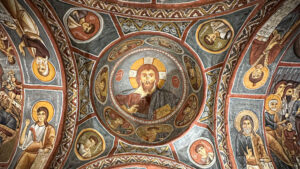
A saying is often attributed to Saint Symeon the New Theologian: “Knowledge is not light, but light is knowledge.” As far as I know, Saint Symeon did not write it in this exact form, but it is at least a paraphrase of his teaching on the knowledge of God and the uncreated Light. The saint taught that intellectual, theoretical theological knowledge of God cannot truly illumine God—in this sense, knowledge is not light. True knowledge of God is participation in and experience of the uncreated divine Light, the Taboric Light, which was beheld by the three apostles (cf. Mt. 17:1–9; Mk. 9:2–9; Lk. 9:28–36). In this sense, light is knowledge. The Lord Himself says: “I am the light of the world; he who follows Me shall not walk in darkness, but shall have the light of life” (Jn. 8:12). This uncreated Light is true knowledge, and it does not depart from us, but comes towards us: “Yes, I am coming quickly” (Rev. 22:20).
This parallel between light as knowledge in science and in theology is, therefore, striking. These are indeed two lights—the created and the uncreated. The first, created light, departs from us—and in that sense knowledge will indeed cease. The second, uncreated light, comes towards us and is already here. It is, of course, above all the knowledge of God. Yet I would venture to say that it will also be the final knowledge of that which we now know only partially through created light. In this sense I would interpret the Psalm: “In Your light we see light” (Ps. 36:9). In the light of the knowledge of God, in the uncreated light which comes towards us and is already present, we shall finally know even that which we now know partially through created light, which departs from us. I believe this is also the meaning of the words of Saint Maximus the Confessor, who, speaking of the eschaton, says:
“For then, as it seems to me, having come to know the essential existence of beings—that is, what they are, and how and from whom they exist—we shall no longer move voluntarily towards anything in order to know it, since our knowledge of everything that is after God [that is, of the created cosmos] will already have been brought to completion; and the only thing that awaits us, in accordance with each of us, is participation in the infinite, divine, and incomprehensible knowledge in which we shall share.” (Ambigua, 2)
Presbyter Dr Aleksandar Milojkov
PHOTOGRAPHY: pixabay