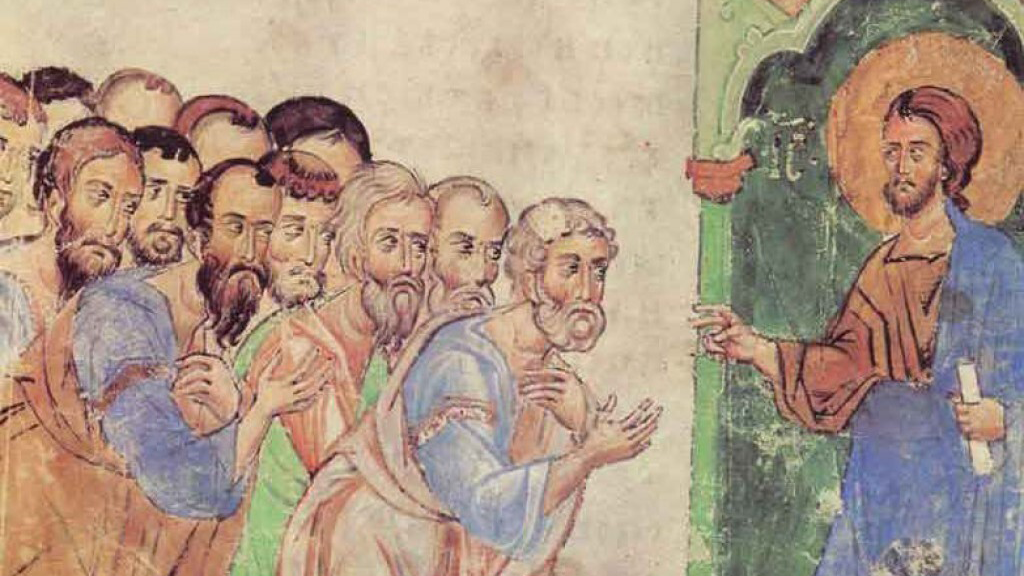
We begin the sermon with the 34th verse:
You brood of vipers, how can you speak good when you are evil? For out of the abundance of the heart the mouth speaks.
Saint Chrysostom shows that it is completely futile to rely on the piety of ancestors if there is no sincere intention to live in God, but also an important spiritual criterion that we can use in assessing the spiritual state of a person we are in contact with: “He calls them a brood of vipers because they boasted of their ancestors. So, to show that they gain no benefit from this, Jesus cuts them off from kinship with Abraham and gives them other ancestors who had the same nature as they did; in this way, he deprives them of the lineage they were proud of. Jesus speaks from the abundance of the heart; the mouth speaks. Here again, His Divinity, which sees hidden thoughts, is revealed, and He also shows that the Pharisees will be punished not only for their deeds but also for their evil thoughts; He also shows that He, as God, knows these thoughts. However, men can also know them. Naturally, words pour out through the mouth when the inner self is overflowing with evil. Therefore, when you hear a man uttering evil words, do not think that there is as much evil in him as is shown in his words, but understand that his source is much more abundant, for what is expressed outwardly is only the excess of what is within. Do you see what a powerful blow Christ strikes against the Pharisees? If their words are so full of evil and come from a devilish spirit, imagine what the root and source of these words are. It often happens that the tongue, held back by shame, does not yet pour out all the evil in words; on the contrary, a heart that has no one among men to witness its movements fearlessly conceives within itself every evil it desires, for such a heart does not think much about God. Words are proposed to all by hearing and judged by all, while the heart hides in the shadows. Therefore, there is less evil on the tongue and more in the heart. However, when too much evil accumulates inside, then that which had been hidden until then comes out with great force. And just as a person who is nauseous at first tries to hold back the liquid they are going to vomit, and then when they no longer have the strength to control themselves, they expel it in large quantities, so too do those who are filled with evil thoughts finally expel it all in the form of malicious judgment of their neighbor.”
Saint John of Kronstadt points out that this accumulation of evil does not happen only to others, but very often to ourselves as well. He here also gives advice on how to turn this sad reality of our spiritual lives to our own benefit: “If at times a special attack of malice arises in us and we begin to hate everyone, let us not be surprised by it; it is blind pride that considers itself good. Let us humbly acknowledge that we are indeed such and turn it into an occasion for humility; for it is a special grace, the grace of God toward us, when we are truly good to others, when we are truly benevolent. More often we say to the Lord: Lord! You came into the world to save sinners, of whom I am the first (1 Tim. 1:15): save me from the evil that lurks within me. I can do nothing without You (John 15:5), and not only can I do nothing good without You, I cannot of myself have good thoughts, a good and holy feeling. Help me, Lord!” Therefore, when we see that we have stumbled, that evil has accumulated within us, we should not persist in sin and justify ourselves, but rather turn to God in prayer and seek forgiveness and help from Him.
The next three verses:
A good man brings good things out of the good stored up in him, and an evil man brings evil things out of the evil stored up in him. But I tell you that people will have to give account on the day of judgment for every careless word they say. For by your words you will be acquitted, and by your words you will be condemned.
Saint John Chrysostom shows that this spiritual law also applies to people who strive in virtue. He also explains what a barren word means: “Do not think,” says the Saviour, “that this happens only to evil people; on the contrary, the same thing happens to the good as well. And with them, more virtue is hidden on the inside than appears on the outside in their words. Through this, the Lord showed that just as the Pharisees should be considered more evil than they appear in their words, so too is He Himself much more benevolent than what is revealed from His words. By the word treasury, Jesus means a multitude. He then again instills great fear in them. “Do not think,” says Christ, “that this is all there is to it—that evil words are subject only to human judgment.” No, all such will be punished by the ultimate condemnation at the Last Judgment. He did not address them with ‘you’ here, partly to convey this teaching to all people, and partly so as not to utter an overly harsh and bitter word. And I tell you, that for every idle word they speak, people will give an account on the Day of Judgment. A vain word is a word that is not in accordance with action, then a false word, a word that reeks of slander, and also, as some explain it, a frivolous word, for example, a word that provokes improper laughter, a shameful, shameless, indecent word. For by your words you will be justified and by your words you will be condemned. Do you see how harmless the judgment is? How gentle are the demands of answering it? Not by the words of another, but by your own words will the Judge render his verdict. What could be more just than this? For it is in your power both to speak and to remain silent. Therefore, it is not those who are slandered who should fear and tremble, but those who do the slandering, for the slandered will not be justified because of the slanders spread about them. The slanderers will be held accountable for speaking evil of others. All the suffering will fall upon them.” Therefore, the Lord Himself has set up the Last Judgment in such a way that no one else will be responsible for our triumph or defeat at it.
Blessed Jerome explains in detail the gravity of the idle word of which Christ speaks: “An idle word is a word spoken not for the benefit of the one who speaks and the one who listens; it is a word when we, leaving aside important matters, speak of frivolous things and tell ancient fables. … a man who is given to jokes and incites others to laughter, who utters something shameful, is guilty not of a vain, but of a sinful word.” Saint John of Kronstadt writes the following on this verse: “It is worthy and just: for this entire present life should be used for the preparation of the future life; for us there is no idle day, nor hour, nor word or deed; with us, everything should be directed towards the same goal. We have no time for idle talk.”
We can also quote the words of the holy Symeon the New Theologian: “The Lord did not say that it proceeds from a good heart, but from a good treasure, so that you might understand from this that none of us can have an empty heart, but that each of us has in his heart one of these two: or the grace of the Holy Spirit through faith and good deeds, or the wicked devil because of unbelief, slothfulness towards the commandments of God, and the commission of evil deeds. Lest it be thought that the Lord is speaking of those who keep only some of God’s commandments, and not all of them with precision, having the treasury of the Holy Spirit, Jesus says elsewhere: ‘Whoever has My commandments and observes them is the one who loves Me;’ and he who loves Me will be loved by My Father; and I will love him and will reveal Myself to him. And He also added: ‘If anyone loves Me, he will keep My word, and My Father will love him, and We will come to him and make Our home with him’ (John 14:21, 23). Do you see how the man who has acquired a good heart through effort and the keeping of the commandments has within himself the entire Godhead, which represents a good treasure?” Therefore, we see that we are asked to have devotion to the Lord, but in return, we receive a hundredfold more.
Verses 38 and 39:
Then some of the scribes and Pharisees answered, saying, “Teacher, we want to see a sign from you.” But He answered them, “An evil and adulterous generation seeks a sign; and a sign will not be given to it except the sign of Jonah the prophet.”
Saint John Chrysostom, in his commentary, shows the persistent opposition of the Pharisees and their great cunning. Likewise, he shows why Christ answers them so strictly: “Can there be anything more senseless, not to say godless, than these words? After so many signs, the Pharisees speak as if none of them had ever happened: ‘We want a sign from You to see!’ Why do they say this? To trap Jesus again. Since He had already so many times silenced them with His words and restrained their shameless tongue, they again turn to His deeds. Marvelling at this, the evangelist again repeats the words—then. Then some of the scribes answered… we want a sign. Then. When was that? When they should have bowed their heads, when they should have been filled with wonder, when there was nothing left to do but be amazed and withdraw. And yet the Pharisees do not give up their cunning even then. And see how their words are filled with flattery and pretence. They hoped to ensnare Jesus in their nets with this. Just moments before they had insulted Him, and now they flatter Him; just moments before they had called Jesus possessed, and now they extol Him as a Teacher. However, they speak both with malicious intent, even though their words are completely contradictory. This is why the Saviour now reproves them very strictly. When they asked Him rude questions and insulted Him, Jesus answered them meekly; but when they began to flatter Him, He addresses them very strictly and utters reproachful words against them, thereby showing that He is above both passions. And just as they could not anger Him then, so now they cannot soften Him with their flattery. Delve now into the character of Jesus’ rebukes: in them you will not see insults, but the exposure of Pharisaical wickedness. What does Christ say? A wicked and adulterous generation seeks a sign. The meaning of these words is as follows: what is so wonderful if you act this way towards Me, whom you do not yet know, when you have acted in the same way towards My Father, whose power you have seen so many times? How many times have you forsaken My Father and fled to demons, drawing to yourselves these evil allies, for which the prophet Ezekiel has also reproved you many times! By saying this, the Saviour was indicating that He was of one mind with the Father, while the Pharisees were acting just as they had before; along with this, He was revealing their hidden thoughts and showing that they were asking for a sign from Him hypocritically and as enemies.
That is why He calls them a wicked generation, because they have always been ungrateful to their benefactors; receiving kindness, they became even worse—all of which serves as a sign of extreme wickedness. Jesus called them a adulterous generation, pointing to both their past and present unbelief, and then He showed a new confirmation of the fact that He is equal to the Father—since it is precisely unbelief in Jesus that makes a man an adulterer. After rebuking them, what does Jesus say next? No sign will be given to them except the sign of the prophet Jonah. Here, Jesus begins to speak of His resurrection and, as a confirmation of this, points to a foreshadowing. What, you might ask, was no other sign given to the Pharisees? It was not given when they asked for it. The Saviour knew of their blindness, so He performed miracles not to convince them, but to correct other people. And in this sense, these words can be understood.
Or in them, you can see the meaning that the Pharisees will no longer receive a sign like the one mentioned. The sign was given to them when they recognized the power of the Lord in their own punishment. Therefore, Jesus here covertly points to that future punishment and, threatening them, as if to say: I have done a thousand good deeds for you, but not one of them has drawn you to Me, and you have not been willing to pay homage to My power. Therefore, you will know My power from the opposite: when you see your city destroyed to its foundations, when you see its walls in ruins and the temple turned into rubble, when you are deprived of your former freedom and way of life, and when you wander again everywhere, as refugees and homeless. All this was fulfilled after the Passion on the Cross. This is what will be sent to you instead of great signs!”
Adapted and for the contemporary reader from the patristic interpretations by: Stanje Stanković