We begin the patristic interpretation of chapter 12 of the Gospel according to Matthew.
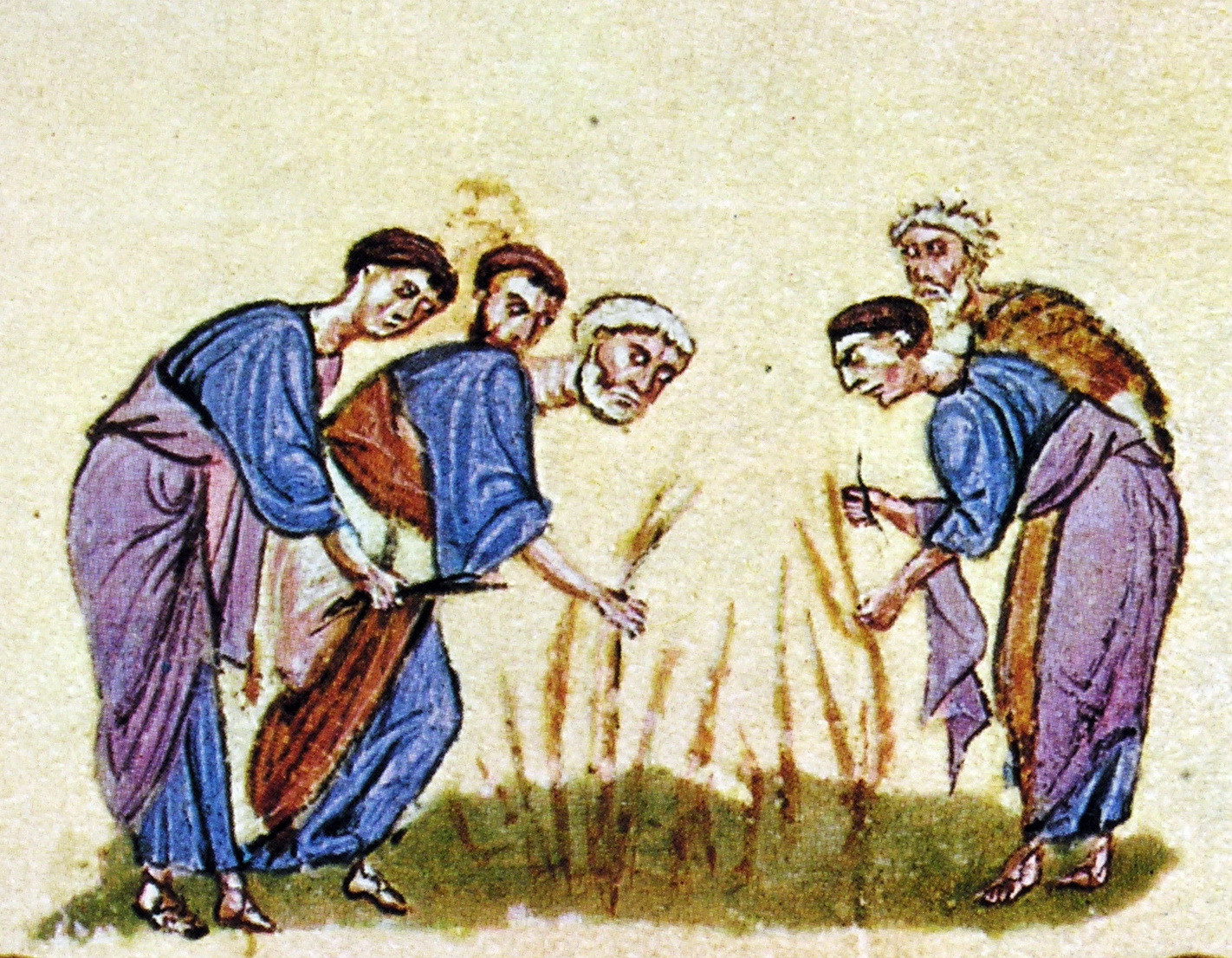
At that time Jesus went through the grainfields on the Sabbath; and His disciples were hungry and began to pluck heads of grain and to eat. But when the Pharisees saw it, they said to Him, “Look, Your disciples are doing what is not lawful to do on the Sabbath.”
Saint John Chrysostom here explains not only the action of the Lord Jesus Christ—why He allowed this to take place on the Sabbath—but also the virtue of the disciples themselves. These are his words: “Why did Jesus, foreseeing everything, lead them there, if not because He wished to abolish the Sabbath? He wished this, but not simply and without purpose. For Christ never violates the Sabbath without reason; rather, He uses appropriate occasions to do so, in order thus to bring the Law to an end without offending the Jews. Yet there are also cases in which Jesus violates the Sabbath independently of circumstances: when He anoints the eyes of the blind man with clay, and when He says, My Father is working until now, and I am working (John 5:17). In the latter case, Jesus acts in this way to glorify the Father; in the former, to instruct the weak Jews. Thus He acts here as well, accommodating Himself to the needs of nature. Obvious sins are in no way to be defended. Thus neither can a murderer cite anger as his justification, nor an adulterer lust, nor any other such cause. Here the Saviour, showing hunger as a justification, freed the disciples from every accusation. But rather admire the disciples, who were so restrained that they did not concern themselves at all with bodily matters, but had their bodily sustenance as they passed by. Though they were continually afflicted by hunger, they did not depart from Christ. For had they not been compelled by severe hunger, they would not have acted thus. And what do the Pharisees do? When the Pharisees saw it, they said to Him, ‘Look, Your disciples are doing what is not lawful to do on the Sabbath.’ Here they are not excessively strict. Although they could be, they do not become greatly enraged, but merely accuse. When the Lord commanded a man to stretch out his withered hand and healed him, then they were so enraged that they even took counsel to destroy Him. Where nothing great or glorious occurs, the Pharisees remain silent; but where they see someone’s salvation, they become harsh, disturbed, and fall into utter madness. So incapable are they of enduring the salvation of men!”
Saint Hilary of Poitiers provides a temporal framework for when this event occurred and also offers an allegorical interpretation of the circumstances themselves. He writes: “First it should be said that these verses begin thus: At that time Jesus went through the grainfields—that is, at the time when He was giving thanks to God the Father for the salvation of the people. Let us look further. The field is this world; the Sabbath is rest; the sown grainfields signify the harvest among those who will believe. It follows that the Lord, going into the field on the Sabbath, at the time of rest according to the Old Testament Law, came into this world. He beholds this sown field, that is, the crop of the human race. And since hunger represents the intense desire for the salvation of the human race, the disciples hasten to pluck and tear the heads of grain, that is, to be nourished by the salvation of the saints. For it is not fitting for man to feed on raw ears of grain, nor is it beneficial for him to eat plucked stalks; therefore this image points to faith in future realities. The power of the word hidden within it reveals the mystery both of hunger and of satisfaction.”
Blessed Jerome also draws attention to the disciples themselves, to details that reveal their virtue: “In the accounts of the other Evangelists we read that they felt hunger as men, for because of extreme hardship they had no time to take food. The fact that they plucked the ears of grain with their own hands in order to relieve their hunger indicates the austerity of their manner of life. They do not seek flour already prepared, but simply the wheat grain itself.”
The third and fourth verses:
But He said to them, ‘Have you not read what David did when he was hungry, he and those who were with him? How he entered the house of God and ate the bread of the Presence, which it was not lawful for him or for those who were with him to eat, but only for the priests?’
Blessed Theophylact exposes the hypocrisy of the Pharisees and also explains what is meant by the “bread of the Presence”: “The Pharisees once again find fault with a natural need for food, while they themselves live in far graver sins. The Lord puts them to shame by recalling David, who, he says, dared because of hunger to commit an even more serious transgression. The bread of the Presence consisted of twelve loaves that were placed each day on the table in the Temple, six on the right side and six on the left.”
Chrysostom explains why the Lord mentions David and with what purpose He cites this event described in the First Book of the Prophet Samuel: “When Jesus defends the disciples, He presents David as an example; but when He speaks of Himself, He presents the Father. And observe how powerfully He does this: Have you not read what David did? This prophet is exceedingly renowned. Therefore Peter later, defending himself before the Jews, said: Let me speak freely to you of the patriarch David, that he both died… (Acts 2:29). Had the Pharisees possessed good intentions, Jesus would have pointed them to the hunger that afflicted the disciples; but since they were impious and cruel, the Lord instead reminds them of a historical event.” Here Chrysostom also draws attention to another detail and provides an elevated apologetic response concerning this episode: “Mark says that this occurred in the time of the high priest Abiathar, and this does not contradict history, but simply shows that the high priest had two names, adding that it was he who gave David the bread of the Presence.” Chrysostom’s explanation serves as an excellent answer to arguments raised against the Gospel, among which is this very issue concerning the name of the high priest; Muslims even compile collections of such examples, emphasizing such details and presenting them as errors of Holy Scripture. Chrysostom continues: “Moreover, by this he shows what a great justification David had, if even the priest himself permitted it—and not only permitted it, but acted accordingly in that case. Do not tell me that David was a prophet. This did not grant him the right to eat, for only priests were permitted to do so; therefore it is written: but only for the priests. Even if David was a most glorious prophet, he was not a priest. And if he was a prophet, the men who were with him were not. Thus the Lord especially defended His disciples against the Pharisaic reproaches by presenting the example of a prophet greater than they, who did the very same thing.”
The Next Three Verses:
Or have you not read in the Law how on the Sabbath the priests in the temple profane the Sabbath and are guiltless? But I say to you that something greater than the temple is here. And if you had known what this means, “I desire mercy and not sacrifice,” you would not have condemned the innocent.
Saint Isidore of Pelusium explains what the Old Testament priests did on the Sabbath in the following way: “On the Sabbath every kind of work is forbidden, and yet they cut wood, kindle fire, and divide the sacrifice into parts. All of this, as work that is customary in ordinary life, is not permitted; but as something necessary for the offering of sacrifice it is not forbidden, but is even prescribed by the Law itself. From this it follows that the Sabbath is violated by action, yet the priests are guiltless, because their actions have a particular purpose.”
Saint John Chrysostom, in his interpretation, precisely reveals the Lord’s wisdom: by justifying the actions of the Old Testament priests who violated the Sabbath, He simultaneously justifies His own disciples: “First, the Lord cited David as an example in order to shatter their pride by the dignity of David’s person. Having thus shamed and humbled their arrogance, He then resolves the question of the Sabbath more decisively. How so? Or have you not read how on the Sabbath the priests in the temple profane the Sabbath and are guiltless? There, says Jesus, a well-known event served as an occasion for the violation of the Sabbath, whereas here it is violated independently of circumstances. Jesus did not resolve this question abruptly; rather, He first presents the violation of the Sabbath as something permissible, and then persistently demonstrates its correctness. A stronger proof was reserved to be shown later, although this initial statement also possessed great force… Christ defeated the Pharisees especially by showing Himself as the One who abolishes the Law, justifying the disciples in two ways—by pointing both to the place and to the Sabbath itself… And I do not say this, the Lord declares, in order to accuse the priests, nor do I act out of indulgence by freeing them from guilt, but according to the law of justice. Here Jesus justifies the priests, and together with this frees His disciples from accusation as well. If the priests are guiltless, says Jesus, are the disciples not all the more so? Are they not priests? Indeed, they are even greater than the priests. Here is the Lord of the Temple Himself—the Truth, not a mere type. Therefore the Lord said: But I say to you that something greater than the temple is here. Although the Pharisees heard such weighty words, they made no reply, because the teaching being set forth did not concern human salvation. Then, since this teaching appeared difficult to the listeners, the Lord immediately veils it again, once more justifying His disciples by His word and exposing the Pharisees, saying: If you had known what this means, “I desire mercy and not sacrifice,” you would not have condemned the innocent. Do you see how the Lord once again protects the disciples by His word, while at the same time showing that they have no need of justification at all? You would not have condemned, says Jesus, the innocent. At first He spoke these words with reference to the priests, and now He speaks the same words with reference to His disciples.”
Saint Hilary of Poitiers explains the essence of what was unclear to the Pharisees of that time, and to many even today. He writes: “The work of our salvation does not lie in sacrifice, but in mercy. With the cessation of the Law, we are saved by the grace of God. Had they understood the gift of grace, they would never have condemned the innocent—that is, the apostles—whom they sought to accuse falsely and maliciously of violating the Law. With the abolition of the ancient sacrifices, a new mercy appeared for all, so that the Pharisees should not imagine that the Lord of the Sabbath can be bound by regulations concerning its observance.” This may also apply, for example, to Adventists or so-called Sabbatarians, who have elevated the Sabbath to the level of an idol and thus entirely miss the meaning of the redemptive struggle of our Lord Jesus Christ.
Saint Justin of Ćelije draws attention to another characteristic trait of the Pharisees: “The Pharisees focused everything on external sacrifices, on customs established by tradition; in them there is no mercy, no compassion towards one’s neighbour, nothing of what God demands through the Prophet Hosea: I desire mercy, and not sacrifice (Hos. 6:6). Had they fulfilled this divine requirement, they would have realized that almsgiving and compassionate love towards the hungry are greater than all the traditions of the elders, customs, and sacrifices, and they would not have condemned the hungry who plucked ears of grain and ate on the Sabbath. Therefore the Lord says to them: If you had known this, you would not have condemned the innocent, that is, the apostles, who are greater than your priests whom you consider innocent.” The same phenomenon can be observed even today in our Church, for example, in an unyielding strictness regarding fasting imposed upon people who are clearly unable to bear it. As though God became man, suffered, and rose again solely so that we might fast exclusively on bread and water regardless of one’s state of health; as though the ascetic labour of fasting has replaced the Sabbath and has become the sole criterion of one’s Orthodox identity.
Adapted for the contemporary reader based on Patristic commentary by Stanoje Stanković