
— On the Calendar —
As is well known, the schism of the “zealot” Old Calendarists in Greece arose on the occasion of the change of the calendar in the Church of Greece and in the Church of Constantinople. Mount Athos, although part of the Ecumenical Patriarchate of Constantinople, did not accept this change, yet neither did it enter into schism. The “zealots” of the Genuine Orthodox Christians (GOC), as we have seen, separated themselves into schism from these two Orthodox Churches because of their transition to the “modified (by the addition of 13 days) Julian calendar,” while at the same time retaining the old Paschalion (the calendar change was implemented on 10/23 March 1924, as has already been discussed above). This decision to change from the Old to the so-called New calendar—which “is not Gregorian but a modified or reformed Julian calendar” (although the designation itself is not of decisive importance, given that the old Paschalion was retained)—was a matter decided by the Synod–Council of the Greek and Constantinopolitan hierarchies. This position was respected by the other Orthodox Churches, which did not, on that account, break canonical unity and liturgical communion, that is, fellowship with them, nor with other Churches that later adopted the New calendar.
From this alone it is already clear—and also from the prior agreement of the Orthodox Churches (expressed on several occasions, including at the Congress in Constantinople in 1923)[1]—that the calendar question is neither a dogmatic nor even a canonical issue, nor did the calendar change call into question the decision of the Holy First Ecumenical Council at Nicaea concerning the common celebration of Pascha.
The issue of the calendar in Orthodoxy and its modification, without changing the Paschalion in the Churches of Constantinople and Greece, together with the schism of the “zealot” Old Calendarists that arose at that time, as well as the position of the Serbian Church on all these matters, was succinctly presented by His Holiness the Serbian Patriarch Pavle in the Herald of the Serbian Patriarchate for November 1982; the text was recently reprinted in a separate booklet (Belgrade, 2002). For the sake of readers who may not have had this Patriarch’s text at hand, we shall briefly consider the matter here.
With regard to the celebration of Pascha (Easter), it is known that during the first three centuries of the Church its observance was not uniform. Namely, the majority of Churches celebrated, as we do today, the Paschal Resurrection (always on Sunday), which necessarily fell after the Jewish Passover, while certain Christians in Antioch and some Churches of Asia Minor—primarily those belonging to the tradition of St John the Theologian—celebrated the Crucifixion-Resurrection Pascha (beginning on 14 Nisan, on whatever day of the week it occurred; for this reason they were called Quartodecimans—“Fourteenth-day observers”—and it could happen that it coincided with the Jewish Passover). Yet this difference in the celebration of Pascha did not interrupt ecclesial communion and participation in the Holy Mysteries among all the Orthodox Churches of the world.
There were attempts to resolve this dispute (especially during the second half of the second century), but uniformity in the celebration of Pascha was not achieved. In particular, the Bishops of Rome—Anicetus (155–166) and Victor (189–198)—endeavoured to impose upon the Churches of Asia Minor, above all Smyrna and Ephesus, the date and manner of Pascha observed by Rome and the majority of the Churches (that is, the Sunday Pascha), because many Christians from Asia Minor came to Rome and lived there while continuing to observe their own custom of celebrating the Crucifixion-Resurrection Pascha. For this reason, Victor of Rome threatened those Asian Churches (which supported them) with “excommunication,” that is, with the breaking of communion; however, many bishops—especially St Irenaeus of Lyons (martyred in 202)—rose up against this position and sharply rebuked Victor of Rome.[2]
Here is how St Irenaeus of Lyons (in the second half of the second century) writes about an earlier attempt (that is, prior to Victor) to harmonize the common celebration of Pascha, during the time of St Polycarp, Bishop of Smyrna (ca. 112–165), and Anicetus, Bishop of Rome (155–166). In his letter to Victor of Rome, St Irenaeus tells him that the Roman bishops before him (among whom he names Soter, Anicetus, and others) were at peace with the bishops of Asia, even though they did not agree on the date of the Paschal celebration. And Irenaeus adds:
“And when the blessed Polycarp came to Rome in the time of Anicetus, although they had some small differences in certain other matters, they were immediately reconciled and did not quarrel even over this issue (the celebration of Pascha). For neither could Anicetus persuade Polycarp not to observe what he had always observed, having been with John, the disciple of our Lord, and with the other apostles with whom he had associated; nor, on the other hand, could Polycarp persuade Anicetus to observe it, since he said that he ought to keep the custom of the elders before him. And since matters stood thus, they had communion with one another, and Anicetus yielded to Polycarp in the Church the Eucharist (the Liturgy), clearly out of respect; and they parted from one another in peace, maintaining peace throughout the whole Church, both those who observed it thus and those who did not.”[3]
This difference in the celebration of Pascha was, as we have said, finally harmonized at the Holy Council of Nicaea in 325, where the practice of the majority of the Churches prevailed, and the decision was respected and observed in all Churches down to the present day (until Pope Gregory, in 1582, by changing the calendar, also altered the Paschal celebration established by this Council). Therefore, when the calendar was modified, the Churches of Constantinople and Greece, upon adopting the New corrected calendar (more closely aligned with the tropical year, though not entirely accurately), undertook to retain the old method of calculating Pascha largely according to the Old calendar—that is, to respect the decision of the Nicene Ecumenical Council.[4]
The “zealot” Old Calendarists accuse all of us Orthodox of having departed from the decision of the Council of Nicaea because we “concelebrate with the New-Paschalists.” Namely, the Finnish Orthodox Church, for its own pastoral reasons, having adopted the New calendar, celebrates Pascha according to the New-calendar calculation (which can result in Pascha coinciding with the Jewish Passover). This greatly troubles these intolerant “zealots for the Paschalion,” yet it did not trouble them, as we have seen above, when they received episcopal ordination from the Russian Church Abroad, which concelebrates with New-Calendarists and New-Paschalists (the case of the Romanian Bishop Theophilus Ionescu in Detroit, and parishes in the Netherlands that celebrate Pascha according to the New calendar; see above, pp. 55–56). At that time, the “zealots” regarded this as a necessary “pastoral economia” on the part of the Russian Church Abroad. Why, then, do they not permit that same pastoral economia to the Ecumenical Orthodox Church with respect to the brethren in faith and unity of grace in the Finnish Church? Is economia their exclusive privilege, while they deny the Church the right to it?
There is no doubt that the question of the new Paschalion in the Finnish Church is a topic for a future Pan-Orthodox Council, and not a matter that any individual—whether layperson, cleric, or bishop—may, at his own whim, seize upon as a reason to break communion with that Orthodox Church, or with those who are in communion with it. For the question of worship in the Church—the daily, weekly, and annual liturgical cycle, that is, the Heortologion of movable and fixed feasts—is a question of the sanctification of time, that is, of the sanctification of “the crown of the year of the Lord’s goodness.” Yet this sanctifying action of the Holy Spirit in the Church through worship, although it takes place in time and space, does not mean the enslavement of the Church to time and space; rather, like Holy Pentecost itself, it is both a cycle and a transcendence of the cycle—a passage into eschatology and an irruption of the Eschaton into time and space.
What is essential is that the Finnish Church, despite this difference in the celebration of Pascha, remains in full grace-filled communion and canonical unity with all the Orthodox Churches (of both the New and the Old Calendar), and this is far more significant than “zealot” schismatic behavior on that account. For just as in the first three centuries the difference in the celebration of Pascha did not interrupt communion and fellowship among the Orthodox Churches of God, so too here an eventual deviation from the conciliar, universally accepted rule concerning the common celebration of Pascha is not lightly taken as a sufficient reason for breaking communion and unity in the grace of the Holy Spirit in the Holy Mysteries of the Church of Christ.
The life of the living, Spirit-grace-filled Church of God will reveal the path to resolving this issue as well as other questions and differences that have arisen in the meantime, just as the Holy Spirit in the Church revealed to the Holy and Great Photius the path and manner of action in that exceedingly difficult and complex period and constellation of circumstances in the relations between the Churches of Constantinople and Rome. Let us also recall how wisely and church-buildingly Photius’ disciples, the holy brothers Cyril and Methodius, the Enlighteners of the Slavs, conducted themselves amid the delicate relations between Constantinople and Rome in their time—and how they “arranged all things wisely by God for the Slavic people” through the Holy Spirit.[5]
But the Old Calendarist “zealots” assail us relentlessly with something else as well, constantly thrusting before our “eyes and consciences” dreadful “anathemas,” allegedly pronounced against all who accept the New Calendar. These, they claim, are the “anathemas” issued by the councils held in Constantinople in 1583 and 1593, during the time of Patriarch Jeremiah II (Tranos, †1595). However, these notorious “anathemas” against the New Calendar, allegedly proclaimed at those “councils,” simply do not exist; rather, they are in fact fabrications, that is, later falsifications inserted into two Athonite manuscripts in which the decisions of those councils were copied (in the nineteenth century—see the discussion in: X. Papadopoulos, Bibliography, no. 4).
The fact is that in 1583 Patriarch Jeremiah II of Constantinople addressed a Letter (also signed by the then-present Patriarch of Alexandria, Sylvester) to the Armenians, who complained that Rome wished to impose upon them the New Calendar and a new Paschalion (introduced by Pope Gregory in the preceding year, 1582). Patriarch Jeremiah replied that in Rome they neither should nor were permitted to alter the Paschalion determined by the Fathers of the First Ecumenical Council. He further noted that even their addition of ten days to the calendar “is not astronomically accurate” (!?), and he advised the Armenians not to accept any of this. In this Patriarchal Letter to the Armenians from 1583,[6] there is no explicit condemnation of the New Calendar as a calendar, and still less is there any “anathema.”
There is also a second Letter of Patriarch Jeremiah, addressed to the Metropolitan of Philadelphia in Venice on 6 July 1593 (Τόμος Ἀγάπης, pp. 540–541; Gedeon I, pp. 38–40), in response to the question whether Greeks and Latins in Venice might celebrate Pascha together, as the pope sought to impose through the Venetian Doge and Senate. The Patriarch replies that he absolutely does not accept this “innovation of Pascha introduced by the Italians,” that is, by “the Most Blessed Pope of Old Rome,” because our Church has no custom of introducing innovations (neōterizein) in any way. For, he says, “you yourselves know well that the schism and separation of the two Churches (to schisma kai hē diastasis tōn dyo Ekklēsiōn) did not occur during our Patriarchate, such that we would be obliged—having united what was united—to reunite what is divided; rather, long ago the Roman Church introduced innovations (tais kainotomiais oistrēlatheisa), and not only does it remain unchanged, but it also increases the distance—i.e., the rupture—by various additions” (ibid., 39–40). And in this text as well, as we see, there is no anathema.
The third text is the Decision of a broader council held under Patriarch Jeremiah (12 February and during May 1593),[7] with the participation of Patriarch Meletius of Alexandria, who also represented the other two Eastern Patriarchs (Joachim of Antioch and Sophronius of Jerusalem). In this Synod–Council there also participated forty-one hierarchs of the Patriarchate of Constantinople. This council of 1593 in fact decided on the recognition of the Patriarchate of the Russian Church, and therefore the Patriarch addresses his letter to the Russian Tsar Feodor Ivanovich, so that the text largely concerns that matter. At the end of the text the Synod–Council added first eight, and then a further twelve rules–canons, of which the eighth canon simply repeats the first canon of the Local Council of Antioch (341), which commands adherence to the decision of the Council of Nicaea concerning the celebration of Pascha and forbids altering it. In other words, at this council as well only the Gregorian alteration of the Paschalion was rejected, and no anathema whatsoever was pronounced or cast upon anyone or anything.
Such an “anathema” was later falsified and inserted into the text by the “zealots,” who even misnamed that conciliar decision a Sigillion,[8] thereby showing that the falsifier does not even know ecclesiastical acts and protocol (for a sigillion is a sealed charter issued for a monastery).
That suffices concerning these notorious and terrifying “anathemas.” As we have already said above: even if such “anathemas” did exist, their significance would be grossly exaggerated; similar “anathemas” neither have nor can have a lasting, pan-Orthodox significance. Therefore, concerning the decisions of 1583 and 1593, Patriarch Basil of Constantinople, together with the Synod of twelve hierarchs of his throne, states (17 February 1927):
“Although our Church (Constantinople), in difficult times such as the sixteenth century, when the calendar change was carried out in the West, refrained from itself proceeding to correct the errors of the Julian calendar and generally condemned the calendar change of that time, such a stance of our Church—arising from a very justified pastoral concern for the flock because of the circumstances then prevailing—by no means signifies nor can signify that any calendar change is thereby forever forbidden as something excluded by the Holy Canons; for, as has been said, no such canonical prohibition exists, and insofar as any exists, it does not pertain to the calendar as such, but to the preservation of the canonical decisions of the Council of Nicaea, that is, with regard to Pascha.”
(Encyclical of 17 February 1927; Christian Life, 1927, nos. 10–12, p. 249).
To the “zealots,” the so-called Old Calendarists—whether Greek or Serbian—it is evident that the principal reason for schism and separation from the Church is not merely the question of the Old or the New Calendar, but rather their fear of new phenomena and developments within the Church.[9]
They are pharisaically backward and conservative, and this constitutes the fundamental cause of their fear of what is new. Had they truly experienced the Pentecostal, Spirit-bearing event of the Church, they would have known that there exists both good and bad conservatism, just as there exists bad and good innovation, progress, and progressivism. Had they come to know and to live—more deeply and more fully—the dramatic history of the Church, that is, her living grace-filled, ascetical–liturgical life, and our growth within it, our maturation in her eschatological orientation and journey towards the Kingdom of God, they would not cling so spasmodically only to the “old,” but would also accept the “new” within her. For the Church is the living and wise Evangelical Scribe, “trained for the Kingdom of Heaven” (μαθητευθεὶς τῇ βασιλείᾳ τῶν οὐρανῶν), the Evangelical Householder who “brings out of his treasure what is new and what is old” (καινὰ καὶ παλαιά) (Matt. 13:52).
From the book The Delusions of Schismatics and Old Calendarists
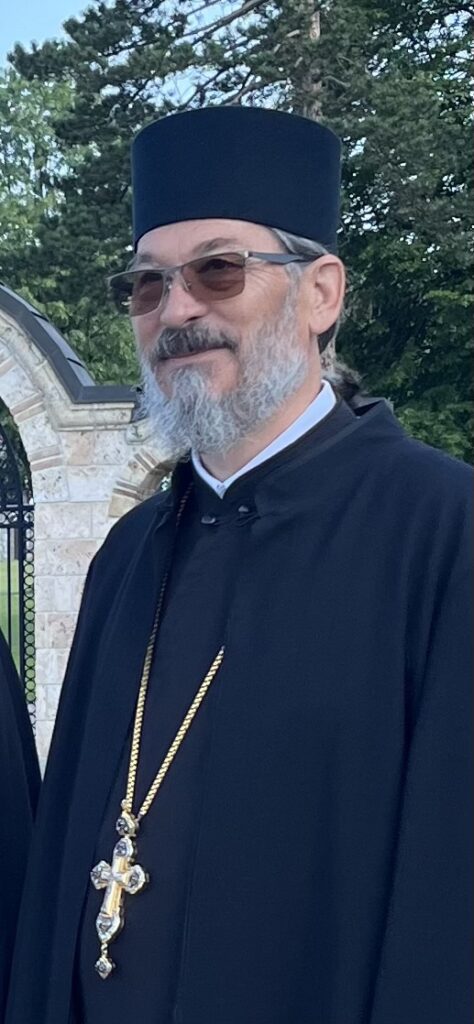
Bishop Athanasios Jevtić (2004)
PHOTOGRAPHY: pixabay