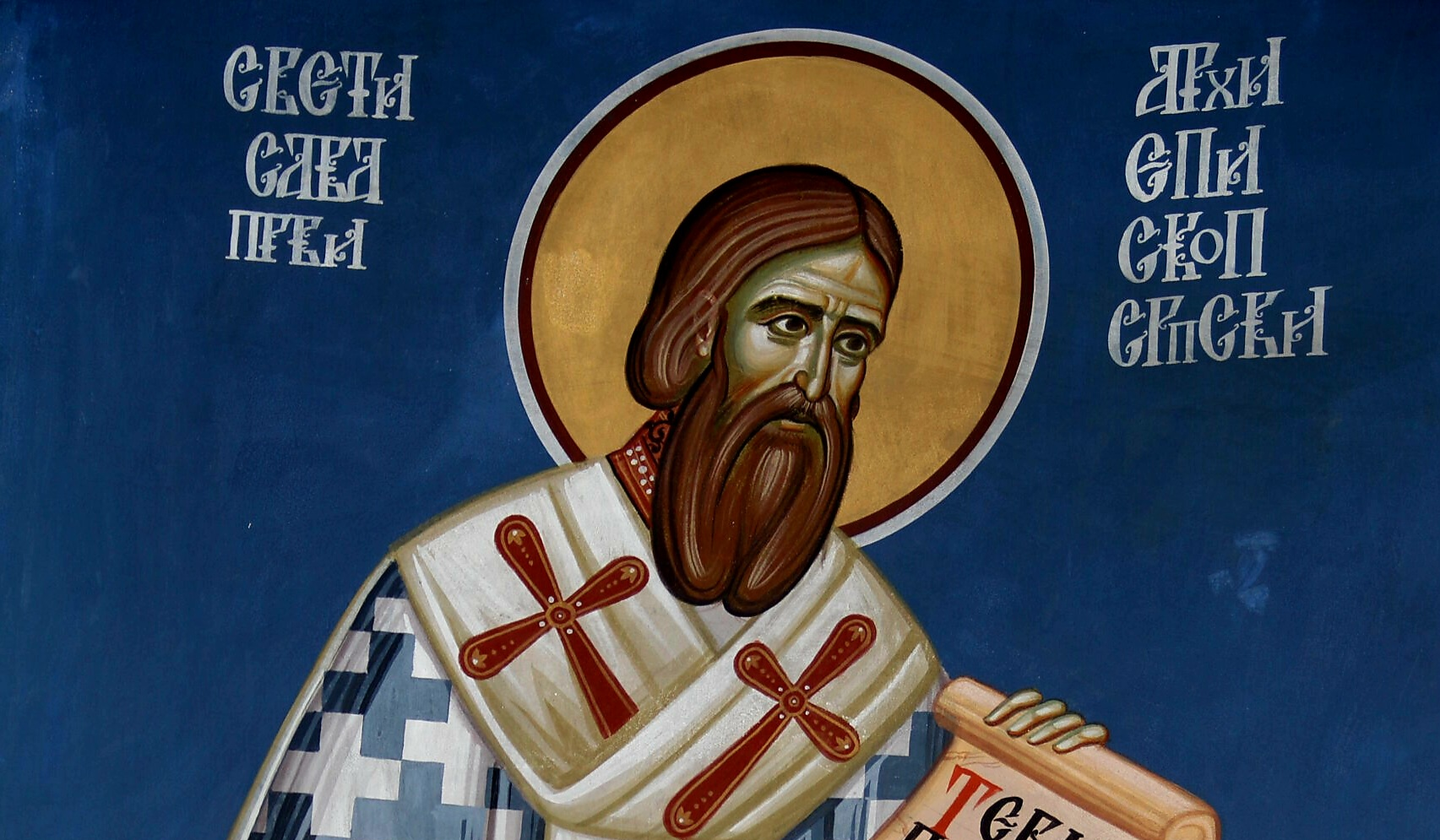
Let us acclaim with love Saint Sava!
Saint Sava accomplished so much in the sixty years of his earthly life, that anyone who tries to delve into it can, only by the grace of God, begin to discern where to begin with such an account. It is therefore no coincidence that we start this contribution with the prayer which his hagiographer and hymnographer, Theodosios, had woven into the acrostic of the canon to Saint Sava: “Grant me knowledge, O my God, that I may praise Sava.”
The primary prayerful intercessor of our people secured autocephaly for the Serbian Church and, as its first Archbishop, organised its spiritual life into eleven dioceses, with numerous monasteries and archpriestships. He redirected the development of Serbian sacred architecture through the construction of the Church of the Ascension in Žiča and opened new horizons in Serbian fresco painting with the styles of Studenica and Žiča. He is the father of Serbian literature as the author of the Life of Saint Simeon, as well as of letters and homilies.
He established the Serbian ecclesiastical law through his typika for the Karyes Hermitage and the monasteries of Hilandar and Studenica, as well as through the renowned Zakonopravilo (Nomocanon) and the chrysobulls which he composed together with his father and brother. He carried out important state and diplomatic missions with the Bulgarians and the Hungarians, cultivated good relations with the Eastern Patriarchates, maintained delicate ecclesiastical and political relations with Rome, and was a pioneer of interreligious dialogue with Islam.
He founded, or as a second main ktetor restored and generously endowed, the monasteries of Hilandar, Vatopedi, Iviron, the Great Lavra, Karakallou, Xeropotamou, and Philotheou on Mount Athos; Žiča, Mileševa, and the Studenica hermitages in Serbia; monasteries and churches in Jerusalem, Bethlehem, Alexandria, and Thessaloniki; as well as in Rome and Bari.
He laid the foundations of Serbian medicine by establishing hospitals in Hilandar and Studenica and laboured tirelessly to enlighten his people with the light of evangelical truth. Among the Serbs, he tirelessly fostered a love for liturgical worship, demonstrating by his own example a unified ascetical practice of communal and personal prayer, as well as a deep appreciation for the liturgical traditions of pre-Nemanjić Serbia, Mount Athos, Constantinople, and Jerusalem.
In the year when the entirety of the Serbian Orthodox Church celebrated the dual jubilee—the 850th anniversary of the birth and the 790th anniversary of the repose of Saint Sava—the missionary portal Kinonia, through both the written and the spoken word, contributed to its commemoration, offering glory to the Lord, who is wondrous in His saints.
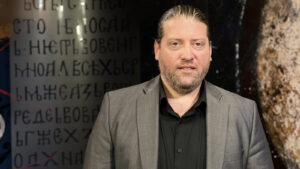
The Editor of the Portal, together with his dedicated collaborators