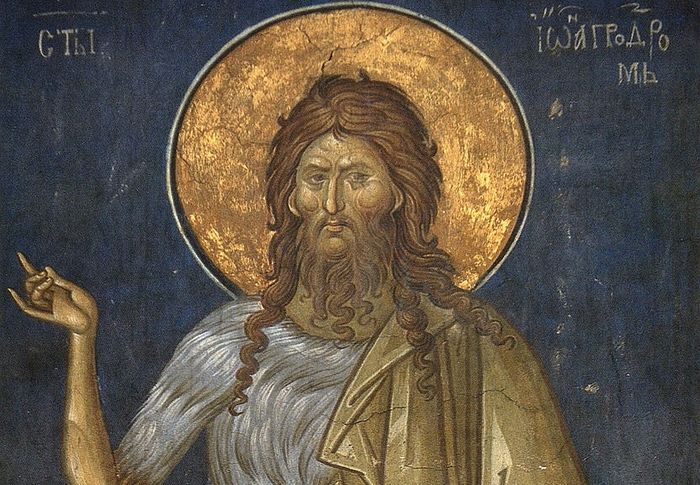
Before us are verses 12 and 13 of the eleventh chapter:
From the days of John the Baptist until now the Kingdom of Heaven suffers violence, and the violent take it by force. For all the Prophets and the Law prophesied until John.
Saint Hilary of Poitiers explains what is meant by the force by which the Kingdom of Heaven is taken in the following manner: “The Kingdom of Heaven is taken by force, and the violent take it by force, because the glory of Israel, which the fathers merited, which was revealed to the prophets and manifested by Christ, is won through the faith of the Gentiles.” Thus, the ascetic struggle of faith serves for us as the means of acquiring the Kingdom of Heaven. Venerable Isidore of Pelusium describes the character of those who are able to attain it and writes as follows: “Who are these violent ones? They are people who compel their body to fasting, to chastity, to every virtue, who subject it to the laws of the spirit; they make the body assist them and incite them towards virtue.”
In the interpretation of Venerable Seraphim of Sarov on these verses, we can find much consolation for ourselves. This great ascetic of more recent times said: “People who, despite the sinful bonds that have bound them and which by their violence do not allow them to approach our Saviour, people who, with complete repentance, despise the full power of these sinful bonds and strive to break them—such people later truly appear before the face of God, cleansed of lawlessness by His grace.” At this point we see that, however much our passions may cast us down, if we strive to rise and continue to walk towards Christ, we will surely emerge victorious in the end.
Saint John Chrysostom reasons as follows: “It follows that the prophets would not have ceased to appear had I not come,” says Jesus. “Therefore, do not hope any longer and do not expect another Messiah. That I am the One who is to come is evident both from the fact that the prophets have ceased to appear and from the fact that faith in Me grows day by day.” Because of these words of Saint John Chrysostom, one might ask: if prophecy ceased with the appearance of Saint John the Baptist, how is it that even to this day we see ascetics in our Church who possess the gift of prophecy? Blessed Jerome resolves this dilemma in the following way: “This does not mean that Jesus excludes the possibility of prophecy after John. For indeed, in the Acts of the Apostles we read that Agabus prophesied, as did the four daughters of Philip. Rather, it means only that the Law and the Prophets, when they prophesied about something, as we read in Holy Scripture, in fact prophesied about the Lord. For when it is said, ‘All the prophets and the Law prophesied until John,’ this points to the time of Christ’s coming, so that John showed that He had come whose coming the prophets foretold.” Thus, in this sense the words that prophecy ceased with the coming of the Forerunner should be understood, because the purpose of his ministry was to point to the One of whom all the Old Testament prophets prophesied, from the prophet Moses to the prophet Malachi, whom the Holy Fathers call “the seal of the prophets,” as the last Old Testament prophet.
The next two verses read:
And if you are willing to accept it, he is Elijah who is to come. He who has ears to hear, let him hear.
Here Saint John Chrysostom points to one detail: that the Lord Jesus seeks our good will, that He calls us to serve Him freely and compels us to nothing. He then calls people themselves to reflect upon what He preaches to them: “The Saviour did not say by chance, ‘If you are willing to accept it,’ but in order to show that He compels them to nothing. ‘I do not compel you,’ says Jesus. By these words He requires careful reflection from them themselves and shows that John is Elijah and that Elijah is John; both received the same ministry, both were forerunners. Therefore, the Lord did not simply say, ‘This is Elijah,’ but rather, ‘If you are willing to accept it, he is,’ that is, if you observe events attentively.”
Saint Anthony the Great explains in greater detail why the Lord calls the holy Forerunner by the name of the prophet Elijah, interpreting it as follows: “John is beautifully called Elijah because of the equality of grace and the similarity of ministry. For at the beginning and at the end of both Covenants there was John. He was the end of the Law and the beginning of the Good News, that is, a teacher of a manner of conduct and life different from that of the Law, just as Elijah who is expected will precede directly the second coming of Christ in the flesh, which will mark the end of this mode of existence and the beginning of the future one. Like John, Elijah too will be killed for the truth.”
Blessed Jerome adds here another very important explanation for us today, in a time when New Age teachings and theories are particularly prevalent. This is how Blessed Jerome interprets these verses: “He who has ears to hear, let him hear. If the meaning were plain and the sense obvious, why would it be necessary for us to be prepared to understand them? Thus, John is called Elijah not in the way that certain heretics and foolish philosophers introduce the doctrine of the transmigration of souls, but in the sense in which another Gospel testimony speaks—namely, that John comes in the spirit and power of Elijah, that is, that he possesses the same grace or measure of the Holy Spirit. For the severity and ascetic restraint in their manner of life were the same in both Elijah and John. One was in the wilderness and the other in the wilderness; one was girded with a leather belt and the other wore the same kind of belt. Elijah, because he reproved King Ahab and Jezebel for their impiety, was forced to flee, and John, because he reproved the unlawfulness of the marriage of Herod and Herodias, suffered beheading.” From these words of Blessed Jerome we also see that even at that time the words of Jesus could be properly understood only by the faithful Jews, people who studied the Old Testament Law, and today only by Christians who study Holy Scripture.
Saint John Chrysostom also points out the reason why the Lord speaks in this manner. Namely, the Lord Jesus Christ wishes to awaken interest in the people who surrounded Him. This is how he writes: “Jesus set forth so many difficult thoughts to be understood in order to awaken in the Jews the desire to ask questions. If even this did not rouse them from their sleep, then all the more could the clear and easily understandable words of the Saviour not awaken them. No one can say that they did not dare to ask Him and that they were afraid to approach Him. If the Jews tested Him by questioning Him about matters of little importance, and despite the fact that the Lord Jesus silenced them a thousand times, they did not desist, why then could they not ask Him about essential matters, had they wished to learn about them? If they asked Him about matters concerning the Law—for example, which commandment is the first, and the like—although there was no real need to ask such things, how then did they not seek an explanation of His words when He was obliged to answer their questions, especially when Jesus Himself was encouraging them to do so?” We may conclude that a similar situation is present even today. Even today there are many people in the Church who are capable of spending hours and days studying matters of lesser importance, entangling themselves in trivialities and making these the focus of their attention, while widely avoiding the study of the commandments and the study of the dogmas of the Church.
We continue further with the following verses, verses 16 and 17:
But to what shall I compare this generation? It is like children sitting in the marketplaces and calling to their companions, saying: We played the flute for you, and you did not dance; we mourned for you, and you did not lament.
At this point Euthymius Zigabenus explains who the companions of the Jews are and why the Lord compares them to children: It is like children sitting in the marketplaces and calling to their companions. Jesus compared the Jews to children because of their lack of understanding. The marketplace is a place to which crowds of people gathered from all sides for trade. By their companions, the Lord called Himself and John the Baptist, to whom the Jews were calling out.
Saint John Chrysostom writes that by these words Jesus shows that He, as God, did everything so that the Jewish people might not lose salvation: “Christ again directs the Jews towards this same principal goal and wishes to show that John acted in agreement with Him, although what occurred—for example, the question of John’s disciples—might have appeared as a contradiction. At the same time, the Lord shows that not a single necessary means for the salvation of the Jews was omitted, just as the prophet says concerning the vineyard: What more was there to do for My vineyard that I have not done in it? (Isa. 5:4).” From these words we can understand that the Lord does the same for every human being: He does everything that depends on Him so that a person may be saved, while it is left to the person and his free will to decide whether he is with God or not.
Blessed Jerome, in his interpretation of this passage, also refers to the Old Testament event of the bringing of the Ark of the Covenant into Jerusalem and David’s dancing before it. He writes as follows: “We played the flute for you, and you did not dance; we mourned for you, and you did not lament—that is, we called you to respond to our playing by doing good works and by dancing to our melody, just as David danced before the Ark of the Lord (see 2 Sam., ch. 6), but you did not wish to do so. We wept and called you to repentance, but you did not wish to do even that, showing contempt for both forms of preaching: both for the call to live in virtue and for the call to repent after sin. And it is not surprising that you despised the twofold path to salvation, for in the same way you mocked both fasting and the taking of food for the sake of God.”
Adapted for the contemporary reader based on Patristic commentary by Stanoje Stanković