The text was published on the Kinonia portal, in the column “From the Editor’s Pen,” on January 19, 2026.
“Today the Master has come to sanctify the nature of the waters,” thus chants the holy Church in the ninth ode of the festal canon. The present feast, as we sing in one of the stichera of the forefeast of Theophany, is more glorious than the previous feast of the Nativity of Christ: “The feast that has passed was radiant, but the one that comes is even more radiant, O Saviour,” and it further explains why: “It had an angel as a bearer of good tidings, and this one found the Forerunner as its herald. He, shedding blood, lamented Bethlehem as childless, while in these blessed waters the source of many children is revealed. There a star disclosed the cave to the Magi, but here the Father Himself has revealed You to the world…” If there the star revealed the cave, here the Father Himself reveals His Son: “This is My beloved Son” (Matt. 3:17).
Theophany is the feast of the revelation of divine mysteries—and not only of divine mysteries, but also of the mysteries of the world in which we live. Today the mystery of Theophany is revealed: Christ has appeared, as we have sung during these days of the forefeast, to clothe man in the first garment, of which the Great Canon of Repentance of Saint Andrew of Crete speaks: “I have torn my first garment, which the Creator fashioned for me in the beginning, and from that moment I lie naked.” Yet this is not enough: “Christ has appeared, wishing to renew the whole creation.”
This inseparability of man from creation permeates the entire divine service. In the sacred worship we pray: “O Lord, have mercy on us and on Your world…” In Christian consciousness, we do not separate ourselves from the world in which we live, and Christ appeared at the Jordan not only to renew fallen human nature, but also to renew the whole creation through the nature of water. “You, our Saviour, were baptized in the Jordan; You sanctified the waters by the hand laid upon them by Your servant, and You healed the passions of the world.” The nature of water is sanctified so that, above all, man may be sanctified. Each of us, at our spiritual birth, is sanctified by the Jordanian Baptism, for the water for the Mystery of Baptism is sanctified by the Baptism in the Jordan.
On this feast God is especially close to humanity; our hearts rejoice as we behold our Lord Jesus Christ coming to the Jordan. He abundantly pours out His divine light upon us all and sanctifies the nature of the waters. For now “the saving grace of God has appeared to all men” (Titus 2:11–12).
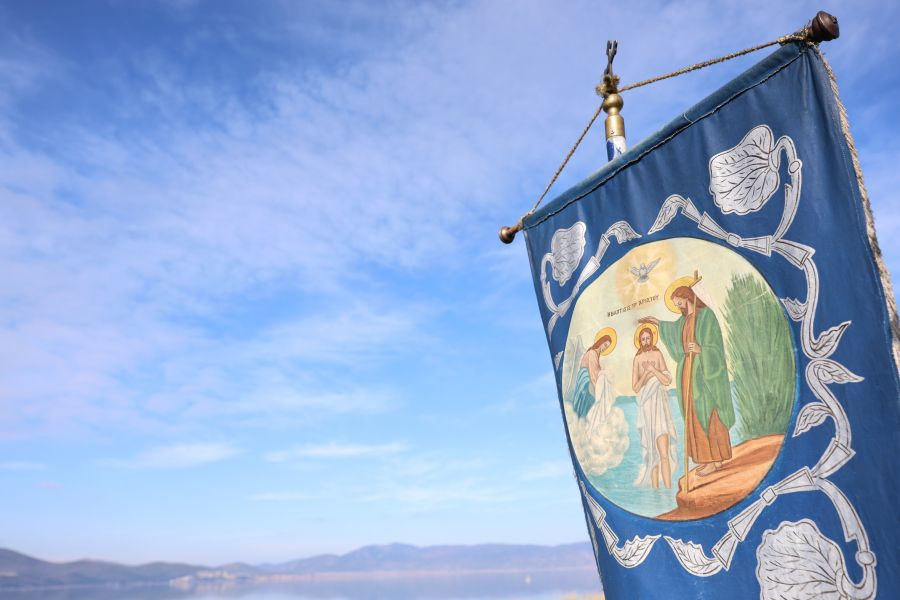
Old Testament baptism, performed according to the Mosaic Law, consisted of ritual washing from bodily impurity and did not grant the forgiveness of sins. Different was the baptism of John, which was expressed through the repentance of those baptized and their immersion in the River Jordan. The baptism and the entire preaching of Saint John the Baptist prepared those who came and listened to his preaching to accept faith in Jesus Christ. The third baptism is that of our Lord Jesus Christ. The fourth is our holy Baptism, by which we are baptized with water and the Spirit, in the name of the Holy Trinity—the Father, the Son, and the Holy Spirit—for the forgiveness of sins. Our Lord received John’s baptism, yet as the pure and spotless Lamb without sin He had no need of this baptism or of the confession of sins; rather, He was baptized for our sake and in obedience to the divine Law. The holy Baptism of the Saviour is also called Theophany, because at that moment all three Persons of the Holy Trinity were revealed: Jesus Christ standing in the flowing waters of the Jordan; the Holy Spirit descending upon Him in the form of a dove; and the voice of God the Father speaking to the Lord: “You are My beloved Son, in whom I am well pleased” (Mark 1:11).
What is the essence of the Baptism of the Lord, and how does it relate to each of us? We find and hear the answer in the liturgical texts and hymns of the feast. By His Baptism, Christ “renews fallen Adam by the streams of the Jordan and destroys the heads of the serpents that lurk there.” And again, “Christ has appeared at the Jordan to sanctify the waters.” Through the baptismal water, Christ grants peace, purification from sin, and enlightenment to the human race—through that very water by which we too have been born of water and the Spirit.
Saint Gregory of Nyssa writes: “Today He is baptized by John, in order to cleanse what is unclean, to bring the Spirit from on high, and to raise man to heaven; that those who had fallen might rise again, and that the one who cast them down might be put to shame.” This is the essence of the feast of Theophany.
Christ went out into the wilderness, to the River Jordan, where John was baptizing the people. John preached repentance and called sinners to be baptized in the Jordan as a sign of repentance. And behold, Christ also comes as a sinner and asks for baptism—He in whom there was no sin. John was afraid. “You should baptize me.” “Permit it now,” Jesus replies, “for thus it is fitting for us to fulfill all righteousness.” Adam sinned through pride; he desired to exalt himself, to become like God. Christ, however, came to fulfill the righteousness of God, to heal Adam’s sin of pride through humility. Adam sought to exalt himself before God, while God humbled Himself before man.
John laid his hand upon the Master and his God, and Christ humbly bowed His head before him. This humility of Christ opened the heavens. Then the heavens were opened and the voice of God the Father was heard: “This is My beloved Son, in whom I am well pleased.”
By immersing Himself in the Jordan, Christ sanctified not only the waters of the Jordan but the entire nature of waters, as the Church proclaims in her hymns: “Christ has appeared to sanctify the waters of the Jordan” (forefeast troparion), “Today the nature of the waters is sanctified” (troparion at the procession to the Jordan). And since water is found everywhere, by sanctifying the waters Christ thereby sanctified all creation, the entire universe. Christ prepared nature itself so that it too might feel the salvific significance of the sacrifice He came to offer. But not only that: He granted water the power to wash away human sins. John’s baptism was only a sign of repentance. Christian Baptism is a new birth, the forgiveness of all sins. By water God once punished the sins of the first world and destroyed it in the flood. By water God now saves humanity through the Mystery of Baptism.
Thus, upon the waters of the Jordan, Christ destroyed the head of the serpent—as the Church sings—the head of that serpent which deceived Adam and Eve, yet was overcome by the humility of Jesus; He revealed to mankind that God is Trinity; He sanctified the water, and together with the water He prepared all creation to receive the word of forgiveness and incorruptibility.
On the day of the Lord’s Theophany, as on the day of the Nativity of Christ and on Pascha, the ancient Church always baptized the catechumens. These catechumens were those preparing for Baptism, who underwent special catecheses given by bishops or presbyters, and who were intellectually and spiritually prepared to receive this great holy Mystery. Therefore, the services of Pascha, Christmas, and Theophany commemorate the baptism of the catechumens that was performed on those days. We sing the beautiful hymn: “As many as have been baptized into Christ have put on Christ”—the same hymn that is sung during the holy Mystery of Baptism.
These are wondrous words: “As many as have been baptized into Christ have put on Christ” (see Gal. 3:27). On the one hand, this is a prayer—a great supplication to God—that every baptized person may be granted the strength to put on Christ; that is, to accept what we have been taught, to accept God’s providence concerning us, His will, His power, His might, His grace. We beseech the Lord; yet, on the other hand, these words also express a certain affirmation: those who have been baptized into Christ have indeed put on Christ. These words sound both as a call to all of us who are baptized and as a rebuke to all of us, for each of us may ask: “Whether I was baptized as a child or as an adult, have I put on Christ?”
“Have I accepted His words, His will, His promises? Do I open my heart to receive His grace?”
Today is a great day. It reminds us all of the Mystery of our own Baptism, calling each of us to receive this Mystery not as a mere custom or ritual, but as the great mystery of our salvation, and to clothe ourselves in Christ through Baptism. This clothing does not occur instantaneously—as though a person were to emerge from the waters of Baptism and immediately be clothed in Christ. To put on Christ, to don the garment of salvation, is a lifelong undertaking; it is always accompanied by struggle and effort, for being clothed in Christ requires overcoming many temptations. It is a task that lasts an entire lifetime, and until the final breath each of us must repeat these wondrous words: “I have been baptized into Christ; into Christ I clothe myself.”
In the words of the Apostle Paul, “the saving grace of God has appeared to all people”; in our Baptism we have cast off estrangement from God and worldly desires, malice, and the worship of the father of lies—the devil. Through our Baptism we have become like our Lord Jesus Christ, cleansed by water and the Spirit, so that we might become members of His holy and immaculate Body, which today John baptizes in the waters of the Jordan.
At the Jordan, Christ revealed His glory through humility: as the Son of Man, He was baptized by John for the forgiveness of sins, though He Himself had no sin. At the second Theophany, for which we yearn, Christ will be revealed as the Only-begotten Son of God, coming to judge the world which He created and for which He became the God-Man, suffered, and rose again.
The Feast of Theophany was originally celebrated as a twofold feast or a collective feast, and thus it was simply called the Manifestation—Epiphany (ἐπιφάνεια) or Theophany (Θεοφάνια). The Latins, moreover, called this collective feast festivitas declarationis, manifestationis, apparitionis. All these names, as well as the history of the feast, confirm that it was originally dedicated to the commemorations of the manifestations of our Lord Jesus Christ: His Birth, the adoration of the Magi from the East, His Baptism by the hand of Saint John the Baptist, as well as all His miracles in which He experientially manifested His divine power, abundantly poured forth. On the other hand, the name Theophany also derives from the very centre of the feast, namely, the manifestation of the Most Holy Trinity at the Baptism of the Lord in the waters of the Jordan. The feast was later also called Enlightenment, because on the eve of the feast all the catechumens were baptized and from that moment were called the enlightened.
“Come, behold a strange cataclysm, far more perfect and better than the one seen in the time of Noah; there the water brought death to human nature, but here the water of Baptism, through the One being baptized, has brought life to those who were dead; there Noah built an ark of incorruptible wood, but here Christ, the spiritual Noah, fashioned a bodily ark from the immaculate Mary; there the dove, holding a withered olive branch, prefigured the sweet fragrance of Christ the Master, while here the Holy Spirit came in the form of a dove and revealed the Merciful Lord”—upon these words of Saint Proclus, Archbishop of Constantinople, the entire hymnography of the Feast of Theophany is founded. Truly, holy Theophany is like a second flood—a flood of divine love and grace—for the spiritual salvation of humankind and its restoration to Paradise. Christ enlightens the world and pours light into our souls. He comes to John the Forerunner to be baptized in the River Jordan after thirty years have passed since His birth, observing the Law in all things, wishing to show humankind that He is “God in the flesh,” the true Son of God, “of one essence with the Father,” He of whom the Prophets prophesied with longing and preached with great expectation. And although Christ had no sin, being sinless, in order to fulfill the Law in all things, He came to the Jordan to be baptized by John. Immortal in relation to humanity and in His divinity, He comes and clothes Himself in the mortality of the sinful world, and thus Theophany is the moment when Christ sets out on the path toward Golgotha.
Within the service of the Nativity of Christ there has been preserved the commemoration of the adoration of the Magi, while the liturgical remembrance of the Lord’s first miracle at Cana of Galilee has almost disappeared. In the services of the feasts of the Nativity and Theophany we find traces of their common celebration. Thus, at the Ninth Hour on the eve of the Nativity, in one sticheron we sing: “We worship Your Nativity, O Christ; show us also Your divine Theophany.” Or, in the third sticheron at Lord, I Have Cried, we sing that “the Lord has enlightened all creation,” while at Theophany we sing: “Today all creation is enlightened.” In one of the prayers of the Great Blessing of Waters we read: “By Your Birth You sanctified the virginal womb; every creature glorifies You who have appeared.” The very order of the sacred services at Theophany is similar to the order of the services at the Nativity. Thus, on the eve of Theophany we likewise have the celebration of Matins, the Royal (Great) Hours, and the Liturgy of Saint Basil the Great, which begins with Vespers. At the end of the Liturgy on the eve of the feast there is a special prayer behind the ambo:
“Sanctify the sources of waters, O Fountain of our life, Lord Jesus Christ our God, You who have made the sanctified water to be deliverance for captives, remission of debts, forgiveness of sins, the bath of regeneration, the gift of adoption, the garment of incorruption. By it enlighten and save Your people, O our God who have appeared, and deem us worthy to meet with pure conscience and in joy the most radiant feast of Your manifestation. For to You belong all glory, honour, and worship, together with Your beginningless Father, and Your most holy and good and life-creating Spirit, now and ever and unto the ages of ages. Amen.”
Among the eminent hymnographers who composed the service of Theophany, special mention should be made of Saint John the Monk, Saint Germanus of Constantinople, Anatolius, as well as Saint John of Damascus and Cosmas of Maiuma. The Feast of Theophany has five days of forefeast and seven days of afterfeast.
We live from Theophany to Theophany. A few days ago we celebrated Theophany in the cave of Bethlehem. Today—at the River Jordan. Soon we shall celebrate Theophany at Golgotha and in the life-giving Tomb, from which the risen God-Man will shine forth upon the world. All our joy lies in these Theophanies, and our hope and faith rest in the final coming of Christ. Then everything will become clear and revealed.
How short is our life in comparison with what awaits us at the final Theophany. How insignificant and distant our present problems, aspirations, plans, and sorrows will seem. All present anxieties and fears will vanish when our Savior appears.
Thirsting for grace, let us hasten to the source of living water—Christ our God! Christ, the Sun of Righteousness, illumines us and warms us with the divine rays of His Divinity: “Therefore, you who are from Adam, come, let us all clothe ourselves in Him that we may be warmed; for He covers the naked and enlightens those in darkness. You have come and have appeared, O Light unapproachable.”
Written by: Catechist Branislav Ilić, Editor of the Kinonia Portal