The text was published on the Kinonia portal, in the column “From the Editor’s Pen,” on January 18, 2026.
The Feast of the Circumcision of the Lord, situated between the great feasts of the Nativity of Christ and the Theophany of the Lord, within the sacred period known as the “Twelve Days,” often remains somewhat in the shadow. Nevertheless, this event is of great significance for us.
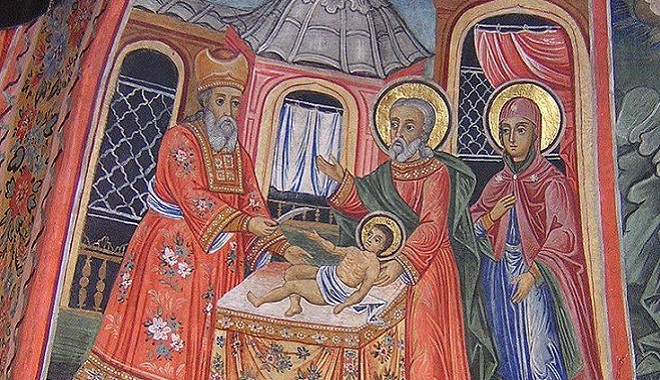
On the eighth day after His birth, our Lord Jesus Christ willingly consented to be circumcised. He did so in order to fulfill the Mosaic Law, as He Himself declared: “I have not come to abolish the Law … but to fulfill it” (Matt. 5:17). He endures suffering for our sake, manifesting profound condescension and love towards human nature fallen into sin, and sanctifying it.
Why did the Lord willingly submit to suffering through circumcision on this day?
Christ accepted circumcision, first, in order to fulfill the Law, which required that every Jew be circumcised on the eighth day—an act that served as a precursor to Christian Baptism. He says, “I have not come to abolish the Law, but to fulfill it” (Matt. 5:17), and He obeyed the Law so that He might make us—who were bound and subject to the Law—free. Second, the Lord accepted circumcision in order to show that He assumed a true and not merely an apparent body, thereby silencing the heretics who vainly claimed that Christ did not take on true human flesh, but only its appearance. Circumcision revealed not a fictitious, but His true humanity. For if His body were merely apparent and not real, how could circumcision be performed on an apparent body? In contemporary terms, this strikes a blow against all cults that perceive the Lord as something abstract—as an idea or a spiritual ideal—while refusing to acknowledge God as a Person. Third, the Lord accepted physical circumcision in order to lead us into inward, spiritual circumcision. Having brought the bodily Old Covenant to completion, the Lord Jesus Christ laid the foundation for the new, spiritual covenant; and just as the old man was required to circumcise the sensory body, so too must the new, spiritual man circumcise the passions of the soul: rage, anger, envy, pride, impurity, and other sinful desires. Old Testament circumcision gave way to the holy Mystery of Baptism, of which circumcision was a prototype. Baptism is spiritual circumcision. It is the gateway to future life through liberation from sin, for nothing unclean can enter the Kingdom of God (see Rev. 21:27).
Along with circumcision, we see that Christ was given the name Jesus—the name proclaimed by the angel. Even today, if we open our Trebnik—the book containing the rites of the holy Mysteries and prayers—we find the “Prayer of the Eighth Day,” a prayer for the naming of a child and, at the same time, the invocation of the Name of God over the child. The text of the prayer reads as follows:
“Lord our God, to You we pray and You we invoke: may the light of Your countenance shine upon this Your servant, and may the Cross of Your Only-begotten Son be inscribed in his heart and thoughts, that he may avoid the vanity of the world and every evil assault of the adversary, and keep Your commandments. And grant, O Lord, that Your holy Name may remain ineffable upon him, being joined in due time to Your holy Church and perfected by the dread Mysteries of Your Christ, so that, having lived according to Your commandments and preserved the seal undefiled, he may obtain the blessedness of the elect in Your Kingdom, by the grace and love for mankind of Your Only-begotten Son, with whom You are blessed, together with Your most holy and good and life-creating Spirit, now and ever and unto the ages of ages. Amen.”
We see that this tradition is very ancient, for Adam already gave names to all the animals, thereby expressing the essence of each of them. If we read the Old Testament, we see that Old Testament names often carry a special meaning. The name Jesus means “Saviour,” and this name, on the one hand, seems to place Him in a particular service. On the other hand, we see that this name, not subject to human power, lies beyond the control of human strength; it is inspired by the power of God. From this point onward, this name belongs to the Divine Person of the Lord Jesus Christ, who united within Himself a human nature like ours and the invisible divine nature.
Our Lord Jesus Christ accepted circumcision in order to teach us spiritual circumcision. Christ was circumcised in the flesh as a man, fulfilling the Old Law; but as the True God, He gives us the New Law, which commands circumcision—that is, the cutting off of our spiritual passions: anger, rage, envy, pride, fornication, every impurity, and other sinful desires and attachments. In the New Covenant, circumcision is no longer physical, but spiritual.
In what does this spiritual circumcision consist?
The Lord Jesus Christ repeatedly said: “If anyone would come after Me, let him deny himself, take up his cross, and follow Me.” This self-denial is spiritual circumcision. But what does it mean to deny oneself? It means to renounce sin, which has penetrated so deeply into the soul and body of every human being that the denial of sin is equivalent to the denial of oneself. Just as, without circumcision in the Old Covenant, a person could not enter into the community of the chosen people, so too, without spiritual circumcision, a Christian cannot enter the Kingdom of God.
This mystery is eloquently illuminated for us by Saint John Chrysostom: “Just as the sign of circumcision distinguished the Jews from other nations and showed them to be a people chosen by God, so among us the circumcision of Baptism constitutes the clearest distinction and division between the faithful and the unbelieving. For for this reason, says the Apostle, you were circumcised with a circumcision made without hands, by putting off the body of the sins of the flesh. As there circumcision is performed by the removal of the flesh, so here it is accomplished through Baptism by the removal of sins. Therefore, since we have once put off the sinful body and put on a pure garment, beloved, let us remain in purity; conquering the passions of the flesh, let us acquire virtue.”
To the words of Saint John Chrysostom are joined the words of Saint Theophan the Recluse, who points to the essence of the feast: “The essence of the Feast of the Circumcision of the Lord consists in this: that from that moment a person lives only for God (and for his salvation), and no longer exclusively for himself as before (by which he was preparing his own ruin). Thus he casts aside former habits, all comforts, and everything in which he found pleasure, cutting off passions and lustful dispositions, and embracing strict self-denial.”
In commemoration of the Circumcision of the Lord, the Church established a feast that bears all the characteristics of a great feast. Alongside the commemoration of the Saviour’s circumcision, according to the Gospel of Luke (Luke 2:21), the liturgical celebration also commemorates the bestowal upon the Lord of the salvific name Jesus. The Feast of the Circumcision was established relatively late and therefore has neither a forefeast nor an afterfeast; and since on the same day we also commemorate Saint Basil the Great, Archbishop of Caesarea in Cappadocia, from the structure of the service we may conclude that the service to Saint Basil the Great is older than the service of the Circumcision of the Lord.
The first mentions of the feast are found in the eighth century, in a homily of Saint Andrew of Crete on the Circumcision of the Lord. The inspired hymnographer, with the following words, poetically calls us to embrace the essence of the feast, glorifying with one mouth and one heart the Lord who, for our sake, was circumcised on the eighth day after His birth:
“Having come down, the Saviour dwelt among men; He accepted swaddling in bands and did not disdain bodily circumcision; on the eighth day He was circumcised according to the flesh, though according to the Father He is without beginning. To Him let the faithful cry aloud: You are our God; have mercy on us” (first sticheron at Lord, I Have Cried).
“You were not ashamed, O all-good God, to be circumcised in the flesh, but You gave Yourself as an example and became a rule of salvation; as the Creator of the Law You fulfill the laws and all the prophecies of the prophets concerning You. Though wrapped in swaddling bands, You hold all things in Your embrace; therefore, O Lord, glory to You” (second sticheron at Lord, I Have Cried).
“The Creator of the ages is circumcised in the flesh as an eight-day-old Child, to fulfill the Law; He is wrapped in swaddling clothes as a Man and fed with milk, He who, as God, holds all things by immeasurable power and creates by His command” (exapostilarion).
Written by: Catechist Branislav Ilić, Editor of the Kinonia Portal