The text was published on the Kinonia portal, in the section “From the Editor’s Pen,” on 13 January 2026.
Through the sacred period of the Twelve Days in which we find ourselves, we extend the festal joy through its content and liturgical commemorations, thus uniting the Feast of the Nativity of Christ with the Feast of Theophany. The Twelve Days represent a kind of spiritual bridge that connects these feasts, which were celebrated together until the fourth century. Within the Twelve Days—which otherwise consist of three groups of commemorations (1. Commemorations of those directly connected with the Nativity of Christ; 2. Commemorations of the holy apostles and deacons of the Jerusalem Temple who were among the first to proclaim the word of God; 3. Commemorations of saints who, in various wondrous ways, manifested their love for the Lord)—there is also the commemoration of the holy 14,000 infants of Bethlehem.
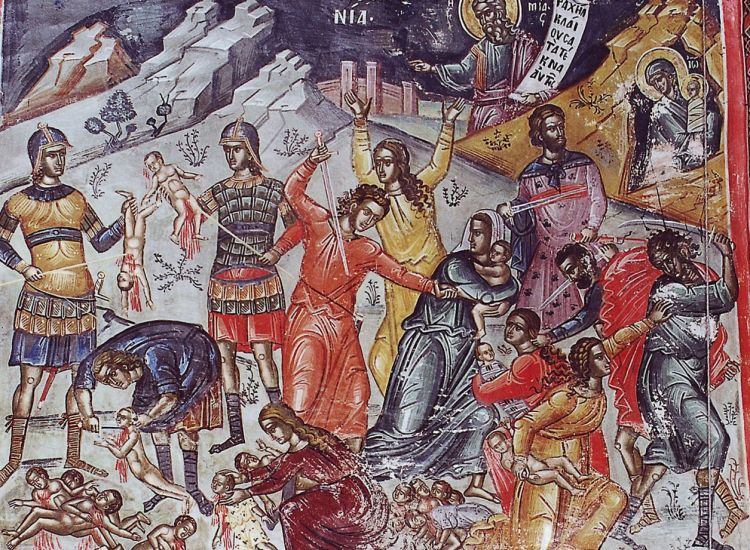
“When the wise men had departed, behold, an angel of the Lord appeared to Joseph in a dream and said: ‘Rise, take the Child and His mother, flee to Egypt, and remain there until I tell you; for Herod will seek the Child to destroy Him.’ And he rose, took the Child and His mother by night, and departed to Egypt” (Matt. 2:13–14). Guided by the star from the East, the wise men hastened to worship the newborn God-Man Christ, offering Him gifts: gold, frankincense, and myrrh. Having worshiped the God-Man, the wise men did not return to Jerusalem to Herod, as he had ordered them, but, having received a revelation from above, they departed by another way to their own country. “Then Herod, when he saw that he had been deceived by the wise men, was exceedingly angry, and he sent and slew all the male children in Bethlehem and in all its districts, from two years old and under, according to the time which he had carefully ascertained from the wise men” (Matt. 2:16). Herod believed that the star which had revealed the birth of Christ to the wise men in the East had not appeared to them immediately, but that the Child had been born much earlier. For greater certainty, he ordered that the time be extended to two years. Herod hoped that among the slain children there would also be the God-Man. The murdered infants thus became the first martyrs for Christ. The hatred and fury of King Herod were not directed only against the innocent newborn children, but also against Saint Simeon the God-receiver, the holy prophet and high priest Zechariah, and others as well.
When one first reads the Gospel, one may be horrified by the fact that 14,000 innocent infants were killed in Bethlehem. It is clear that such a number of children “two years old and under” could not have existed in the small town of Bethlehem and its surroundings. From this it becomes evident that the number has a symbolic meaning. The Church began to commemorate the massacre of the infants in Bethlehem as early as the second century. It is likely that the number of 14,000 was determined at that time. The number fourteen is the number of David’s name. The ancient Jews represented letters with numbers, and the sum of the numerical values of the letters in David’s name equals fourteen. The Evangelist Matthew provides the genealogy of Jesus Christ, structured into three groups of fourteen names, in order to show that Jesus is a descendant of King David. No suffering is meaningless before God. This is confirmed by numerous testimonies from Holy Scripture, as well as by examples from the lives of people who suffer in this world for various reasons. God’s providence for humanity and the world directs all things towards the good, yet human logic cannot immediately comprehend and accept this truth in the proper way. The infants of Bethlehem became the first martyrs for Christ, shedding their innocent blood for the Saviour of the world. Although they became martyrs unconsciously, this occurred by God’s providence. After the Saviuor’s sacrifice on the Cross, suffering for Him becomes a testimony of faith, and it is not accidental that the original meaning of the word martyr is, in fact, witness.
The sacred history of the Church presents before us numerous names of holy martyrs, and in that Martyrology we can observe examples of martyrdom by choice and martyrdom by necessity (without choice). In the first case, the martyr is offered a choice: to renounce Christ and continue living without Him, or to remain with Him, suffering for Him, in accordance with the words: “Therefore whoever confesses Me before men, him I will also confess before My Father who is in heaven” (Matt. 10:32). The second form of martyrdom includes those cases in which a person does not choose between “life or faith,” but accepts suffering. The senseless King Herod issued an order and “sent forth and slew all the male children in Bethlehem and in all its districts, from two years old and under” (Matt. 2:16). Not knowing where Jesus was, Herod wished to kill the newborn Christ among these innocent infants. These infants had no choice—they had not yet comprehended life in its true sense, nor was any of them asked whether they chose this path or not. Yet this was their path to the Kingdom of Heaven.
When we speak of the holy martyrs of Bethlehem, from year to year one question repeatedly arises: Why did God permit the death and suffering of innocent children? The most concrete answer to this question is given by the great Father and Teacher of the Church, Saint John Chrysostom: “If someone were to take a few copper coins from you and in return give you gold, would you consider yourself wronged? On the contrary, would you not say that this person was your benefactor?” Here, the few copper coins represent our earthly life, which sooner or later ends in death, while the gold represents eternal life. Thus, in a few moments of suffering and pain, the infants attained blessed eternity, achieving what the saints attained through lifelong struggles and labours. The infants of Bethlehem inherited eternal life among the angels. For them, suffering was like a mysterious door leading them into the Kingdom of Heaven.
“Then was fulfilled what was spoken by the prophet Jeremiah, saying: ‘A voice was heard in Ramah, lamentation, weeping, and great mourning; Rachel weeping for her children, refusing to be comforted, because they are no more’” (Matt. 2:17–18). Does this refer only to the infants of Bethlehem, or to all generations of Christian infant martyrs? Geographically speaking, the city of Ramah is located twelve kilometers from Bethlehem. When King Herod slaughtered all the small children in Bethlehem and all its districts (Matt. 2:16), this territory included Ramah. In the Old Testament, the prophet Jeremiah describes the inhabitants of Jerusalem who were led away into a foreign land (Jer. 31:15), and the words about Rachel’s weeping refer to them. On this sorrowful journey, they pass by the city of Ramah—the burial place of Rachel (1 Sam. 10:2); and Jeremiah depicts Rachel as weeping even in her grave over the fate that befell her people in the Babylonian captivity.
In the joy of the Twelve Days, we celebrate the commemoration of the holy 14,000 martyrs of Bethlehem, offering them prayerful supplications and magnifying their suffering for Christ. The children of Bethlehem are the first martyrs of Christ. Without words, without conscious choice, without resistance, by their sacrifice they seal Christ’s entry into history. Their sacrifice reveals how violent and merciless the world can become in the face of childlike innocence. Rachel’s lamentation (Jer. 31:15), in which she “weeps for her children,” repeated by the Evangelist Matthew, does not belong only to the past; it penetrates through the centuries and reaches our own time, perhaps more powerfully and painfully than ever before. On the day of this prayerful commemoration of the 14,000 martyrs of Bethlehem, illumined by the light of the Feast of the Nativity of Christ, together with the Church hymnographer we raise our prayers to these holy martyrs, that spiritual purity akin to that of children may dwell in our hearts:
“The greatest lawless one, seeking the hiding place of the Hidden One, on this day slaughtered innocent children; Rachel was inconsolable, beholding the unjust killing and premature death, and she wept for them and suffered in her heart, yet she also rejoiced when she now beheld them in the bosom of Abraham” (First sticheron at Lord, I Have Cried).
“To You, O pre-eternal Lord, born of the Virgin, who in Your goodness became a child, a host of little children was brought by martyrial blood; their undefiled and righteous radiant souls You settled in eternal dwellings, while You exposed the malice and most savage madness of Herod” (Third sticheron at Lord, I Have Cried).
“When Jesus was born in Bethlehem of Judea, the rule of Judea ceased; let the children who suffered for Christ rejoice, and let Judea lament, for a voice was heard in Ramah: Rachel weeps and mourns, as it is written in Scripture, for her children; for Herod, the greatest lawless one, slaughtered the children, fulfilling the Scripture. Judea was filled with innocent blood, and the land was reddened by the blood of children; the Church of the Gentiles is secretly purified and adorned with beauty. Truth has come, God has appeared to those who sat in darkness; He was born of the Virgin in order to save us” (Doxastikon at the Aposticha).
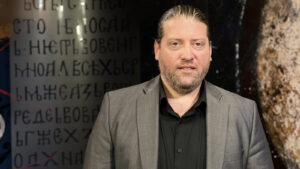
WRITTEN BY: Catechist Branislav Ilić, Editor of the Kinonia Portal