Text published on the Kinonia portal in the “Featured” section, 5 January 2026.
A WORD ON THE ESSENCE OF THE FEAST
The Church, as the guardian of the divine economy of salvation, preserves and hands down to us what she received from the beginning in Holy Scripture, guarding it as the apple of her eye: the prophetic word, “Behold, a virgin shall conceive and bear a Son”—“For unto us a Child is born, unto us a Son is given” (Isa. 7:14; 9:6); the apostolic word, “But when the fullness of time had come, God sent forth His Son, born of a woman, born under the law” (Gal. 4:4); the evangelical word, “And the Logos became flesh and dwelt among us” (John 1:14); the angelic hymn from heaven, “Glory to God in the highest, and on earth peace, goodwill among men” (Luke 2:14); and the call of the Church hymnographer: “Christ is born—glorify Him! Christ comes from heaven—go out to meet Him! Christ is on earth—be exalted!”
The Incarnation of God the Logos, together with His Resurrection, belongs among the principal works of God’s love for mankind and of His providential care for the human person and creation; in it lies the purpose and the supreme aim of God’s providence for the world. The human person is the occasion (ὑπόθεσις) of the Incarnation of the Logos, while the “image” of God in man is the very warp and woof of His Incarnation. Saint John Chrysostom explains the mystery of the Incarnation of God the Logos in the light of our salvation in the following manner: “For the world to be saved, it was necessary that a man should mediate. No other being could save the world—not even God Himself, by Himself. There was no way for God, from afar, to say: ‘Be saved.’ That would then have been an ethical, juridical question—namely, a question of transgression—if God from afar were to forgive man. On the other hand, neither could an angel save the world, for he does not possess a bodily being and thus could not encompass within himself the whole of creation.” The theology of the feast of the Nativity of Christ clearly indicates that the mystery of the Incarnation of God the Logos is intimately linked with the mystery of calling and response—that is, with the mystery of love and freedom (love of God and love of man), with the mystery of serving and co-serving, of self-offering and offering, of giving oneself to the other. In our people there is even a saying that what is truly ours is only what we give to another.
Concerning the significance of the coming of the Lord Christ into the world, Saint Gregory Palamas says: “The Incarnation of God the Logos has brought us human beings ineffable blessings, and even the Kingdom of Heaven itself.” This feast speaks to us clearly: by the Birth of Christ, heaven and earth are united into one. The truth of these words is confirmed by the liturgical hymn we chant at Christmas: “Heaven and earth are united today, for Christ is born. Today God has appeared on earth, and man has been raised to heaven. Today, for man’s sake, He who is by nature invisible is seen in the flesh. Therefore we too give Him glory with the angelic cry: Glory to God in the highest, and on earth peace.”
The Saviour’s coming into this world was described by the holy Apostles Matthew and Luke, who set forth only the most essential testimonies to that unique event from which a new era of human history begins. Saint John the Theologian gathers all testimonies into what is most fundamental: “The Logos became flesh” (John 1:14). The Logos is the Only-begotten Son of God, Light of Light, true God of true God, through whom all things were made, as we confess in the Symbol of Faith formulated precisely 1,700 years ago at the First Ecumenical Council in 325, at Nicaea. The God-man Christ is “the true Light which enlightens every man coming into the world” (John 1:9). He appeared as God in human flesh; He humbled Himself and identified Himself with us by becoming man, while remaining God. Thus God assumed human nature in order, by His boundless love, to bestow upon us all His boundless perfections.
Far from every royal audience and pomp, and without the priestly establishment of Jerusalem, the King of the universe and the “Good Shepherd” is welcomed by the meek and the poor—those who are like Him. With this in mind, Blessed Jerome notes that He who created the world had not even a room in an inn in which to be born, and thus went to a stable (Luke 2:7), among animals and people who were simple and meek. He links this with Christ’s later words: “Foxes have holes and birds of the air have nests, but the Son of Man has nowhere to lay His head” (Matt. 8:22).
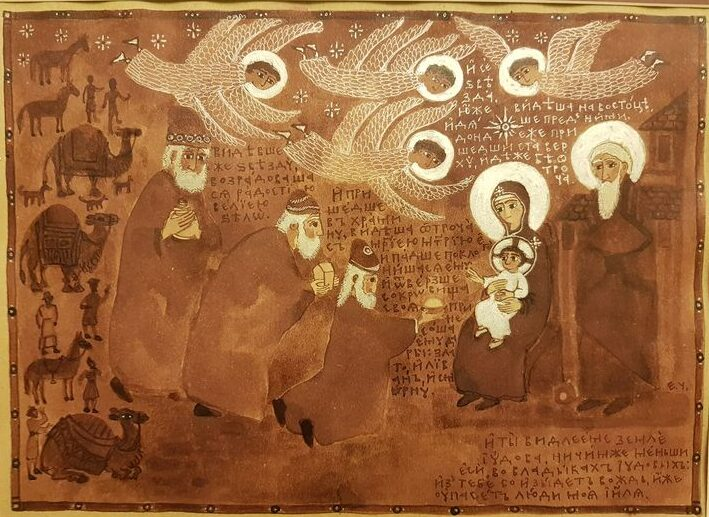
Entering this world as a helpless child born of the Most Holy Virgin, the Lord Jesus Christ entered into the extremity of human poverty. Born in a dark cave, wrapped in swaddling clothes and laid in a manger, He condescended to human beings, alienated from God, who dwell in the darkness of sin and the shadow of death (Matt. 4:16). By this condescension He did not diminish the omnipotence of His divinity; rather, He revealed what His love is like. It freely accepts every humiliation and goes to the Cross to be sacrificed for the salvation of the world. In His childlike weakness, with the eyes of faith we behold divine omnipotence; and through His helplessness as He lies in the manger, we contemplate our Deliverer and Saviour of human souls.
Contemplating this ineffable mystery and marvelling at the love of God, it becomes clear to us that we can overcome every temptation and challenge only when inspired by the love of God and when our gaze is fixed upon Christ. Our most holy Patriarch Porphyrios often reminds us in his homilies of a truth that ought to become an imperative of our Christian existence: “If Christ is in first place, everything in our life will be in its proper place.” Thus, if Christ is our measure and our helmsman, guiding us as we sail the stormy and turbulent sea of this life, then every hardship, temptation, and challenge will be conquerable. The godly-wise Apostle Paul defines all this in the following words: “I can do all things through Christ Jesus who gives me strength” (Phil. 4:13).
IT IS IMPORTANT TO RECOGNISE THE PEACE THAT CHRISTMAS BRINGS
Whether everything will fit into a suitcase depends not only on the quantity or size of the items, but also on the way we pack them. Something similar happens with our lives: if we spend them in vanity, in haste, and in aimless wandering, they end by our achieving nothing, while becoming greatly exhausted in the process. The busyness—or, more precisely, the lostness—of the person of today is the result of little or no prayer. When we begin our day with prayer, we lay a strong foundation upon which everything throughout the day will be built in perfect order. Thus Holy Scripture says of the godly person that “whatever he does, he prospers in all things” (Ps. 1:3). Therefore, the spiritual life cannot be a hobby or a pastime for which we may or may not have time. It is the foundation upon which we later add everything else.
As active members of the Church, we experience the mystery of God’s love manifested in the Birth of our Lord Jesus Christ at every Divine Liturgy, and thus also that sanctified peace which the annual celebration of the feast of the Nativity of Christ brings with it. The Birth of Christ is not merely a moment in the flow of history; it is God’s supreme promise to mankind. By His Incarnation, God comes to dwell among us and to deliver us from the chains that press upon and burden our very existence—and thus also from the chains of being weighed down by the rapid rhythm of life. Christmas is a feast in which we ought to set aside every earthly care, so that our centre—and our meaning—may be the encounter with God, who alone is our peace.
The name “Emmanuel”—“God is with us”—is not accidental. It reveals the deepest meaning of the Incarnation: that God is actively present in every bitterness of ours, in every fear, and in every burden of earthly cares. The Son of God, as the Eternal One, enters time and space, shares our poverty and our weaknesses, and becomes our companion in every moment of our life, with love and tenderness. By His humble descent God teaches us that true power is not shown through imposition and fear, but through self-giving, sacrifice, and simplicity of heart and purity of intention.
The Saviour was pleased to be born of the Most Holy Theotokos and Ever-Virgin Mary so that the human person, by the grace-filled powers of the Holy Spirit—through Baptism, participation in the Divine Liturgy, and life in Christ—might be reborn and become god by grace, a brother and co-bodily member of the God-man. He Himself made this possible for us through the true birth unto eternal life granted by holy Baptism, Chrismation, and the whole sacramental life, crowned in the Divine Liturgy, together with our ascetical effort to acquire the evangelical holy virtues. As we begin truly to belong to the Community of the children of God—the Church—we participate by grace in the divine life of Christ and are being saved and made saved within her.
WRITTEN BY: Catechist Branislav Ilić, editor of the “Kinonia” portal
Source: Kinonia Portal