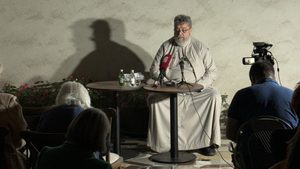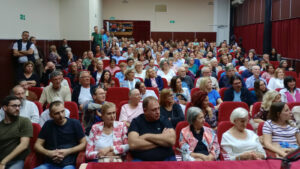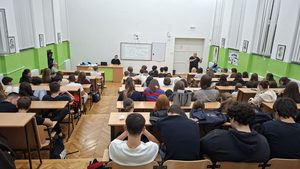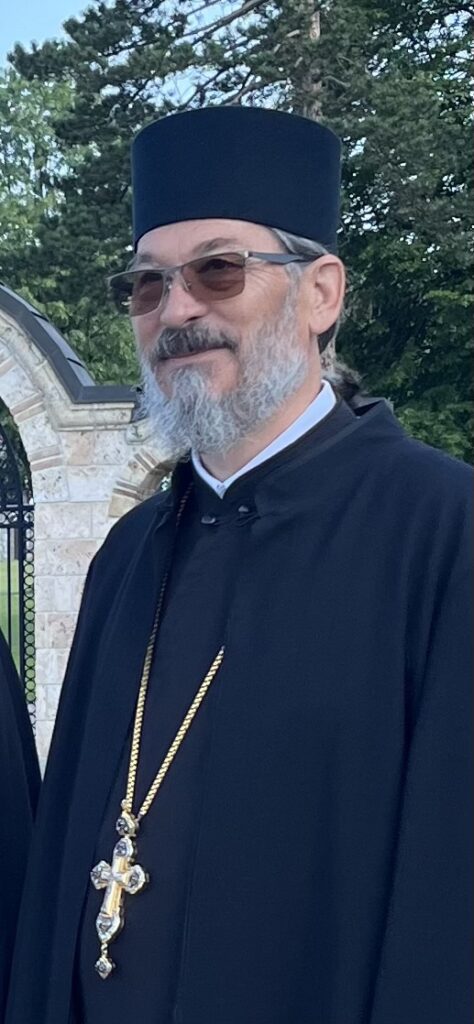
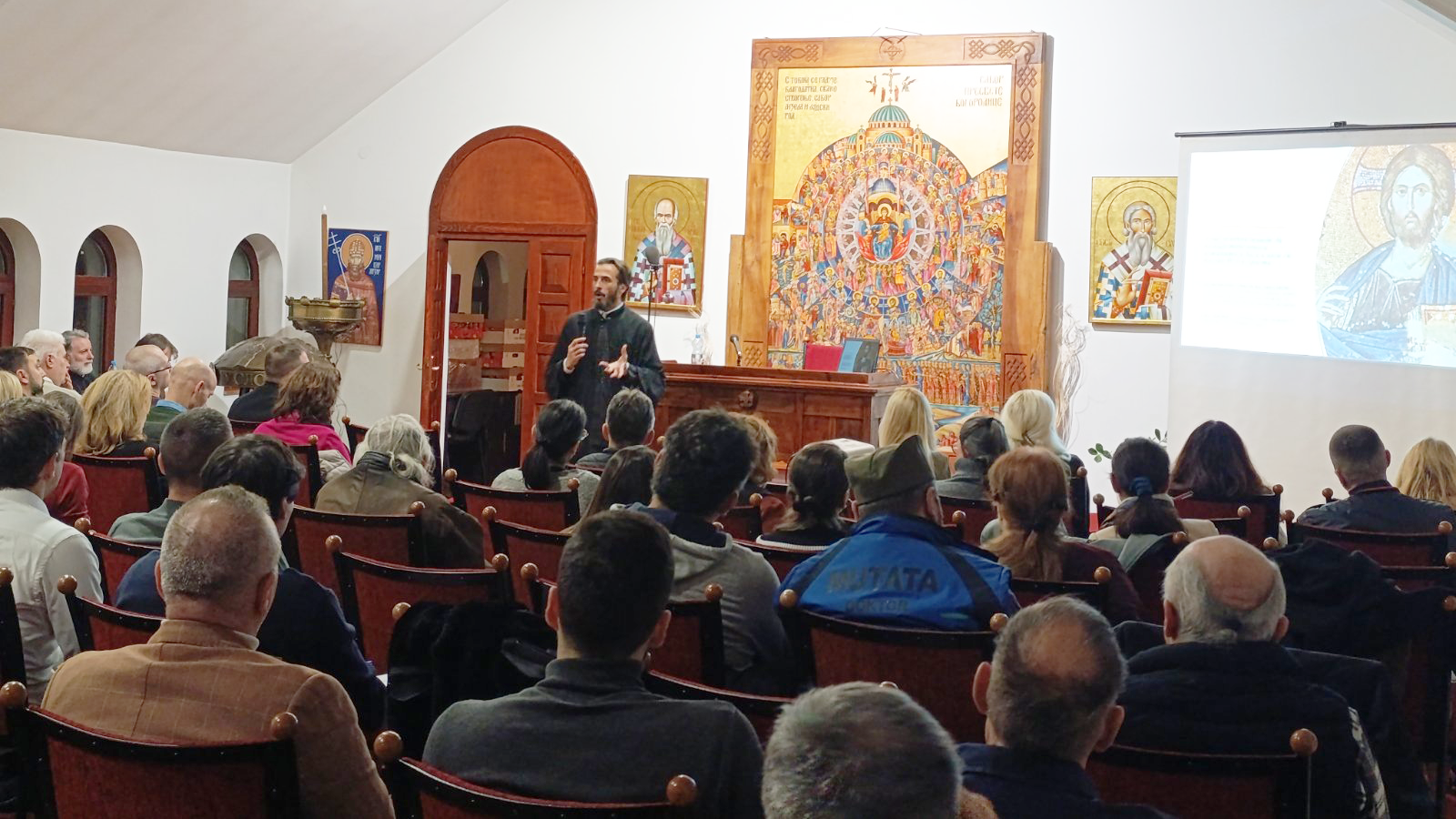
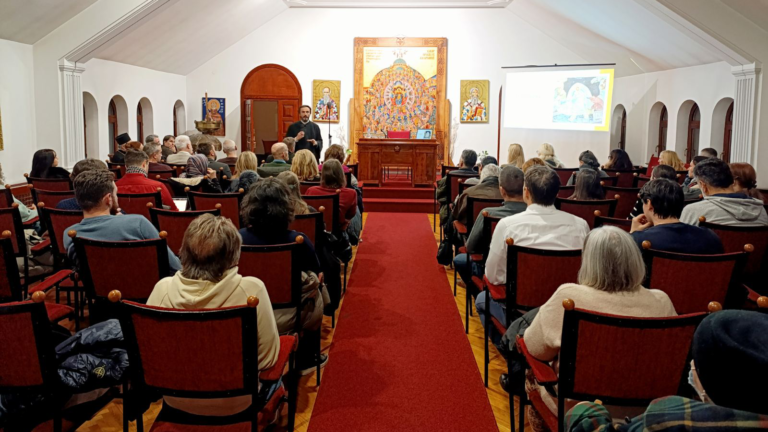
The lecture entitled “External Mission: Fundamental Principles, Historical Experiences, and Our Time” was held on 25 December 2025 at 7:00 p.m. in the hall of the Church of Saint Alexander Nevsky in Belgrade. Around seventy participants registered for and attended the Seminar. Among them was a deacon from Belgrade who expressed particular interest in the external mission of the Church. Special joy was occasioned by the presence of Archimandrite Theophilus (Dimitrić), abbot of the Osovica Monastery in the Diocese of Banja Luka, a clergyman who has been actively engaged in the Church’s missionary work for many years, especially among young people. Father Theophilus travelled a considerable distance to Belgrade solely to take part in the Seminar, in order to share his missionary experience with the speakers and to compare the approach of the Missionary Department of the Archdiocese of Belgrade–Karlovci with the practices he and his collaborators apply in the missionary sphere of the Diocese of Banja Luka.
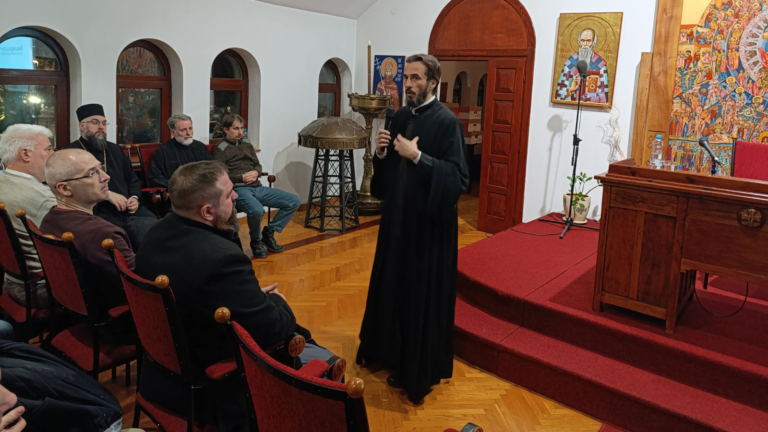
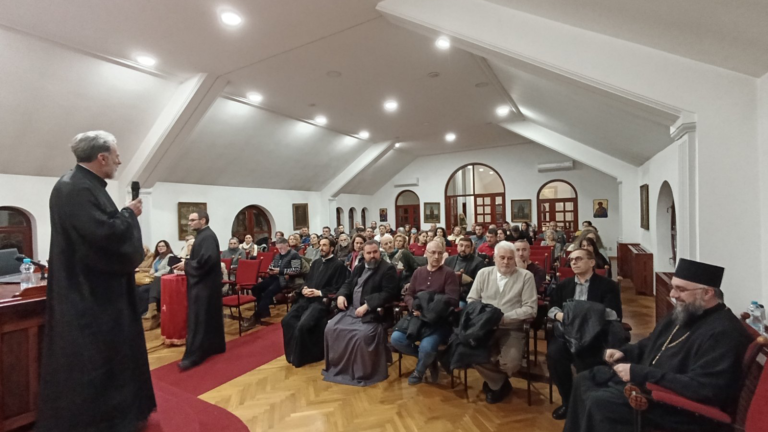
The opening address was delivered by the rector of the Church of Saint Alexander Nevsky, Protopresbyter Stevan Vukić, who greeted those present and briefly reflected on the missionary work of Protopresbyter Ljubodrag Petrović, the renowned former rector of the church, in whose memory the Missionary Department of the Archdiocese of Belgrade–Karlovci initiated the missionary seminars.
This was followed by the main lecture, delivered by the head of the Department, Presbyter Dr Oliver Subotić.
At the very beginning of the lecture, the essential determinants of mission were emphasized, above all its primary goal—the revelation of the glory of God and humanity’s participation in it. The Resurrection was identified as the key event that defines the activity of the Church’s external mission, after which attention was drawn to the missionary nature of the Church, revealed already on the day of Pentecost. Drawing on the thought of the late Archbishop Anastasios Yannoulatos, the lecturer emphasized the need to constantly remind ourselves that the apostolic nature of the Church does not refer solely to apostolic succession, but also to apostolic fervour in proclaiming the Gospel.
In the second part of the lecture, Father Oliver began with the methods of apostolic preaching, with particular emphasis on the method of the Apostle Paul, regarded as the first and greatest strategist of mission in the history of the Church. This was followed by an explanation of the characteristics and specific features of successful missions throughout Church history, illustrated by the activity of the Holy Equals-to-the-Apostles Cyril and Methodius, the Enlighteners of the Slavs, as well as by the missionary methods of saints such as Stephen of Perm, Macarius of Altai, Innocent of Moscow, Herman of Alaska, and Nicholas of Japan. Particular attention was devoted to the missionary method of Ephraim of Arizona, which is grounded in the hesychastic tradition. The personal characteristics of these missionaries and the individual contributions each made to the sphere of external mission were also examined.
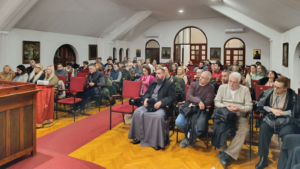
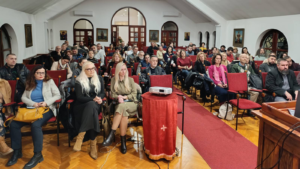
In the third part of the lecture, the audience’s attention was directed towards practical recommendations for missionary activity, based on experiences gathered thus far within the discipline of missiology. The most common missionary errors were identified, along with the reasons for their occurrence. Particular emphasis was placed on the problem of so-called ecclesiological provincialism, described as a specific spiritual pathology in which external mission is viewed as something entirely superfluous or, in its mildest form, as something marginal, under the pretext that various internal problems must first be resolved. In this regard, the activity of Saint Innocent of Moscow was cited as an example of how external mission contributes to the development of internal mission, as well as certain reflections of Saint Nicholas of Japan, who reminded the provincialists of his time that we would not be Christians today had the apostles themselves thought in a provincial manner. The negative influence of nationalism, in its most commonly encountered form, on the slowing of the Church’s external mission was also addressed, with the emphasis that in Christ artificial boundaries between nations are erased.
In the concluding part, the lecturer reflected on the place and role of Orthodox Serbs in the external mission of the present day, emphasizing that it concerns two domains. The first concerns the presence of the diaspora, which should move towards the principle of integration into Western societies, accompanied by the rejection of the mutually exclusive and equally harmful tendencies of ghettoization and assimilation. The idea is that, by preserving one’s spiritual identity while being integrated into Western societies, opportunities may be created for missionary activity through the lay apostolate—that is, through the faithful who live and work in those countries. The second form of external mission was described by the speaker as an asymmetric approach, grounded in the very limited resources required for missionary work, given that non-Orthodox foreigners in the twenty-first century are already present in our own country, numbering several tens of thousands. Consequently, it is not necessary to travel to distant lands in order to proclaim the Gospel to them; rather, what is required is the effort to learn foreign languages and to recognize the need to work pastorally with foreign citizens. In this context, the NevskyTalks project, which has been ongoing for a full three years, was also mentioned.
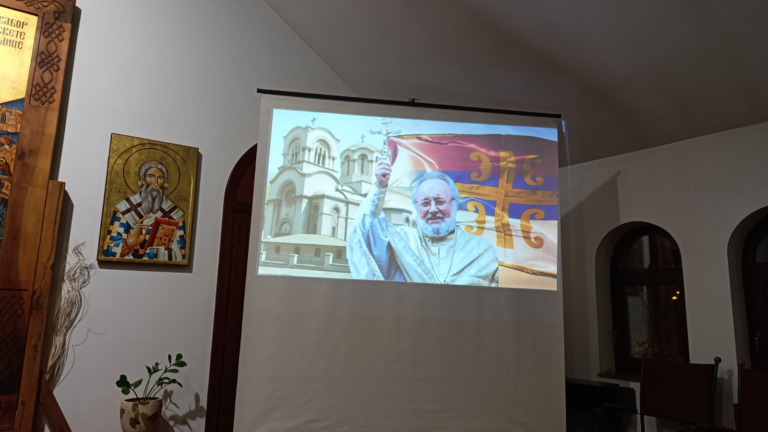
In his concluding remarks, Father Oliver referred to Father Ljuba Petrović and the contribution he made to the field of internal mission, expressing the view that Protopresbyter Ljuba would, in our own time, certainly have supported the activity of external mission as a natural continuation of the work he began four decades ago.
The event concluded with a lively and substantive discussion with those present, during which the lecturer invited all who are interested in the mission of the Church and who wish to become more actively involved in this field to contact the Missionary Department, with the blessing of their spiritual father or parish priest.