The text was published on the Kinonia portal, in the section “From the Editor’s Pen,” on 15 December 2025.
Fasting is a time of our intensified communion with Christ and with all the saints who, through their ascetic struggle, were pleasing to the Lord. The season of fasting calls us to active love and to good works; therefore St Basil the Great says: “Do not confine the virtue of fasting merely to abstinence from food. True fasting is not only the renunciation of various foods, but the renunciation of passions and sins: that you wrong no one, that you forgive your neighbour for the offense he has committed against you, for the evil he has done to you, for the debt he owes you. Otherwise, you abstain from meat, but you devour your brother himself. You drink no wine, yet you humiliate another human being.”
In order that we might welcome in the most worthy manner the feast of the Nativity of the Incarnate Logos of our Lord Jesus Christ, the Church, in her divine wisdom, established the Nativity Fast, which at the same time reminds us of the fasting of the Old Testament patriarchs and righteous ones who, in fasting and prayer, awaited the coming of the Saviour. According to the words of St Symeon, Archbishop of Thessaloniki, the fast of the Nativity Forty-Day Fast prefigures the fast of Moses, who, having fasted for forty days and forty nights, received the divine commandments on tablets of stone. And we, fasting for forty days, contemplate and receive the living Word from the Virgin—not inscribed on stone, but incarnate and born—and we partake of His divine flesh.
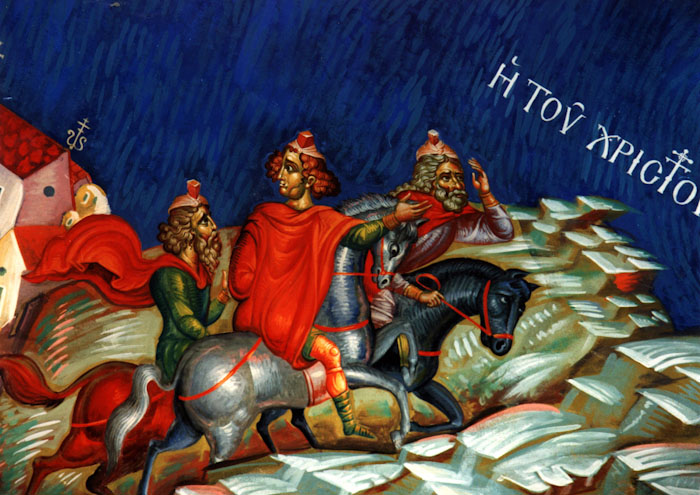
The duration of the Nativity Fast may be symbolically associated with the journey of the three Magi to the cave of Bethlehem in which our Lord Jesus Christ was born. The Christian ethos teaches us that fasting is a guiding star for Christians: we are led by fasting, just as the Magi, guided by the star, came to the God-Child. In his sixteenth homily on the Nativity, St Gregory Palamas reminds us that the Incarnation of God the Logos brought ineffable treasures to us human beings, even the Kingdom of Heaven itself. As distant as heaven was from earth before the Incarnation and the becoming human of God the Logos, so distant was the Kingdom of Heaven from us; and, strengthened by these words of St Gregory Palamas, the God-bearer of the fourteenth century, through fasting and prayer during the Nativity Forty-Day Fast we go forth to meet the God-Child Christ, the true Sun of Righteousness.
The establishment of the Nativity Fast, as well as of the other multi-day fasts, dates back to the first centuries of Christianity. From the fourth century, St Ambrose of Milan, Philastrius, and Blessed Augustine mention the Nativity Fast, while in the fifth century Pope Leo the Great wrote about it. Originally, the Nativity Fast lasted seven days for some Christians, and for others somewhat longer. At the council held in 1166, during the time of Patriarch Luke of Constantinople and the Byzantine Emperor Manuel, all Christians were commanded to observe a forty-day fast before the great feast of the Nativity of Christ. The Nativity Fast was instituted so that, before the day of Christ’s Birth, we might be purified through repentance, prayer, and fasting, in order that with purified heart, soul, and body we may welcome the Son of God who has appeared to the world, and that, in addition to ordinary gifts and offerings, we may offer Him our pure heart and our desire to follow His teaching.
When we set foot upon the spiritual path of the Nativity Fast, our synergy with God ought to become even stronger. This is a time when our movement towards God and our desire to encounter Him through fasting, through prayer, through service should be more intense and more profound. But how can we ensure that our souls are not merely outwardly benevolent and engaged only in external deeds, but are truly filled with divine grace?
Forgiveness is one of the most powerful means, beneficial at every moment, and especially during the Nativity Fast and the other multi-day fasts. It is mercy, it is love, it is service; it is the readiness to renounce ourselves, to step out into the world, and to serve wherever we may find ourselves. The period of the Nativity Fast begins on the day of the prayerful commemoration of the holy Apostle Philip; therefore, we are called to follow the example of the Apostle Philip, Nathanael, and the great saints, so that our movement towards God may be pleasing to Him. We have no right to indifference; we have no right to stand with our arms crossed. We are expected to participate in the mystery of fasting with our whole being—by word, by deeds, by thoughts, and by our gaze—and the mystery of fasting is far deeper than our concern for food.
Physical fasting without spiritual fasting brings nothing to the salvation of the soul. True fasting is inseparable from prayer, repentance, restraint from passions and vices, and the uprooting of evil deeds. Fasting is not an end, but a means—it is a means for humbling the body and cleansing it from sins. Without prayer and repentance, fasting becomes a diet. The essence of fasting is expressed in a church hymn: “If you fast from food, O my soul, but do not cleanse yourself from passions, you rejoice in abstinence in vain; for if you lack the desire for correction, you will be hated by God as a liar, and you will become like the evil demons who never eat.” In other words, the most important aspect of fasting is not the quality of food, but the struggle against the passions. External fasting that is disproportionate to our spiritual practice is more harmful than beneficial, for it primarily awakens vanity within us. The mere practice of external fasting does not bring us closer to God or to others; on the contrary, it distances us from them.
Year after year, we have grown accustomed to observing the fast too superficially, too formally, often reducing it merely to dietary rules, without adding prayer or penetrating into an understanding of our path towards Christ, into the mystery that is revealed to us during this sacred time. Christ draws near to each of us; therefore, the worst thing that can happen to us is lukewarmness—that is, an outward, formal observance of the fast. True fasting presupposes our striving, through ascetic struggle, to draw closer to Christ—not only through the reading of Holy Scripture, not only through the reading of the Psalter and prayers, nor merely through more zealous participation in the liturgical services, but through the genuine acceptance of the most essential reality in Christ—His love.
Bowing our heads before this great mystery, prayerfully invoking the patronage of the holy servants of God who were pleasing to the Lord through fasting, prayer, good works, and love, we walk the sanctified rhythm of the Nativity Forty-Day Fast and, together with the Church hymnographer, repeat the words of the first ode of the Nativity Canon: “Christ is born—glorify Him! Christ comes from heaven—go forth to meet Him! Christ is on earth—be exalted! Sing to the Lord, all the earth! Rejoice, O peoples!—for He has been glorified.”
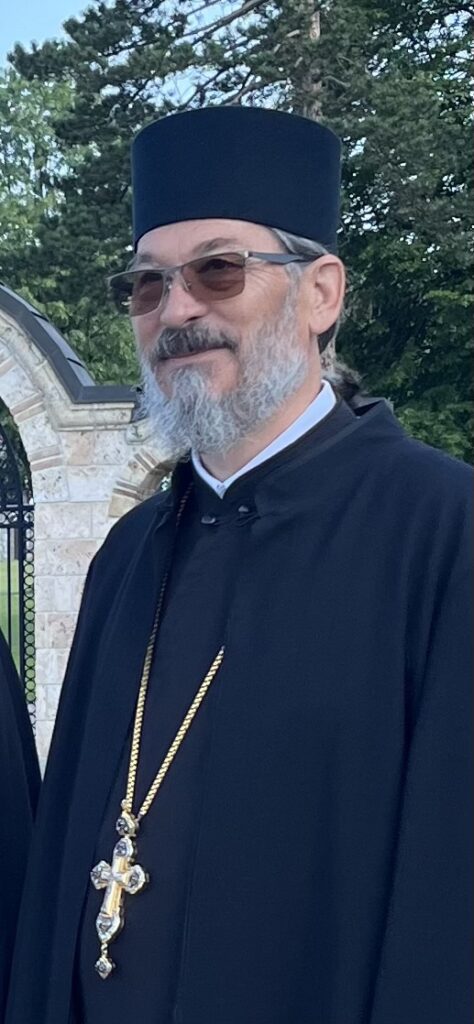
Written by: Catechist Branislav Ilić, editor of the Kinonia portal.
Vrh obrasca
Dno obrasca