The text was published on the portal Kinonia in the section “From the Editor’s Desk” on 4 December 2025.
The Feast of the Entrance of the Most Holy Theotokos into the Temple is one of her radiant feasts that does not rest upon direct scriptural testimony, but rather upon ancient ecclesial tradition. The tradition concerning the feast of the introduction of the Most Holy Mother of God into the Jerusalem Temple is preserved in the writings of the early Fathers of the Church, as well as in numerous liturgical hymns composed in her honour. Although this Marian feast does not derive its foundation from Holy Scripture, this in no way diminishes its salvific and spiritual significance. The hymnographers of the feast include George, Metropolitan of Nicomedia, who composed two lity stichera and the first canon; Leo Vardalis, who authored the doxastikon and the now on the lity and lauds stichera; Sergius of Constantinople (the Hagiopolite), who wrote the doxastikon and the now on the stichera at the aposticha; while the second canon was composed by Basil Pagariot, and the canon of the forefeast by Joseph the Hymnographer. The feast has one day of forefeast and four days of afterfeast.
Saints Joachim and Anna raised their daughter Mary in all piety, purity, and righteousness, virtues which they themselves embodied, filling her heart with Christian virtues and the fear of God. According to ancient ecclesial tradition, when Mary was six months old, the righteous Anna placed her on the ground to see whether she could stand. The Child took seven steps and returned, whereupon Saint Anna declared: “As the Lord my God lives, you shall not walk upon the earth until I bring you into the Temple of the Lord.” When Mary was one year old, her holy and righteous parents held a festal celebration in their home, during which the high priest pronounced a blessing: “O Lord God of our Fathers, bless this child and grant her a name that will be glorified in every generation.” Thereafter the priests present proclaimed another blessing: “O Lord God of glory, look upon this child and send her every blessing.” From these spoken blessings we may discern that every moment of the Most Holy Theotokos’ life—from her conception and birth onwards—was permeated with prayer and divine benediction. The culmination of this prayerful and grace-filled preparation was Mary’s entrance into the Jerusalem Temple in the third year of her life.
“Beholding the entrance of the All-Pure One, the angels were amazed,” we chant in the liturgical hymns of this radiant feast. We are likewise invited to rejoice and marvel together with the angels at this wondrous event. This day stands as a great and significant moment in the life of the Mother of God. It foreshadowed that the Most Holy Virgin—one of the daughters of humankind who, at her birth, was subject to original sin as are we all—would become “more honourable than the Cherubim and beyond compare more glorious than the Seraphim.”
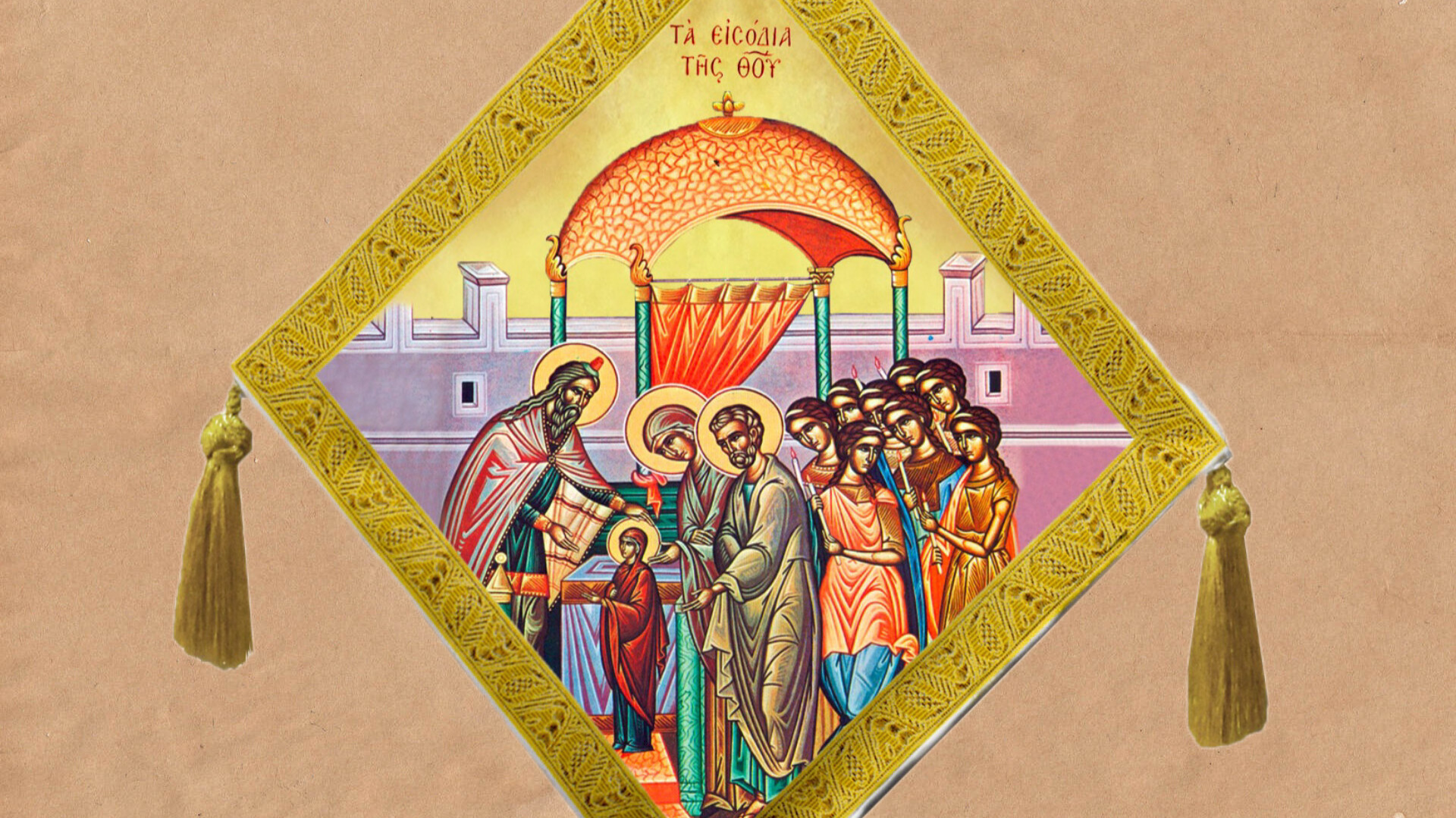
The parents of the Virgin Mary, the righteous Joachim and Anna, while praying that the Lord remove from them the reproach of barrenness, vowed that if a child were given to them, they would dedicate it to the service of God. When the Most Holy Virgin turned three years old, the holy parents resolved to fulfil their vow. Gathering their relatives and friends, they dressed the All-Pure Virgin in her finest garments and, singing sacred hymns and carrying lit candles, led her to the Temple in Jerusalem. The Temple was approached by a staircase of fifteen high steps, which only an adult could ascend unaided. Once placed on the first step, the three-year-old Mary—strengthened by divine power—swiftly ascended all the high steps and reached the top. There the high priest Zachariah met the Virgin face to face. Inspired by divine grace and providence, the high priest led the Most Holy Virgin into the Holy of Holies, into which—according to a precisely defined rule—only one man (the high priest) could enter, and that only once a year.
The Most Holy Virgin enters the Temple in Jerusalem so that God might enter the world and the Son of God might assume human nature from the All-Pure Virgin. Already now, a month before this great feast, we begin liturgically to experience the approaching Nativity of Christ, for the joyous hymn heard in the church summons us to greet the Divine Infant who is born: “Christ is born—glorify Him! Christ from heaven—meet Him!” As together with the hymnographer we magnify the Most Holy Virgin, the holy Church invites us to share with the angels the joy of this wondrous event: “Angels and men, with honours let us magnify the Virgin’s entrance, for with glory has she entered the Holy of Holies.” Yet reverence and admiration before the marvellous providence of God manifested in the All-Pure Mother of God are not sufficient; the Most Holy Virgin was chosen from among us, from the human race, and belongs to us more than to the angels, and therefore our prayerful veneration must be crowned with imitation of her example. Celebrating the Feast of the Entrance of the Most Holy Theotokos into the Temple, we contemplate her entry into the house of the Lord, where the righteous Joachim and Anna brought her as a precious offering to God. There she spent twelve years, growing in spirit and body, in unceasing prayer, fasting, and obedience. Following the All-Pure Virgin Mary, we too enter the temple of God, leaving at its threshold the daily tumult of life—leaving behind all that is transient, senseless, harmful, superfluous, and base—in order to delight in the stillness of prayer and in the joy of communion with God, with the Most Blessed Queen of heaven and earth, with the angels and all the saints; to find refuge in this quiet haven of prayer and grace from the noise and storms of a harsh, cold world. Just as the Virgin Mary mysteriously grew spiritually within the Jerusalem Temple, so in every temple the Christian grows and is strengthened in spirit, is educated for heaven, learns to pray, and receives the grace-filled strength to struggle against sin. Whoever sets aside worldly cares and enters the church with a sincere desire for prayer returns with peace with God in his heart and, fearing no one and nothing, continues to live in peace and joy, living in accordance with the Gospel. The Church is the house of God and the Kingdom of Heaven on earth, and we strive to make this sacred house as beautiful as possible: we gild altars, paint icons, adorn it with stone and flowers, bringing the best we can into the house of God. Yet there is another house, represented by the Mother of God herself. Man is created in the image of God, and that image presupposes an interior world, not in a strictly anatomical sense; our inner space has neither width nor depth—our thoughts may extend from boundless galaxies to kitchens. This world is vast, and it too is called a temple, whose furnishings are our thoughts. And our inner space is intended to be the dwelling place of God. A human being is the temple of the Holy Spirit, and therefore the realm of our thoughts must be beautiful, serene, joyful, devout, and sincere; then the Lord speaks to us, and our prayer becomes a divine service taking place within our inner sanctuary. This is why priests and spiritual fathers tirelessly repeat: pray, read the akathists, pray—this is your own liturgy; for communion with God is the most important reality in the life of every human being. The Mother of God teaches us how we ought to enter the temple; she already possessed the temple in its most perfect form within herself, where joy, peace, and gratitude to God reigned. The example of the Most Holy Theotokos continually awakens us spiritually and urges us always to rise again from the mire of sin in which we all too often find ourselves. “When you fall—rise again,” she tells us, she whose entire being was conformed to the will of God. This struggle, this ascent of the ladder with one’s final breath, is the only thing that we, in our sinfulness and frailty, can offer to the Lord. Celebrating this beautiful feast, we pray that the Most Holy Mother of God—the little girl who easily ascended the high steps—may be our example and help. She is our intercessor, our protectress, and by her prayerful covering will help each one of us. We are called to strive with all our strength to overcome our sinful nature, that we may ascend the spiritual steps towars the Throne of God, confirming at its summit the essence of our faith and our desire to be with God. Finally, together with the hymnographer, we magnify the Most Holy Virgin with the words of the hymn: “Thou art the preaching of the prophets, thou art the glory of the apostles, and the praise of the martyrs. Thou art the renewal of all on earth, O Virgin Mother of God. Through thee we are reconciled with God; therefore we celebrate thy entrance into the temple of the Lord, and with the angel we all cry to thee in song: rejoice, O All-Pure one, for by thy prayers we are saved.” Written by: Catechist Branislav Ilić, editor of the portal Kinonia.