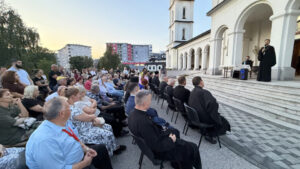
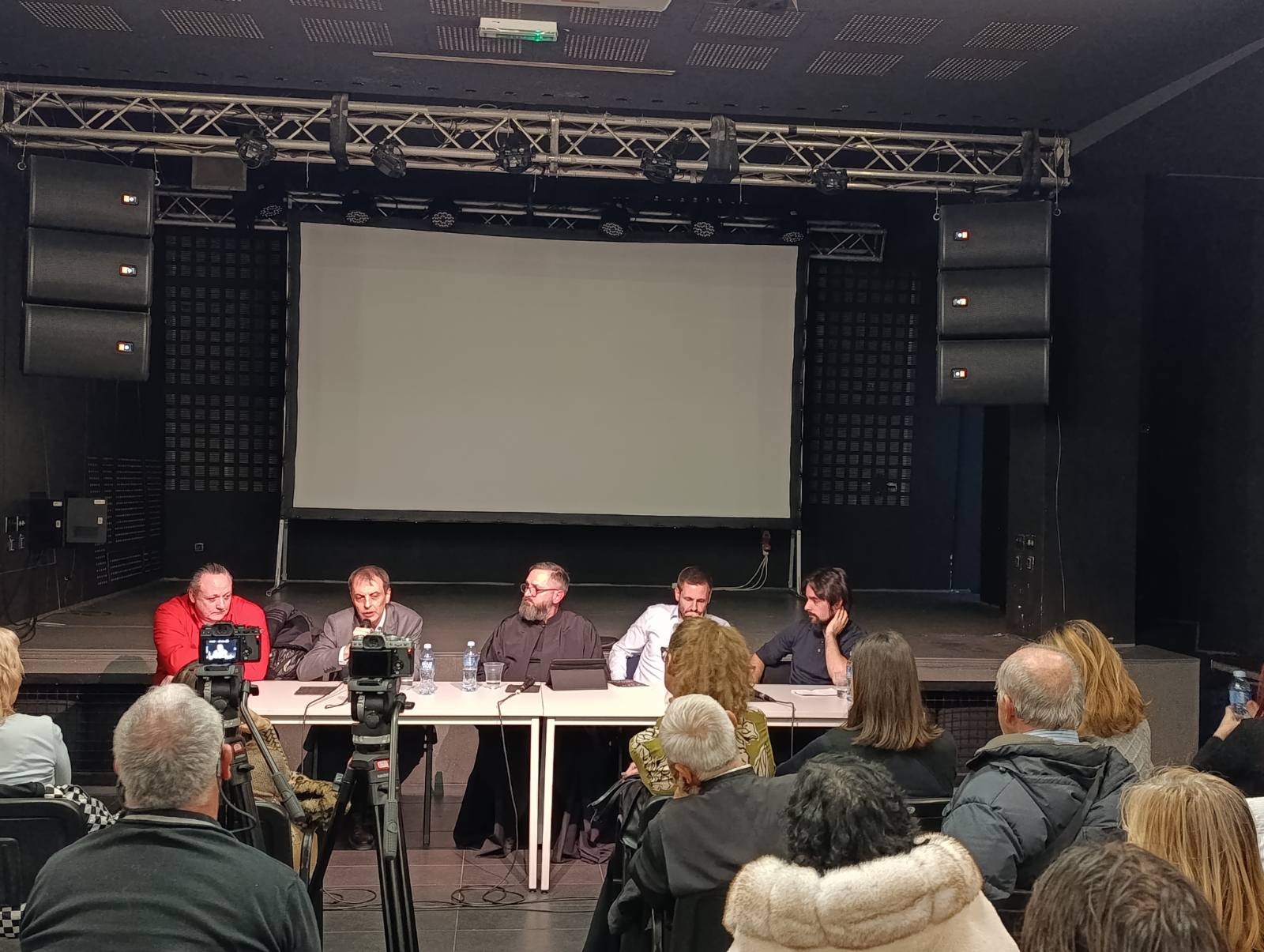
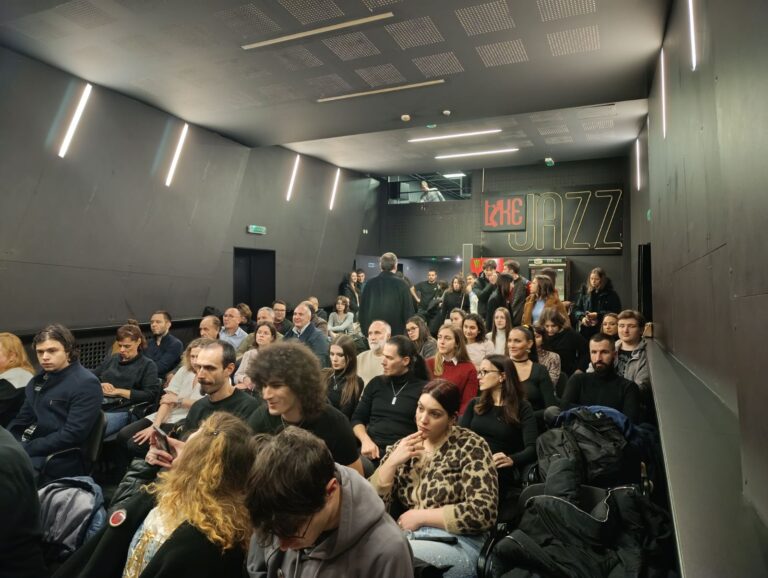
On Monday, 8 December 2025, a panel discussion titled “From Cosmology to Creation: Does Modern Physics Intimate the Creator God?” was held at the Belgrade Youth Centre, organized by the Section for Dialogue in the Public Sphere of the Missionary Department of the AEM. The event drew an exceptionally large audience—the hall could not accommodate all who wished to attend—testifying to the profound public interest in the dialogue between science, philosophy, and theology.
The panel featured the following participants:
• Dr Marko Vojinović, Institute of Physics, Belgrade
• Prof. Dr Miroslav Popović, Faculty of Technical Sciences, Singidunum University
• Prof. Dr Goran Poparić, Faculty of Physics, University of Belgrade
• Veljko Košević, Institute of Social Sciences and doctoral candidate at the Faculty of Philosophy, University of Belgrade (field: philosophy of religion)
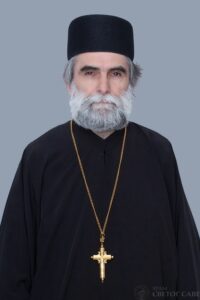
The moderator of the discussion was Presbyter Dr Aleksandar Milojkov, Coordinator of the Section for Dialogue in the Public Sphere of the Missionary Department of the AEM.
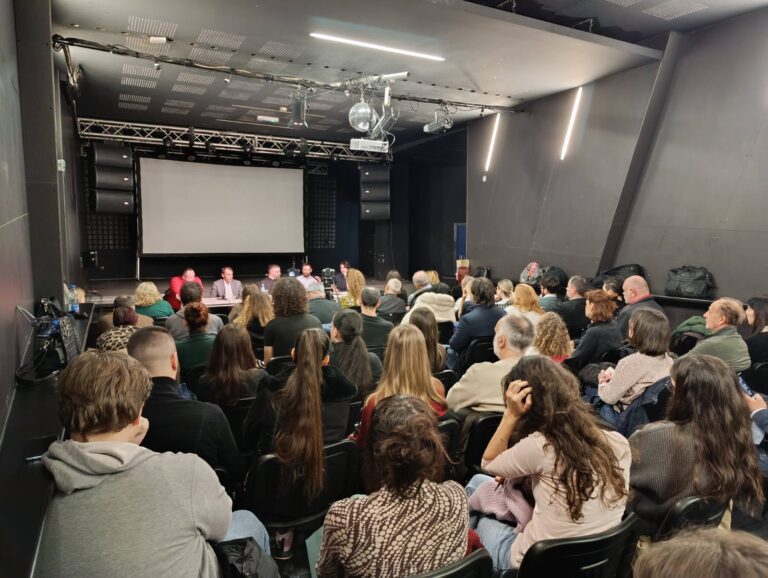
In the introductory segment, participants reflected on the major paradigm shift in cosmology during the twentieth century—from the notion of an eternal, static cosmos to the contemporary Big Bang model. Particular attention was given to the concepts of singularity and quantum vacuum, as well as to the question of how Christian theology, philosophy, and modern physics respectively employ the term nihil (“nothing”) when speaking of “coming into being out of nothing.”
Engaging in dialogue with philosophy and theology, the panel also posed the classical question: is a “First Mover” (actus purus), as formulated by Thomas Aquinas in his cosmological argument for the existence of God, necessary to explain the beginning, or is an infinite regress of physical causes possible? The participants’ presentations demonstrated that precisely where physics no longer has an answer, the space and legitimacy of philosophy and theology begin.
In the second part of the panel, the discussion turned to the fine-tuning of physical constants and the anthropic principle—both its weak and strong forms. Physicists presented several striking examples of the sensitivity of cosmic parameters; from a philosophical standpoint, the question was raised whether these might imply an argument for purposiveness (the teleological argument for the existence of God); and the theologian addressed the Christian understanding of the world’s order and logos-structure.
In the concluding part , the participants examined the well-known assertion of Michio Kaku that “the elegance of the laws of physics points to the hand of a cosmic designer.” They considered whether such a statement should be interpreted as scientific, philosophical, or theological—or whether it is precisely the point at which all three disciplines converge.
The panel concluded in an atmosphere of sincere intellectual enthusiasm. It became evident that physics, philosophy, and theology are not opposing realms, but three distinct yet mutually enriching perspectives on the same mystery of existence.
Moderator Presbyter Dr Aleksandar Milojkov observed that the beauty of the cosmos and the harmony of its laws constitute the point at which these disciplines meet—the place where, as he stated, “science feels awe, philosophy seeks meaning, and theology recognizes the Beauty that saves the world.”
The Missionary Department of the AEM announced that such dialogues will continue in the future as a meaningful contribution to the culture of public discourse and to the encounter between modern science and Christian thought.
The entire event was covered by TV Hram, whose recording of the panel discussion is expected soon.