
I have already written about Dawkins’s misrepresentation of Einstein as a pantheist (which, for Dawkins, is nothing more than “dressed-up“ atheism ), but I now find that the more gentle (unlike Dawkins) Michio Kaku has made the same mistake. In his book The God Equation, Kaku writes:
“…Einstein despaired over the impossibility of answering questions concerning the meaning of life, but he expressed his views on God quite clearly. He wrote that one of the problems lies in the fact that there are two kinds of God which we often confuse. The first is the personal God, the one to whom you pray, the God of the Bible who smites the Philistines and rewards the faithful. He did not believe that the God who created the universe intervenes in the lives of ordinary mortals. However, he believed in Spinoza’s God – in the God of order in the cosmos, who is beautiful, simple, and elegant. The cosmos could have been ugly, random, chaotic, but instead it possesses a hidden order that is mysterious yet profound.
Einstein once invoked an analogy – he said that he felt like a child who had entered a vast library. All around him were countless books containing the answers to the mysteries of the universe. His life’s goal, in fact, was to read a few chapters of those books. Yet he left an open question: if the cosmos is like a vast library, does a librarian exist? Or someone who wrote those books? In other words, if all the laws can be explained by a theory of everything, where do the equations come from?”
Kaku most likely understood Einstein as a pantheist because Einstein often used the expression “Spinoza’s God.” Yet, unlike Spinoza, Einstein was not a pantheist—he did not accept Spinoza’s identification of God with nature (Deus sive natura). Under the phrase “Spinoza’s God,” Einstein had in mind the God of order and cosmic harmony. For this reason, his position is closer to deism, certainly not to pantheism. Here are Einstein’s own words, which confirm what I am arguing:
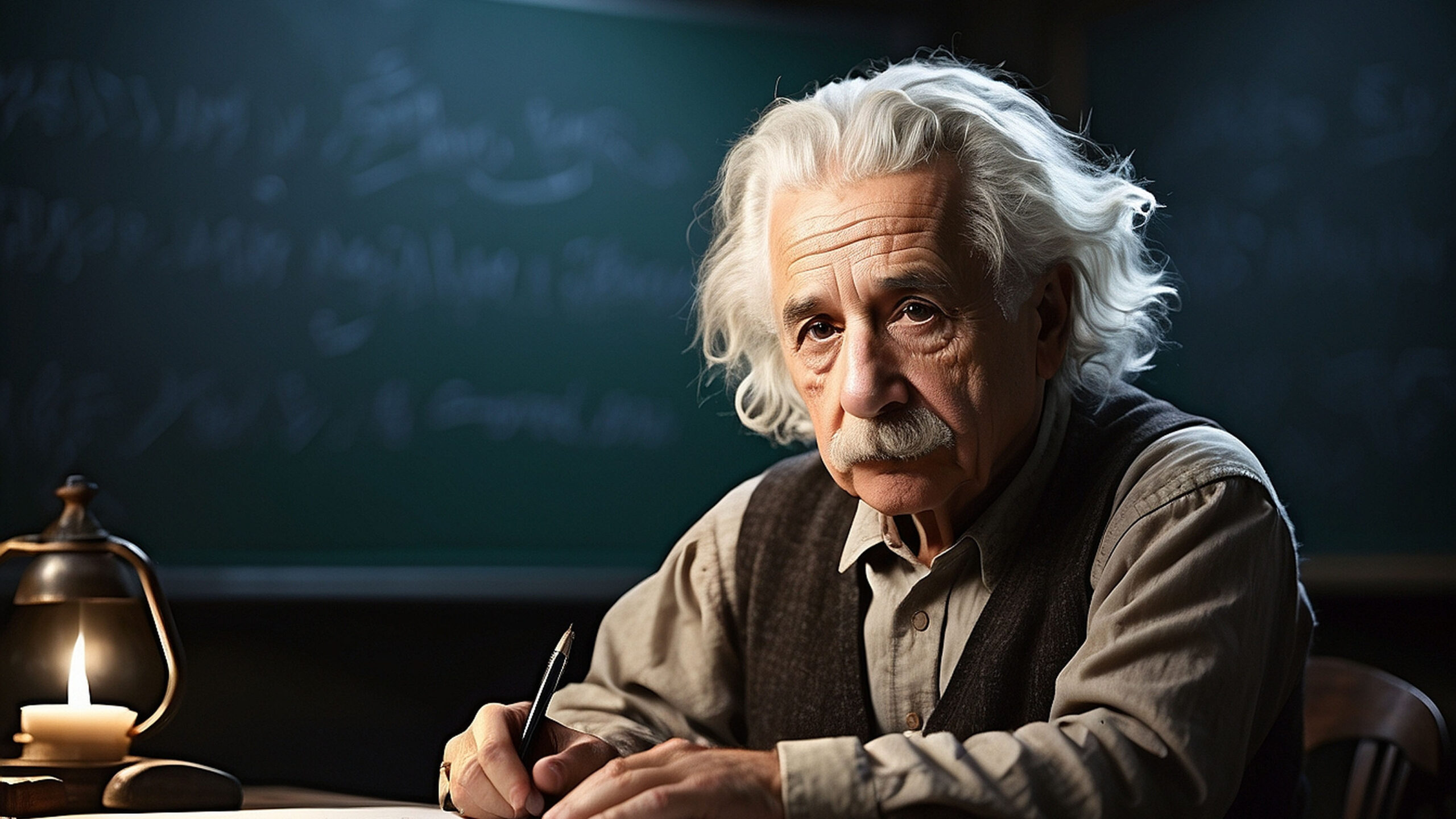
“I am not an atheist, and I do not think I can call myself a pantheist. We are in the position of a little child entering a huge library filled with books in many languages. The child knows someone must have written those books, but does not know how. It does not understand the languages in which they were written. It dimly suspects a mysterious order in the arrangement of the books, but it does not know what it is. That, it seems to me, is the attitude of even the most intelligent human being towards God. Our limited minds cannot grasp the mysterious force that moves the constellations. Spinoza’s pantheism fascinates me, but I admire him more for his contributions to modern thought, for he was the first philosopher to treat soul and body as a unified whole, not as two separate entities.”
Thus, he states clearly: I am not a pantheist. Spinoza was a pantheist. He also clearly says that Spinoza’s pantheism fascinates him, but that he valued Spinoza not for that, but for his rejection of the soul–body dualism.
I found this curious: I came across the same Einstein quotation in another of Michio Kaku’s books—Einstein’s Cosmos. After searching for the sources, I concluded that these sentences are, in fact, drawn from several of Einstein’s letters and other writings; thus they do express his authentic views. Kaku gathered these Einsteinian statements into a single composite quotation, which he then published in the aforementioned book. This raises the question: does the brilliant Michio Kaku contradict himself? Evidently, yes—at least regarding Einstein’s position on God. Considering that Einstein’s Cosmos was published in 2004, and The God Equation in 2021, almost two decades later, it is possible that Kaku simply forgot about his earlier compilation of Einstein’s words.
Let me also comment on Kaku’s assertion that “Einstein despaired over the impossibility of answering questions concerning the meaning of life.” I believe I know why he despaired. Many great scientists, including Michio Kaku, remain firmly committed to the scientific method. Though they occasionally touch upon or reflect on metaphysical questions, they ultimately remain bound to the methodological naturalism of the natural sciences. This methodological naturalism is, in itself, good—for science itself, because without it science could not exist as science. Yet, at the same time, in a certain meaningful (and meaningfulness-related) discourse, methodological naturalism represents a kind of cage into which one voluntarily places one’s mind. And the mind is like a bird in that cage—it naturally longs to fly out (as Aristotle already suggested at the very beginning of his Metaphysics). It desires to go beyond those iron bars. When those bars (methodological naturalism) do not allow it to go out, the mind experiences precisely the despair that Einstein felt.
The question of meaning—the search for truth—as something inherent to the human mind, is exactly the point at which naturalism, both methodological and especially ontological, begins to crack. Let me cite an illustrative example. Let me pose a question to biological evolutionary theory: if our brain is the product of evolution, why does the brain seek meaning? Let me deepen and clarify this point. The main mechanisms in evolutionary theory are genetic mutations and natural selection. Those mutations (changes in organisms) that contribute to better adaptation to given life conditions survive. That is, those that contribute to successful survival and hence to the possibility of leaving offspring. Natural selection explains why we possess traits that contribute to this goal. For example: sharp hearing, quick reflexes, stronger muscles, bipedalism, and many other traits that improved adaptability and survival. Natural selection seems to have a code that reads: remain alive long enough to reproduce. But the mind’s characteristic tendency to ask questions is neither evolutionarily desirable nor useful, nor does it contribute to survival. On the contrary, questions of meaning generate anxiety, reflection on finitude generates fear, and moral dilemmas sometimes prevent behaviour that would be biologically optimal. How did the filter of natural selection allow the emergence of such evolutionarily undesirable and useless traits? Whence comes the desire for martyrdom—surely a genetic catastrophe! Whence monasticism—pure zero in genetic fitness! Whence the need for art—a seemingly futile labour that contributes nothing to survival! Whence the need for science and the search for truth? How is it possible that something “chiseled” by evolution solely for the purpose of survival ends up seeking some distant “truth”? In this respect let me paraphrase Alvin Plantinga: if our reason is the product of blind processes, there is no guarantee that our beliefs are true. If there is no guarantee that our beliefs are true, then belief in naturalism itself cannot be reliable. I would add: why science at all, dear scientists?
Let me now summarise my argument:
• Evolution is concerned only with what is useful, not with what is true.
• The search for meaning is not useful for survival; on the contrary, it produces anxiety.
• Yet the human being nevertheless possesses an innate drive towards meaning.
• This implies that the mind has a function not reducible to survival.
• If the mind possesses a function exceeding biological necessity, then something metabiological or metaphysical is inherent to the human being.
• This suggests that the human being is not (merely) a product of natural selection.
At this point naturalism collapses. Its only hope of survival is to claim that the “search for meaning” is a “system error.” But that would not constitute an explanation; it would amount, rather, to an admission of naturalism’s conceptual breakdown.
Presbyter Dr Aleksandar Milojkov
ФОТОГРАФИЈА: pixabay