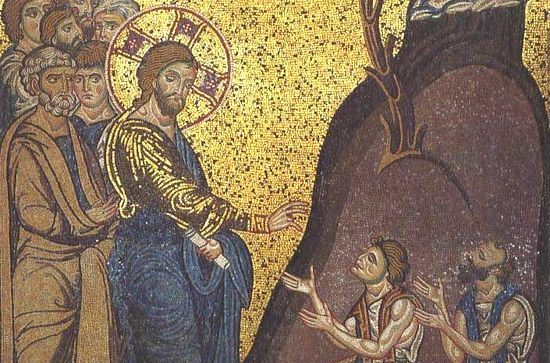
Then He touched their eyes, saying: According to your faith let it be to you. And their eyes were opened. And Jesus strictly charged them, saying: See that no one knows it.
Saint Bishop Nikolai of Ohrid here speaks about the condition which the Lord requires of us: “According to your faith let it be to you. And their faith was not put to shame: according to their faith it was done unto them. Oh, how highly the Lord values His creatures, even though all creatures are smoke and dust beneath His feet! In seeking faith, He seeks the cooperation of man in His work of creation. He could, as the wise Chrysostom says, with a single word make all the sick on earth healthy. But what would He thus accomplish? He would reduce man to the level of the other irrational beings, which are without free will, without the capacity for moral choice, and without the highest purpose. He would lower man to the rank of the sun, the moon, and the stars, which must shine by command; to the rank of the stone, which must stand and fall by command; to the rank of the water in the streams and rivers, which must flow by command. But man is rational and endowed with reason; he must do by his free will what the irrational creation must do by command—that is, to surrender himself completely to God and to fulfil the divine commandments. ‘The Lord commands, and I must obey,’ says all of nature. ‘The Lord commands, and I ought to obey,’ says the true man. Man must choose—not between two goods, but between good and evil. If he chooses good, he will become God’s companion and son in the kingdom of eternity, and he will be more blessed than all nature; if he chooses evil, he will be rejected by God and will fare worse than the irrational beings. Such is, therefore, the will of the Creator: that man freely choose in this life between good and evil. Hence the Lord Jesus asks people for their faith; hence He calls them to cooperation in their own salvation. The Lord asks very little of men—only good will, that they acknowledge Him as the almighty Lord and themselves as nothing. This is faith, and it is precisely this faith that the Lord seeks from men for their own good and salvation.”
In these words lies also the answer to that frequent question and doubt concerning the existence of evil in the world—if God is good, and so forth.
Ava Justin writes the following words as if spoken from the face of Christ: “You are physicians unto yourselves when you have yourselves in Me and Me in you, for you become miracle-workers as soon as you unite your soul, your will, your heart, through the labour of faith, with My soul, My will, My heart. My soul is the healing of your soul; My will is the healing of your will…”
Next, verse 31:
But they, when they departed, spread abroad His fame in all that country.
Saint John Chrysostom explains this verse as follows: “After the healing, Christ commanded them to tell no one, and not merely commanded, but charged them sternly: Jesus strictly charged them, saying: See that no one knows it. But they, when they departed, spread His fame throughout all that country. They did not restrain themselves, but began to proclaim and preach. They could not remain silent, despite the command to keep what had happened a secret. If, in another place, Christ says: Go and proclaim the glory of God, this is not contradictory to what is said here, but entirely consistent with it. Christ teaches us not only to say nothing of ourselves, but also to restrain those who wish to praise us; however, if the praise is given to God, then we are not only not to prevent it but to encourage it.”
Saint Gregory Palamas writes insightfully about the desire of the blind men to proclaim Christ, but also about how, in a certain way, they still fulfilled His command: “Had they not been commanded to remain silent, they would have proclaimed His power throughout the whole world; yet, having received His command, they refrained from going farther, but were not afraid to preach in the nearby regions. Thus, the blind men who followed Christ were completely enlightened—not only in body but also in soul.”
Blessed Theophylact of Ohrid speaks about the motive of the healed men, adding that they spread His glory out of gratitude, not out of disobedience.
Next, verse 32:
As they went out, behold, they brought to Him a man, mute and possessed by a demon.
Saint John Chrysostom explains the nature of the infirmity from which this man suffered: “This illness was not natural, but came from satanic malice. Therefore, it was necessary for others to bring the possessed man to Him. Since the demoniac was unable to speak, he could not pray either by himself or through others, for the demon had bound his tongue and, together with the tongue, the soul itself. The Lord therefore does not ask about his faith, but immediately heals him of his affliction.”
Saint Nikolai of Ohrid continues this reflection, writing that here too the Lord healed the man possessed by a demon because of the faith of those who brought him: “The Lord does not ask him about faith, for how can a man who is insane have faith? How can one who is mute confess faith? But the Lord sees the faith of those who led him to Him. It is probable that the Lord spoke with them in a manner similar to His conversation with the blind men; yet, because of the similarity of those questions and answers, the Evangelist does not record them. For those who seek salvation, there is sufficient guidance and instruction in what was said about the blind. As for those who rush irreversibly into destruction, mocking the Saviour and the words of salvation, not even all the words and all the deeds of the Lord Jesus Christ throughout His entire earthly life would be sufficient.”
Blessed Jerome of Stridon explains that in this passage the word mute actually means deaf-mute, since in the Holy Scripture the same term is used for both the absence of hearing and the inability to speak.
Verse 33
And when the demon was cast out, the mute spoke; and the multitudes marvelled, saying: It was never seen like this in Israel.
Saint John Chrysostom emphasizes that the people’s amazement provoked envy among the Pharisees, which led them to hate Christ: “This especially irritated the Pharisees, for Christ was honoured not only above all His contemporaries but also above His predecessors. He was revered not merely because He healed, but because He healed easily, swiftly, and countless incurable diseases. Thus did the people speak of Jesus.”
For his part, Ava Justin of Ćelije highlights the distinction between the people’s understanding of the Lord and that of the prophets of the Old Testament. Saint Justin writes: “The people were astonished at such power and placed Jesus above the Old Testament prophets and patriarchs, for He heals as One who possesses authority, not as those who prayed to the Lord to heal.”
Another saint of our Holy Church, Saint Bishop Nikolai of Ohrid, continues the thought of Ava Justin, writing: “It was never seen like this in Israel, said the people with wonder. Indeed, both Moses and Elijah and Elisha performed various miracles—but how? Through their faith, fasting, and prayer on one side, and by the good will of God on the other. It was the Living God who worked mighty deeds through them. But Christ performs everything by His own authority and power. The difference between Him and the miracle-workers of old is like that between the sun and the moon: the moon shines with the light it receives from the sun, while the sun shines with its own light. The simple, unprejudiced soul of the people felt that great difference; therefore the mouth of the people confessed: it was never seen like this in Israel.”
Next verse:
But the Pharisees said: He casts out demons by the prince of the demons.
Interpreting this verse, Chrysostom speaks about the utter absurdity of what the Pharisees said: “It is absolutely impossible, as Christ Himself later declares, that a demon should cast out demons. Christ not only cast out demons but also cleansed lepers, raised the dead, calmed the sea, forgave sins, and preached the Kingdom—bringing people to the Father—things which the demon neither desires nor is able to do.”
This is an example of what can still be observed today, when entirely irrational accusations are raised against the Church—for instance, when neopagans claim that Christians committed mass genocides wherever they preached the faith. Anyone who has tried to speak, even briefly, with people who hold such views quickly realizes that the real reason behind such claims lies much deeper than mere ignorance or confusion; it is evident that hatred and the defense of one’s own passions are at work—just as was the case here with the Pharisees.
Saint Nikolai of Ohrid writes about this deeper cause in the following way: “Indeed, it is difficult for any person of even partial awareness to invent a more ridiculous, inconsistent, and foolish interpretation of Christ’s works than that contrived by the darkened minds of the elders and scribes of Israel. Yet it is not without reason that it has been said: envy is blind. One could also say: envy is ridiculous, and envy is foolish. For envy not only hardens the heart and blinds the mind, but also entangles the tongue so that it knows not what it says; thus everything spoken by the tongue of the envious becomes senseless, ridiculous, and absurd.”
Blessed Theophylact of Ohrid exposes the complete irrationality of the Pharisees’ words by momentarily accepting their claim and showing its impossibility even from that standpoint: “Let us suppose, for the sake of argument, that He was allegedly casting out demons as a servant of the prince of demons, by means of magic. How then did He heal diseases, forgive sins, and preach the Kingdom of God? The demon does the opposite: he causes diseases and turns man away from God.”
Adapted for the contemporary reader based on patristic interpretations by: Stanoje Stanković