This text was published on the Kinonia portal, in the section “From the Editor’s Pen,” on 1 September 2025.
At the beginning of every sacred and God-pleasing work, and especially at the start of each new academic year, we invoke the blessing and help of God, for growth in knowledge and true education is a great and holy task, both for those entrusted with the ministry of teaching and for the students committed to their care.
The prayers and petitions that comprise the service of the Moleben at the beginning of the school year are not only of a supplicatory character; they also contain instruction, continually reminding us of the proper understanding of upbringing and education. In the special petitions added to the Great Litany, the deacon prays:
“That He may send upon these students the spirit of wisdom and understanding, and that He may open their minds and mouths and illumine their hearts for the reception of instruction in good learning, let us pray to the Lord. That He may plant in their hearts the seed of wisdom and His divine fear, and thereby drive away youthful frivolity, and illumine their minds so that they may turn away from evil and do good, let us pray to the Lord. That He may open their minds so that they may receive, understand, and remember all good and soul-profiting learning, let us pray to the Lord. That He may grant them His co-enthroned Wisdom and make her dwell in their hearts, teaching them what is well-pleasing before Him, let us pray to the Lord. That by wisdom, virtuous life, and progress in the Orthodox faith, they may be a joy and consolation to their parents and a support to the Orthodox Catholic Church, let us pray to the Lord.”
In addition, the deacon, within the regular petitions of the Fervent Litany, adds prayerful words in which he implores the one true Teacher to fill both students and teachers with every virtue, so that, aided by the knowledge they acquire, they may more fervently glorify God:
“Again we pray to our Lord God, that He may mercifully look upon these students, and that He may send into their hearts, minds, and mouths the spirit of wisdom, understanding, piety, and His fear; that He may illumine them with the light of His prudence; and that He may grant them strength and power, that they may quickly grasp and successfully acquire instruction in His divine law and in all good and useful learning, so that they may advance in wisdom and understanding, in all virtues, and in the keeping of His commandments, to the glory of His most holy Name; and that He may grant them health and long life for the progress and adornment of His Church, let us all say: Lord, hear and have mercy.”
From these petitions of the Great and Fervent Litany in the service of the Moleben at the beginning of the school year, we learn that to educate and nurture another—or oneself—is not possible without a profound penetration into the mystery of sacred education, which presupposes conformity to God. Venerable Father Justin of Ćelije taught his spiritual children that true enlightenment is that which directs a person onto the right path, so that through this earthly life he may attain eternal life in heaven. To be educated and nurtured means to overcome every sin and every passion within ourselves through Gospel faith, love, fasting, and prayer, so that we may make our souls into a dwelling place of the Holy Spirit.
The word vаspitanje (upbringing, formation) has its root in the verb pitati—to feed. Thus, upbringing implies the nurturing, raising, and formation of the whole human person, of his or her personality, not only in a physical but also in a spiritual sense. Education is deeply connected with the formation of the image of God in the human being. It is a lifelong process carried out with the cooperation of the person’s own will, and it does not end with our departure from school, but continues throughout our entire life.
Education is the fundamental priority of every society that seeks the spiritual development and material advancement of its people. In the development of true education for life, the family, the Church, and the school are called to offer children the help necessary for their growth, in accordance with the counsel of the wise King Solomon: “My son, keep your father’s commandment, and forsake not your mother’s teaching. Bind them upon your heart always; tie them around your neck. When you walk, they will lead you; when you lie down, they will watch over you; and when you awake, they will talk with you. For the commandment is a lamp and the teaching a light, and the reproofs of discipline are the way of life” (Prov. 6:20–23).
Most important of all is that children be educated in the spirit of love by parents and teachers, who above all must transmit to them the comfort which they themselves have received from God. The purpose of Christian education is the development of the human person, who realizes his or her being through relationship—in authentic freedom and love towards God, towards humanity, and towards the whole of creation.
The teaching of Orthodox catechism—religious education—has a particularly important role not only in nurturing religiosity and introducing students into the life of faith, but also in socialization and moral refinement. Through this subject, students develop Christian virtues, and through them, the qualities of socially acceptable norms of behavior.
The religious education teacher, throughout both elementary and secondary education, follows the growth and socialization of the student. He or she thus has the opportunity to guide, direct, encourage, and equip the student for the next stage of maturity and personal development. The school period of growth and upbringing is a crucial stage in the formation of a mature moral and religious personality. With the right attitude, sincere and dedicated work, the catechist can most effectively instruct the student in spiritual, moral, social, and communicative skills, and cultivate in him the true likeness of God that was imparted to humankind at creation.
This true likeness of God can only be attained through freedom and love—the greatest of Christian virtues—as confirmed by the words in the Hilandar Typikon of our greatest enlightener, St. Sava: “Nothing is greater than love. For it is the crown and perfection of all virtues. All other virtues and human deeds are like the limbs of the spiritual person, but love is the head and the unity of the whole man. With love are joined high-working humility, mercy, and compassion, for which reason God Himself became man” (Jevtić, 1988: 403).
The goal of man and his vocation in the world are concrete: to advance dynamically, moving unceasingly from the state of being “in the image” (kat’ eikona) toward that of being “in the likeness” (kat’ homoiosis). Thus, the child (as a future mature person) is not created to remain static, but to be in motion; the child is called to make use of God’s gifts, to grow, develop, progress, and be perfected, taking “step by step” towards that ultimate goal. This path is one of ascent, advancing towards God—that is, towards communion with Him.
Religious education is a treasure trove of the deepest and most important questions; it is a path, a search for personal meaning in the light of the Gospel. The model of the ideal religious teacher is Christ, the Supreme Teacher. Christ calls us to follow Him, to experience communion with Him, to embrace the experience of the Cross—the confrontation with evil and sin; the experience of mission—to change ourselves and the world around us; yet all of this in the experience of hope, that He is with us “always, to the close of the age.” These are themes that penetrate deeply into the heart, where lie our desires, dreams, needs, sufferings, decisions, and our future—and after them, just as after the encounters of the biblical figures with Jesus, no one remains the same. Christ’s call is a call to choice and decision, to adopt His way of life.
When we enumerate these foundations of Christian catechesis, we may conclude that religious education has its rightful place in the spiritual dimension of the development of the human person: in the assimilation of imperishable values such as love, solidarity, and hope; in the building of interpersonal relationships; in the discernment of the “signs of the times,” both good and bad; and in addressing the challenges of life.
We fervently pray to the Lord God, worshipped in Trinity—Father, Son, and Holy Spirit—that the beginning of this new academic year may be blessed through the prayers of St. Sava, our teacher on the path that leads to eternal life. May our education and formation thus bear true fruit, culminating in eternal communion with God and all the saints. We crown our humble reflection with the words of the prayer offered by the presbyter when invoking God’s blessing upon all students:
“O Lord our God and Creator, You have honored us men with Your image; You have taught Your chosen ones to heed those who instruct them in Your law; You have revealed wisdom to children; You have taught Solomon and all who seek Your wisdom. Open the hearts, minds, and lips of these Your servants, that they may receive the power of Your law and successfully grasp the profitable learning imparted to them, to the glory of Your most holy Name, to the benefit and advancement of Your holy Church, and to the knowledge of Your good and perfect will. Deliver them from every assault of the enemy; preserve them in the Orthodox faith, and in all piety and purity throughout the days of their life, that they may grow in knowledge and in the fulfillment of Your commandments; so that, thus prepared, they may glorify Your most holy Name and become heirs of Your Kingdom. For You are God, mighty in mercy and gracious in power, and to You belong all glory, honour, and worship, to the Father, and to the Son, and to the Holy Spirit, now and ever and unto ages of ages. Amen.”
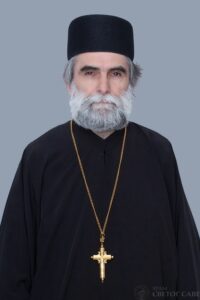
By: Catechist Branislav Ilić, Editor of the Koinonia Portal