We continue with the patristic interpretation of the Gospel.
St. Theophan the Recluse presents the state of mind of the scribes who doubted Christ, and through them, also the mindset of people who do not believe in God: “A mind without faith is devious. It devises cunning doubts and invents blasphemies against the entire realm of faith. At one time it refuses to believe in miracles, and at another it demands the most tangible miracle. But when such a miracle is granted, obliging it to submit to faith, it is not ashamed to persist in unbelief, distorting or misinterpreting the wondrous works of God. This is also how it treats the testimonies of divine truth. Both experiential and rational proofs are set forth in sufficient number. Yet it casts doubt upon them as well.” As we see, it is not a matter of there being insufficient evidence for people to believe in God; the essence lies rather in the absence of the will to fulfill God’s commandments. And until a person voluntarily changes this, no amount of evidence will suffice.
The next three verses read:
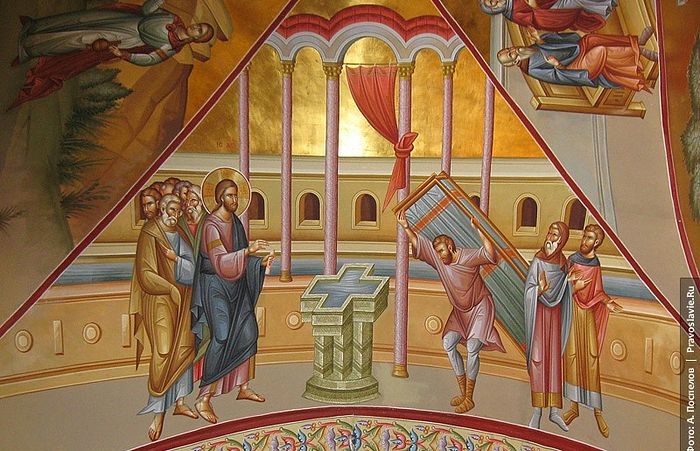
“For which is easier, to say: ‘Your sins are forgiven,’ or to say: ‘Rise and walk’? But that you may know that the Son of Man has authority on earth to forgive sins—He then said to the paralytic—‘Rise, take up your bed and go to your house.’ And he rose and departed to his house.”
Blessed Jerome analyzes more deeply this dilemma which the Lord posed to the scribes: “There is a great difference between speaking and accomplishing. Whether the paralytic’s sins were forgiven was known only to the One who forgave them. But the result of the words ‘Rise and walk’ could be verified both by the man who rose and by those who witnessed him rising. Thus a physical sign was accomplished as confirmation of the truth of the spiritual miracle, for the remission of sins and the healing of the body are both the work of the same Power. Furthermore, we are given to understand that many bodily infirmities arise as a consequence of sins.”
Chrysostom again emphasizes that Christ does everything to manifest the truth even to those who are closed to it. In this way, He removes every excuse from the scribes for rejecting Him. Chrysostom says: “These words bear the following meaning: what seems to you easier—to heal the body of its infirmity or to release the soul from its sins? Obviously, to heal the body. Yet just as the soul is greater than the body, so is the forgiveness of sins a greater work than the healing of the body. However, since the healing of the soul is unseen, while the healing of the body is evident, I, says Jesus, join the former to the latter, which, although lesser, is more visible, in order thereby to confirm the greater and invisible. … Here again the Lord shows His humility and confirms that the miracle He performed was no illusion. He makes those who had been witnesses of the paralytic’s illness also witnesses of his restored health. … The saint also explains the deeper meaning of the Lord’s words to the paralytic: ‘It is as though the Lord were saying: I would prefer to heal through your illness even those who consider themselves healthy but are in fact sick in soul. But since they do not wish this, then go to your house and correct those who are there.’”
Here is how St. Nicholas of Ohrid reflects on the connection between sin and illness—both bodily and spiritual. These words, though largely forgotten today, in no way diminish their truth. The holy bishop writes as follows: “Sin is the cause of illness, both of soul and body, and this is the case almost always. Exceptions occur when God, according to His good Providence, allows bodily sickness even upon the righteous, as is best shown in the example of the righteous Job. Yet as a rule, from the very beginning of the world, sin is the cause of illness. He who can destroy sin in the sick person can more easily heal the body. But he who could grant temporary health to the body, while being unable to forgive sins, would accomplish no more than a gardener who cleanses a tree of worms without knowing or being able to remove the worm from the root. … One must also take note of the words: on earth: ‘The Son of Man has authority on earth to forgive sins.’ That is, only while a man is in this life on earth can sins be forgiven. Once he departs from the earth, forgiveness ceases. In the other world there is no forgiveness for sinners who have passed from this life without repentance. Therefore, it is said: on earth.”
St. Hilary of Poitiers offers an allegorical explanation of these words of Christ: “At the beginning Jesus granted the remission of sins, and then demonstrated the power of resurrection. At first, by the words concerning the taking up of the bed, He showed that weakness and infirmity of the body would be removed; and then, by the words concerning the return to one’s house, He indicated to believers the path of return to paradise, from which our common father Adam went forth defiled by sin.”
The next verse, 9:8, reads:
“But when the multitudes saw it, they marvelled and glorified God, who had given such authority to men.”
Chrysostom here speaks insightfully about a phenomenon in spiritual life to which we, as human beings, are often inclined—that is, to use even our faith as a shield for our passions. The saint reasons as follows: “The people did not clearly recognize this authority as being from God, and therefore they were unable to approach Christ. Later they again said: ‘This man is not from God’ (Jn. 9:16), and they frequently returned to this thought in order to find in it protection for their passions. Many act the same way today. Pretending to be strict zealots for the glory of God, they are in fact satisfying their own passions, when in truth they should deal with everyone in gentleness. For in reality, the God of all, who could strike down with lightning those who blaspheme Him, instead commands the sun to rise, sends the rain, and grants every good thing abundantly. Imitating God, we too are obliged to pray, to advise, and to teach with gentleness, without anger or wrath. Blasphemy does not diminish the majesty of God, and therefore it should not incite you to rage. He who blasphemes wounds himself. Thus you must sigh and weep, for this sickness—blasphemy—is worthy of tears. A man infected with it can be healed only through gentleness. Gentleness is stronger than any form of violence.”
The following verses recount the calling of the author of this Gospel:
“As Jesus passed on from there, He saw a man called Matthew sitting at the tax booth; and He said to him, ‘Follow Me.’ And he rose and followed Him. And as He sat at table in the house, behold, many tax collectors and sinners came and sat down with Jesus and His disciples.”
St. Chromatius of Aquileia writes about the mystery of Christ’s choice of Matthew, a former tax collector, and the deeper meaning hidden in this act of the Lord:
“In order to grant salvation to all sinners who believe in Him, the Lord first deemed Matthew, the former tax collector, worthy. And the gift of his election became an example of our salvation, so that we might know that any sinner may be chosen by God and attain the mercy of eternal salvation, provided he possesses a devout soul and mind. Therefore, God in His will chose Matthew, who, though bound by worldly obligations, on account of his devout disposition was found worthy of such words from the Lord, who, by His Divinity, knows the hearts of men. From what follows we see clearly that the Lord chose Matthew not for hypocrisy but for his faith and piety. For as soon as Jesus said to him, ‘Follow Me,’ he did not hesitate, nor delay, but immediately followed the Lord.”
St. John Chrysostom explains Christ’s action in a way that serves as an example for us as well. He writes:
“Having performed the miracle upon the paralytic, Christ did not remain in Capernaum, lest by His continued presence He inflame still further the envy of the scribes; rather, in order to appease them and restrain their passion, He withdrew. In the same way, we ought not to provoke our enemies by remaining constantly in their midst, but rather, to soften their anger, we should step back and withdraw.”
The great Father further elaborates on another profound mystery of Divine Providence—namely, that God calls a person at the moment that is most fitting for that particular individual. There is no general rule; God looks into human hearts and determines the time and manner of a person’s calling. This truth can bring peace to our hearts, especially when we pray for someone close to us who does not yet believe in the Lord. Chrysostom says:
“But why did the Saviour not call Matthew at the same time as Peter, John, and the others? Just as He approached them at the moment when they were ready to heed Him, so too He called Matthew when Matthew was prepared to follow Him. For the same reason He called the Apostle Paul only after the Resurrection. He who knows the hearts and hidden thoughts of every man knew when each would be ready to obey Him. Thus, He did not call Matthew at the beginning, when he was not yet fully receptive, but after He had worked many miracles, when His fame had spread everywhere, and Matthew had become more disposed to submit. The Evangelist Matthew also shows his wisdom here: not only does he not conceal his former life, but he even names himself directly, while others chose to write under a different name. … Why does the Evangelist write that he was sitting at the tax booth? To show the power of the Lord, who called him not after he had abandoned his unrighteous trade, but drew him out from the midst of evil itself—just as He later converted blessed Paul when he was still breathing threats and murder against the Church.”
St. Luke of Crimea reflects on this event as an example of the sudden power of Christ’s call:
“What does this mean? It means that the call of Christ, the call of His holy words, can suddenly bring about a complete transformation in the human soul. We know from the Lives of the Saints that many of them turned to Christ suddenly, upon hearing the words of the Gospel. … We, sinners though we are, weak and insignificant, can also move the hearts of other sinners in the same way as the Lord Jesus Christ did—by words of love, words of respect. Remember this: never approach sinful people with condemnation, never brand them with harsh words. In your dealings with them always show love and respect for their human dignity, however fallen, however trampled down by themselves.”
Blessed Peter Chrysologus adds that Jesus, so to speak, concealed Himself beneath His human nature so as not to terrify the sinners He sought to save:
“Jesus knew that if sinners were to recognize in Him the Judge, they would fear His power and be cast down by the very nearness of God. Therefore, hiding beneath the covering of human flesh, the Lord wished to appear as one like all others. He who desired to help the world veiled the fact that He is the Judge. He who gave His servants hope concealed that He is their Master.
Adapted for the contemporary reader from the patristic commentaries by: Stanoje Stanković