The next verse, 27, reads:
“And the men marveled, saying: What manner of man is this, that even the winds and the sea obey Him?”
Blessed Jerome here clarifies what we might hastily assume when reading this verse—namely, that it was the Apostles who marvelled. Jerome writes: “It was not the disciples who marvelled, but the others who were on the boat. If someone, out of love for controversy, wishes to insist that the disciples were those who marvelled, we will reply that they are rightly called ‘men’ who had not yet come to know the power of the Saviour.”
Ava Justin of Ćelije (St. Justin Popović) points here to a mystery of the spiritual life, namely that the state of our heart determines how we perceive Christ and what our faith in Him will be. Justin writes: “Not even this tremendous miracle can serve as a clear eye for men to perceive the mystery of the Person of Christ. Because of the hardness of their hearts they still refuse to be convinced that Jesus is the Messiah, the Saviour, the God-man. They continue to regard Him as a mere man.”
St. John Chrysostom, for his part, emphasizes Christ’s patience toward men, and all that He did in order to open their spiritual eyes to see Who He truly was. Chrysostom says: “Yet Christ did not rebuke them for calling Him merely a man; He awaited the proper moment, persuading them through His miracles that such an opinion of Him was false. Why did they consider Him only a man? Because He bore a human body, because He slept, because He was on the boat. Therefore, in their perplexity, they said: What manner of man is this? For while His sleep and outward appearance displayed the man, the sea and the ensuing calm displayed the God within Jesus.”
The next two verses that the Holy Fathers interpret are 28 and 29:
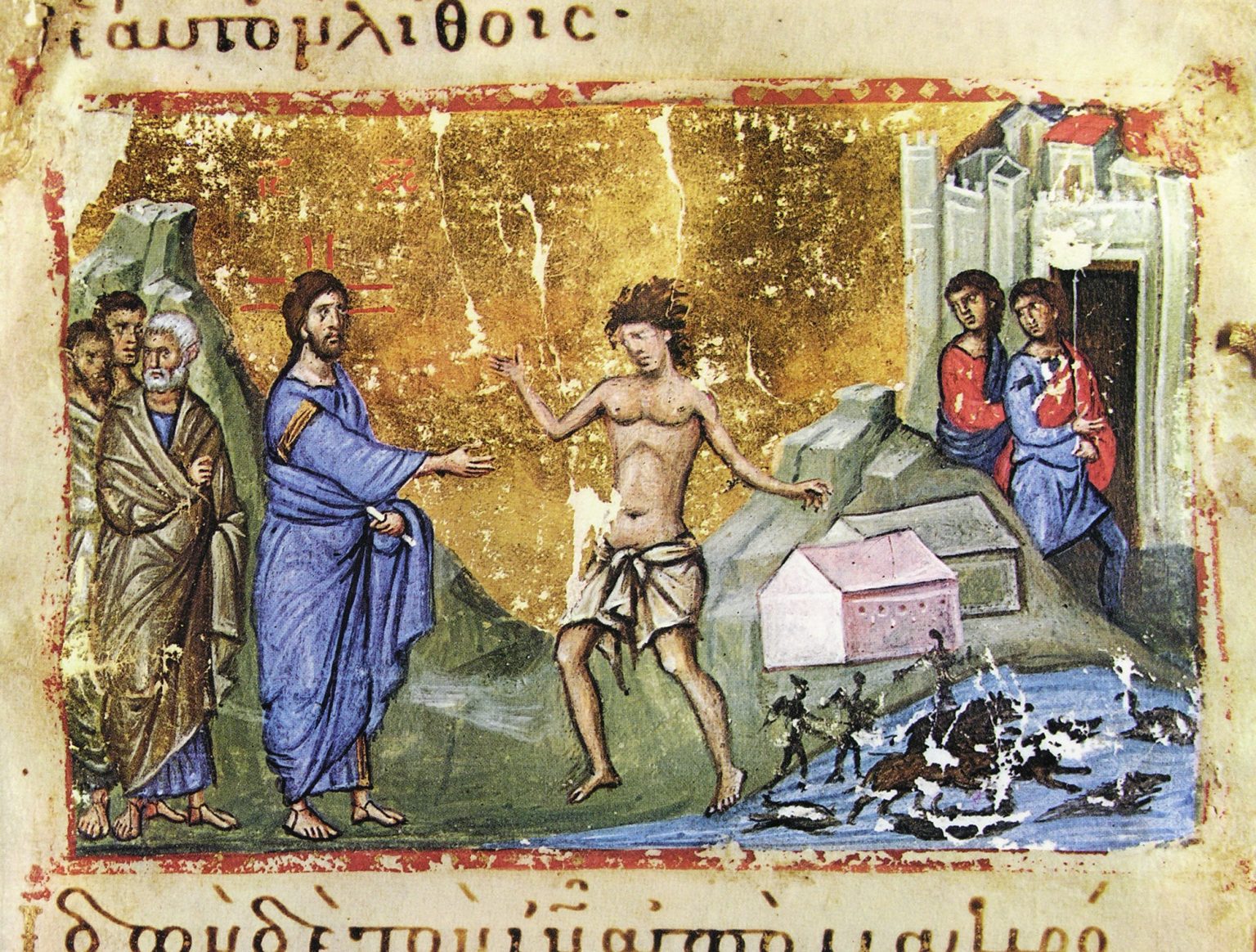
“And when He had come to the other side, into the country of the Gergesenes, there met Him two possessed with devils, coming out of the tombs, exceedingly fierce, so that no man might pass by that way. And behold, they cried out, saying: What have we to do with Thee, Jesus, Thou Son of God? Art Thou come here to torment us before the time?”
This subsequent event is not at all accidental, for St. John Chrysostom explains that the Lord wisely resolves human doubt by compelling His divinity to be confessed by the demons themselves. The ancient Father of the Church writes: “While the people regarded Jesus as only a man, the demons came to proclaim His divinity. And those who remained deaf when the sea was stirred and calmed heard the demons loudly declare what the sea itself had proclaimed by its silence. Furthermore, lest the words of the demons be taken as flattery, they confirmed the truth of their confession by their very actions: Thou hast come here, they cried, before the time to torment us. Thus they first speak of their enmity, so that their petition might not be suspected. Indeed, being pierced, burned, and suffering intolerable torment merely from Christ’s presence, they were invisibly tormented and more agitated than the sea itself. Since no one dared to approach them, Christ Himself comes to them.”
At this point, the saint also resolves a difficulty that arises due to the difference in the description of this event in the Gospels of Matthew and Luke. He states: “That Luke mentions one possessed man while Matthew speaks of two does not indicate a discrepancy between them. A true difference would exist only if Luke had written that there was only one demoniac and that there was no other. When one Evangelist speaks of one and the other of two, this is not a sign of contradiction but merely a different mode of narration. It seems to me that Luke mentioned only the one who was in the worse condition, thus portraying his state as more grievous, saying, for example, that he broke his chains and wandered in the desert. Mark testifies that he also struck himself with stones.”
St. Cyril of Alexandria points out that, although compelled to confess Christ, the demons nevertheless attempt at the same time to slander the divine dispensation. Cyril writes: “That the demons spoke of ‘before the time,’ thereby casting reproach upon the time of the Incarnation, as though it were premature, should not astonish us; for being evil, they dare to utter such things. Even though they know that the Judge will require an account from them, since they have transgressed His commandments, yet they arrogantly say: What have we to do with You?”
St. Anastasius of Sinai supplements the explanation of these words as follows: “By saying ‘before the time,’ the demons show that they know of their condemnation to the fire of Gehenna and that they await it.” Thus, in the patristic tradition, it is clear that the demons are incorrigibly obstinate in their evil and refuse to repent. This must be emphasized, since today there exists a tendency among some within the Church—even in certain published works—to speak of the repentance of demons, or of the possibility of their change, and so forth. This is an error, as we clearly see here. Yet the demons do not fully know the mysteries of the divine dispensation. For this reason, Blessed Theophylact of Ohrid adds here: “Understand that their words ‘before the time’ mean that they thought Christ, being unable to endure their great malice any longer, would not wait for the appointed time of torment. But it is not so, for the demons are permitted to struggle against us until the end of the world.”
Euthymius Zigabenos writes also about the symbolic meaning of the name of the city by which this region was called: “Gergesa, in translation, means ‘the dwelling of the expelled.’ The city was perhaps thus named prophetically, because of the way the owners of the swine treated the Saviour when they begged Him to depart from their region.”
We now move to the next two verses, 30 and 31:
“Now a good way off from them there was a herd of many swine feeding. So the demons begged Him, saying: If You cast us out, permit us to go away into the herd of swine.”
St. Chromatius of Aquileia offers a spiritual interpretation of the presence of the swine in this Gospel account and writes: “The swine into which the demons entered represent the image of unclean and unbelieving men. Feeding near the sea—that is, living amidst the sins of this world—they constitute a fitting dwelling place for demons. Thus, those who are engulfed in a similar sea, namely, the depth of delusion, are drowned by various demons, that is, by sinful desires.”
From his side, St. Dimitry of Rostov raises a question that concerns a very important principle of the spiritual life—the law of the attraction of likeness. Here are his words: “First, why is it that the demons, being proud, did not ask to enter into great and noble beasts, such as lions, elephants, stags, and the like, but instead into unclean swine? Second, why did the Lord not forbid them, but instead quickly commanded it, even though at first He did not wish to hear any of their petitions? The answer is: like seeks like. The demons are by nature unclean. The swine also are unclean, for they wallow in the mire. Their flesh, moreover, was declared unclean in the Old Testament. Therefore the demons request to enter into the swine: the unclean into the unclean, like unto like. … To the second question Blessed Augustine responds: Christ commanded the demons to enter into the swine in order to show that demons dwell in men who wallow in abominations, just as swine wallow in the mud. And who are those men who, like swine, live in the mire of abominations? They are those who serve the impurity of the flesh. Thus speaks Chrysostom: ‘And what evil will carnal passion not commit? It turns a man into a swine.’ In such a man, adds Chrysostom, the devil abides as in his own house. Such a man differs in no respect from the demons: he is as shameless and as malicious as the possessed. Where there is impurity, there is the demon.”
Here we may also cite the words of St. John Chrysostom, which bear directly upon a question often asked in our own day concerning God’s providence, the existence of evil, and human suffering. Chrysostom says: “But perhaps someone will ask: why did Christ grant the petition of the demons, allowing them to enter into the herd of swine? To this I reply that Jesus did not do this because they persuaded Him, but for many wise reasons. First, in order to show those delivered from these tormentors the magnitude of the harm they had suffered from them; second, to instruct everyone else that the demons cannot touch even swine without His permission; third, to make known to us that the demons would deal even more cruelly with men than with swine, had men—even in such misery as demonic possession—not been deemed worthy of God’s great providential care.”
To this thought St. Anthony the Great adds: “The devil has no power even over swine. For it is written in the Gospel that the demons begged the Lord, saying: Permit us to go into the herd of swine. If they have no authority over swine, how much less over man, who is created in the image of God.”
We continue with verses 32 and 33:
“And He said to them: Go. So they came out and went into the herd of swine. And behold, the whole herd of swine rushed violently down the steep bank into the sea and perished in the waters. Then those who kept them fled; and they went into the city and reported everything, including what had happened to the demon-possessed men.”
Chrysostom continues his reflection and says: “It is well known to all that the demons hate us men more than the irrational animals. Thus, if they spared not the swine, but at once cast them all headlong into the abyss, much more would they have done the same with the men whom they possessed and dragged through the deserts—had not God’s providence restrained them, even amidst the most savage torment, and held them back from the fulfillment of their designs. From this it is evident that there is not a single man for whom God does not provide. And if God’s providence is not shown towards all men in the same way, this itself is the greatest proof of His providence. For God manifests His providential care in accordance with what is most beneficial for each individual. Moreover, we learn from this passage that God provides not only for all men collectively, but for each man individually. … All of this is clearly seen in the example of these possessed men, who would long since have been drowned had they not been carefully preserved from above. This is why the Saviour permitted the demons to enter into the herd of swine, in order that the inhabitants of that region might come to know His omnipotence. Where His Name was already known, Jesus did not reveal Himself so abundantly; but where no one knew Him and where all were insensible, there He wrought glorious miracles, so as to draw men to the knowledge of His divinity.”
Adapted for the contemporary reader from the patristic commentaries by: Stanoje Stanojević