Verses 16 and 17:
“That evening they brought to Him many who were possessed with demons; and He cast out the spirits with a word, and healed all who were sick. This was to fulfill what was spoken by the prophet Isaiah: ‘He took our infirmities and bore our diseases.’”
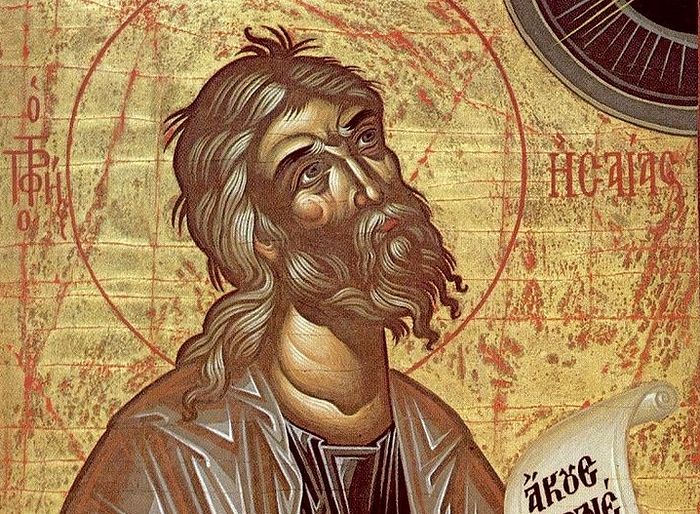
St. John Chrysostom here explains the reason why the Apostle Matthew cited the prophecy of Isaiah, who lived eight hundred years before the birth of Christ. Chrysostom writes: “Observe how great a multitude of the healed the Evangelists pass over in silence, when they do not recount them one by one, but with a single word traverse an indescribable sea of miracles. And then, so that the magnitude of the miracles might not cast people into disbelief—that Christ had, in a single moment, delivered so great a multitude from so many diverse diseases—the Evangelist cites the Prophet as a witness to what had taken place, showing thereby that testimony from Scripture is, in every case, important and not inferior to the very signs themselves. Isaiah, says the Apostle Matthew, declared that Christ ‘took our infirmities and bore our diseases.’ The Prophet did not say, ‘He delivered them,’ but ‘He took and bore them.’ This may be interpreted as referring more to sins, in accordance with the words of John the Baptist: ‘Behold the Lamb of God, who takes away the sin of the world!’ (John 1:29). But why then does the Evangelist Matthew connect this prophecy with illnesses? Either because he literally received the testimony of the Prophet Isaiah in this way, or to show that a great part of sickness is the consequence of sins. For if death itself—that confirmation of disease—has as its root and beginning sin, then much more so do many other illnesses.”
St. Cyril of Alexandria draws attention to the circumstance that people brought their sick to Jesus at night, seeing in this the reason of fear before the Jews. St. Cyril writes: “Why did people not bring the sick during the day? Either because they feared the scribes and Pharisees, or because they were ashamed of their infirmities, as Nicodemus was. Or else because during the day the sick had no one who could bring them to Jesus.” Euthymius Zigabenus adds another reason, noting that the people respected the Old Testament Sabbath and thus waited until it had passed: “The multitude, waiting until after sunset in observance of the Sabbath, then brought those who were afflicted with diseases. The disciples, however, had already asked Christ before sunset to heal the one lying with a fever, since they had already seen that Jesus healed without regard to the Sabbath. They knew from the Lord Himself which works the law of the Sabbath forbade and for which it gave permission.”
Verse 18 reads:
“Now when Jesus saw great crowds around Him, He gave orders to go over to the other side.”
St. John Chrysostom explains this action of the Lord in the following way: “Do you see again how far from vainglory Jesus was? Other Evangelists say that He forbade the demons to speak of who He was; while Matthew says that He withdrew the multitudes from Himself. Christ did this in order to teach us humility, and also to restrain the envy of the Jews, and to convince us that nothing should be done out of vainglory. He did not only heal bodies but also corrected souls, training them in piety. He manifested Himself not only in the healings of diseases, but also in that He did nothing out of vain glory.”
Continuing this line of thought, St. Cyril of Alexandria adds yet another hidden reason for this action of Christ: “Jesus commanded that only the disciples should cross to the other side, so that it might not appear that the mass of people pressing upon Him hindered the disciples from hearing the true teachings and the mysteries of God, which the Lord later revealed to them in a direct manner, while to the crowd He proclaimed them through parables. For since they had abandoned all possessions and followed the Lord purely out of love for His teaching, He commanded them to pass over from the temporal to the eternal, from the earthly to the heavenly, from the bodily to the spiritual.”
Verses 19 and 20:
“And a scribe came up and said to Him, ‘Teacher, I will follow You wherever You go.’ And Jesus said to him, ‘Foxes have holes, and birds of the air have nests; but the Son of Man has nowhere to lay His head.’”
St. John Chrysostom explains the character of the man who approached the Lord and uttered these words. Chrysostom writes: “A man who served wealth, a very arrogant man, came to Christ and said: ‘Teacher, I will follow You wherever You go.’ Do you see what pride there is in this? Considering it unworthy to count himself among the common people, and showing that he was far above the ordinary crowd, with such thoughts he approached Jesus. … Yet the Lord did not condemn him for his inappropriate boldness, teaching us thereby to endure even such people. Thus Jesus did not openly expose those who had evil intentions, but directed His answers against their thoughts, leaving them to perceive the rebuke for themselves, and granting them a double benefit: first, by showing in Himself the knowledge of what was hidden in their conscience; and second, by allowing them, despite His knowledge of their hearts, to conceal their intentions, giving them the opportunity to amend themselves—if they so wished. In the same way the Lord now dealt with the man who approached Him. This man, seeing many miracles and that many were drawn to Jesus through them, hoped that he might profit from such wonders. That is why he hastened to declare his desire to follow the Lord. But how do we know this? From Christ’s reply, which answered not the words of the question, but the thought behind them.”
It is of great importance to note Chrysostom’s emphasis on Christ’s delicacy, for this virtue is often forgotten today. There is always an alternative way of speaking to one’s interlocutor—even to say something unpleasant—without being, as the saying goes, “brutally direct.”
St. Maximus of Turin, commenting on this passage of the Gospel, says: “This was a zealous but self-assured declaration. For the Lord was about to go to His Passion, to descend into Hades, and to ascend into heaven. Could human weakness possibly follow Him in all this? What is at issue here is foolish self-reliance rather than a confession of faith…” This saint continues and explains the spiritual meaning of the “foxes” mentioned in this verse: “Every Christian who wishes to conceal his sins is a spiritual fox. For just as the fox lives in hidden places because of its deeds, so too the sinner hides in holes, concealing himself because of his guilty conscience. And just as the fox dares not reveal its actions before men, so the sinner is ashamed to confess the depravity of his life in church. I would also call a fox every Christian who sets traps for his neighbour, who daily strives to seize another’s possessions and appropriate the fruits of another’s labour…”
St. Tikhon of Zadonsk, for his part, associates the passions with the word “foxes” and writes: “Flattery, cunning, hypocrisy, love of money, every evil desire are like foxes that have their dens in the human heart, and like birds that make their nests there. The Son of Man has nowhere to lay His head in such a heart. However, He enters into hearts that are meek, humble, contrite with sorrow for their sins, and He brings with Him His grace.”
St. Isidore of Pelusium comments that the Lord saw this man as irrevocably given over to evil, and that this was the reason why He distanced him from Himself. St. Isidore interprets it in this way: “The Lord saw that this man was overcome with wicked thoughts, that evil spirits had entered into him, and that he was irreversibly enslaved to vices. Therefore the Lord kept him away from dwelling with Him, so that this man’s persistence in evil might not become a scandal for the believers—that is, that in seeing him, they might not judge the Creator’s power as weak or unable to turn him to virtue.”
Verses 21 and 22:
“Another of the disciples said to Him, ‘Lord, let me first go and bury my father.’ But Jesus said to him, ‘Follow Me, and leave the dead to bury their own dead.’”
St. John Chrysostom expounds upon these verses, which to many are unclear, and at first reading may indeed confuse—why should the Son not be allowed to bury his father? Hear Chrysostom’s explanation: “The Saviour always attends to the intention. But someone may ask, why did He not allow it? Because even without him there were others who would perform this task, and the dead man would not be left unburied. By saying ‘their own dead,’ the Lord shows that the deceased was not His. I think that the man who had died was among the unbelieving. If you marvel that the young man asked Jesus about so necessary a duty and did not withdraw of his own accord, then marvel all the more that he remained with Jesus even when forbidden. Yet someone may say: is not failing to attend one’s father’s funeral the sign of extreme ingratitude? If the young man had acted so out of laziness, then indeed he would have shown ingratitude; but if he did it so as not to interrupt the most necessary work, then in that case departing from such a task would have been the greatest foolishness. Certainly Jesus did not forbid him with the intent of preventing him from honouring his parents. Rather, the Lord wished to show that nothing ought to be more necessary for us than the heavenly, that with great attention we must strive for heavenly goods and not forget them even for the briefest time, even if the most necessary and unavoidable duties draw us away. For truly, what can be more necessary than the burial of a father, and what is easier to accomplish? And yet even for so short a time as that required for the burial of a father, it is unsafe to neglect spiritual matters. Consider, then, what we deserve, we who continually neglect Christian works and choose what is least important instead of what is necessary, and without any true cause give ourselves over to idleness. … Moreover, we should admire the wisdom of the Savior’s teaching in this: that He both strongly drew the young man to Himself by His word and at the same time freed him from countless evils—lamentation, wailing, and all the things that arise from these. For after the funeral there would have been the reading of the will, the division of the inheritance, and all else that occurs in such cases. And thus, wave after wave, carrying him ever farther, he would have been drawn very far from the harbour of truth. Therefore Christ draws him and binds him to Himself. If you are astonished and troubled because he was not allowed to be present at his father’s burial, then understand this: many people do not tell the fainthearted about the death of their relatives, and do not allow them near the grave, even if the one who has died is a father, mother, son, or some other relation. And we do not accuse them of cruelty or inhumanity—and rightly so. On the contrary, if we were to permit the fainthearted to indulge in excessive weeping, that would indeed be cruelty on our part.”
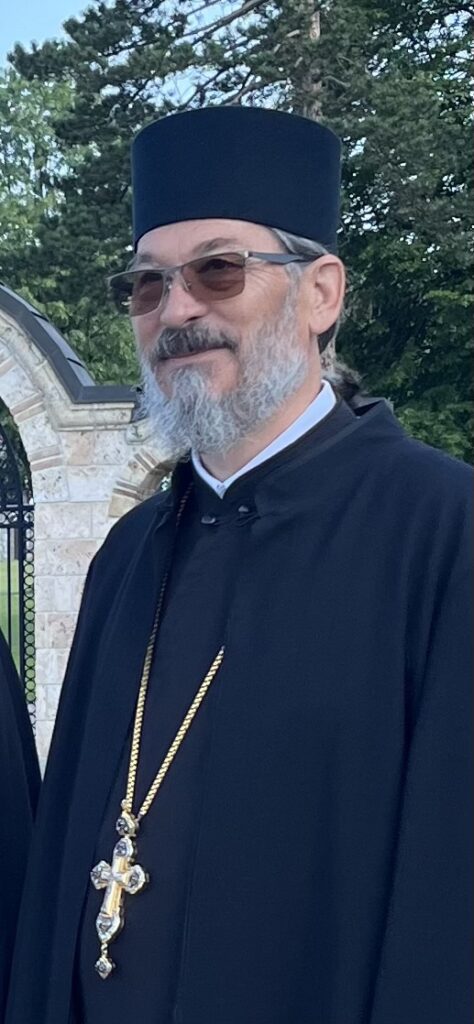
Adapted for the contemporary reader, based on patristic commentaries, by Stanoje Stanković.