
We begin with the patristic interpretation of the eighth chapter of the Gospel according to Matthew. The first verse reads:
When He came down from the mountain, great multitudes followed Him.
Saint John Chrysostom here speaks of the character of the people who faithfully followed the Lord during His earthly ministry and at the same time describes the qualities that we all must have if we wish to follow Christ and remain with Him. Saint John says: “It was not any of the rulers or scribes who followed Him, but only those whose craftiness was far removed from them and who were sincere in their disposition. Throughout the Gospel one can see that only such people cleave to Christ. Thus, even when He spoke, they listened in silence and did not add anything to His words; they did not interrupt Him, did not test Him, and did not seek a pretext to catch Him in His speech, as the Pharisees did. After the conclusion of His preaching, they followed Him with admiration.”
Thus, we clearly see the character of those who are faithful to Christ – people who conform themselves to what the Lord requires, and not those who attempt to conform God to themselves. The saint explains all the wisdom in the manner of preaching that the Lord Jesus chose: “Observe the wisdom of the Lord, with what variety He arranges the benefit of those who stood before Him, when He passes now from miracles to words, now from words to miracles. Before ascending the mountain, Christ healed many, thereby preparing the way for the sermon; and after completing this long discourse, Jesus again returns to miracles in order to confirm in reality what He had said… That the manner in which He taught might not be thought full of vanity and arrogance, He confirmed it precisely by His deeds and healed diseases as One having authority, so that those who saw Him teach in this way might not be disturbed when the Lord, with that same authority, also worked miracles.”
The next two verses, the second and third:
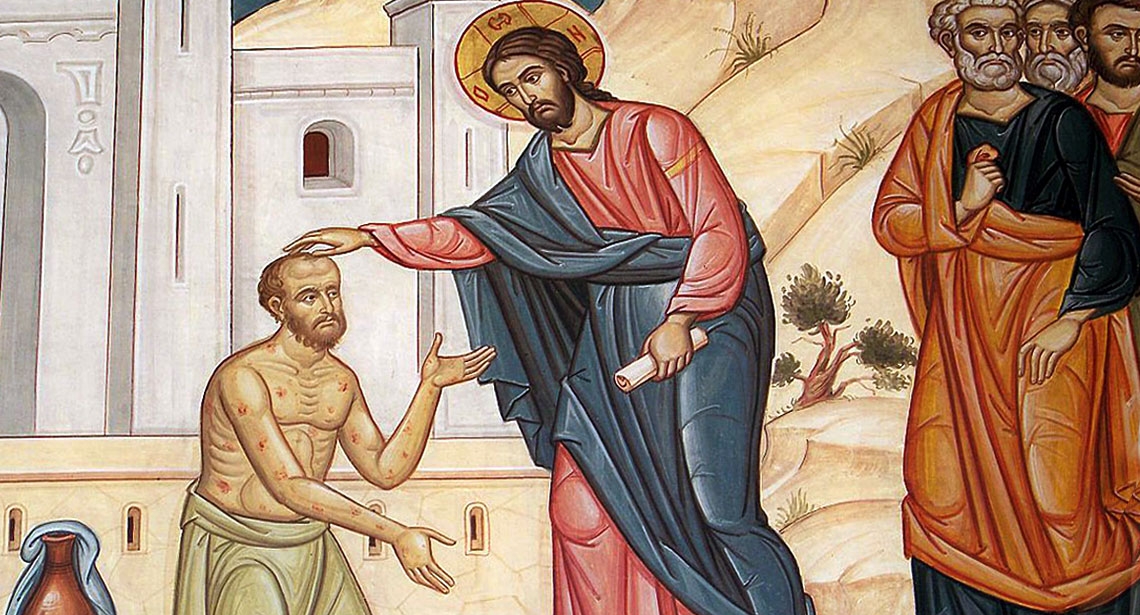
And behold, a leper came and worshiped Him, saying: Lord, if You will, You can make me clean. And Jesus stretched out His hand and touched him, saying: I will; be clean. And immediately his leprosy was cleansed.
We may, perhaps in haste, pass over these verses without paying attention or delving into the full weight of this disease and the tragedy it brought into the lives of those afflicted by it. Saint Gregory the Theologian describes these unfortunate people in the following way: “They are living corpses, for their limbs are for the most part completely deadened; these are people whom you can no longer recognize for who they were, nor from where they came. In order for us to identify them in any way, they must recount their story at length, mention their relatives, or provide us with some recognizable proof of themselves and of their lineage. … These are wretched people, without property, without kin or friends, and even their very body is no longer as it once was; they both hate and pity themselves at the same time – they do not know whether to weep more for the parts of the body already consumed by the disease, or for those parts that the illness will yet attack and overcome; whether to lament the limbs already destroyed by the sickness, or to bewail those still awaiting their suffering… Who is more tender than a father?”
Who has a softer heart than a mother? Yet for these lepers, even the heart of a parent remains closed! A father, his own son—whom he brought into the world and raised, in whom he saw the meaning and future of life, for whom he had so often and fervently prayed to God—this son he not only refuses to lament, but even drives him away, casting him off because of his disease. And the mother, remembering the pangs of childbirth, with a heart torn apart, utters sorrowful cries and, in the sight of all, laments her still-living son as though he were already dead, wailing aloud… Why does the mother lament like Job, grieving with a tender voice: “Why were you ever conceived in the womb? It would have been better had you died immediately, at birth, and death had been joined to you at the very moment of your coming forth! Why did you not die prematurely, before you ever tasted the evil of life? Was it for this that you crawled, was it for this that I nursed you at my breasts—that you should meet with such a bitter life? Your life is more dreadful and more terrible than death itself”!
And it was precisely such a man, despised and cast off by all, who dared to approach Christ. Hear how Saint Chrysostom describes his prudence and discernment: “Great indeed was the prudence and faith of the one who approached. The leper did not interrupt the teaching, nor did he strive to force his way through the gathered crowd, but waited for the right time and came only when Christ had descended from the mountain. And he did not come casually, but with great desire, and—as another Evangelist relates—kneeling before Him (Mk. 1:40), he begged Christ, begged with sincere faith and with thoughts worthy of the Lord. For the leper did not say: ‘If you ask God,’ or ‘If you pray to Him,’ but: If You will, You can make me clean. Nor did he say, ‘Lord, cleanse me,’ but left everything to Him, entrusted the healing to His will, and bore witness to His supreme authority.”
In the continuation of his commentary, Saint Chrysostom addresses a doubt concerning Christ’s divinity that has appeared countless times since his day. Today, for example, Muslims say that Christ nowhere in the Gospel claims to be God. Yet this passage refutes them. Hear how Chrysostom continues: “Someone will say: what if the leper’s opinion was mistaken? In that case, Christ ought to have refuted him, exposed him, and corrected him. Did Christ do so? No. On the contrary, He strengthened and confirmed all the leper’s words. Therefore He did not say: ‘Be cleansed,’ but rather: I will, be clean, so that the concept of Christ’s power should not be regarded as merely the opinion of the leper, but as the thought of Christ Himself. The apostles did not speak in this manner. And how did they speak? When the whole people marveled, they said: ‘Why do you marvel at this, or why do you look at us, as though by our own power or godliness we had made this man walk?’ (Acts 3:12). … In order to confirm the belief in His authority held both by the leper and by the whole multitude, Jesus added: I will, and He did not leave His word unfulfilled, but confirmed it by the deed which He immediately performed. If the Lord had spoken falsely, if He had uttered blasphemy, this deed would have collapsed. But nature, having received the command, obeyed—indeed, it obeyed with even greater swiftness than the Evangelist describes. The word immediately does not fully express the speed with which the deed was accomplished. And the Savior did not simply say: I will, be clean, but, stretching out His hand, He touched him—which is particularly worthy of examination. Why did the Savior, having cleansed him by His will and His word, also touch him with His hand? It seems to me for no other reason than to show thereby that He is not subject to the Law, but is above it; and that for the Pure One, nothing is unclean.”
Saint Ephraim the Syrian offers an interesting explanation of these verses, showing that the Lord responds to the inner disposition of the leper himself. Here is Ephraim’s interpretation: “Since the leprous man was afraid to touch the Lord, lest he make Him unclean, the Lord Himself touched him in order to show him that He not only cannot become unclean by contact, but by His command destroys uncleanness even in others who are unclean.” At this point, Ephraim goes on to say something completely unexpected to us—namely, that the Lord was, in a certain sense, angered with the leper. And here is why: “If He had not touched the leper, then the thought would have been strengthened in the leper that the Lord feared leprosy; but if He touched him, then in his soul the opposite thought would arise, the thought that the Lord Jesus is an opponent of the Law. Therefore, by stretching out His hand, He showed His divinity and cast out the uncleanness… Since the leper was a Jew and had heard from the priests that Jesus was an opponent of the Law and an enemy of the Scriptures, he thought that Christ was unwilling to heal Jews… The Lord responded to this wavering in a twofold way: with rebuke—since He became angry with him—but also with mercy, since He healed him. He was angered because the leper had said: if You will; yet since he also added You can, the Lord healed him in order to cleanse not only the body from uncleanness, but also the soul from false thoughts.”
We now continue with the next verse, the fourth, which reads:
And Jesus said to him: See that you tell no one; but go, show yourself to the priest, and offer the gift that Moses commanded, as a testimony to them.
Chrysostom here explains the meaning of Christ’s action and the sending of the leper to fulfill the Old Testament law concerning leprosy, found in chapter 14 of the Third Book of Moses, Leviticus. Saint John interprets it as follows: “Christ commands the leprous man to tell no one, so that through this He might turn us away from vanity and the love of glory. Although Jesus knew that the leper would not obey Him, but would instead publish abroad the name of his Benefactor, He nevertheless did His part. But you may ask: how is it that in other places the Lord commands those who are healed to speak of their healings? In this He does not contradict Himself, but teaches them to be grateful, because even in such cases He does not command that He Himself be glorified, but that God be glorified. Through the leper spoken of here, the Savior preserves us from pride and vanity, but in other cases He teaches us gratitude and that in all things thanksgiving should be rendered to the Lord.”
In the same spirit, Saint Tikhon of Zadonsk writes: “The Lord did not come to earth in order to boast and glorify Himself, but to humble Himself and to save us. All glory He rendered to His heavenly Father, although He Himself was the Only-Begotten and consubstantial Son of the Father, yet at that time hidden under the humility of the flesh. He did not wish to be glorified by the tongues of men, but by the Cross. He sought only that men should believe in Him as the Messiah Who had come, and thus be saved.”
Blessed Jerome continues regarding the reasons for Jesus sending the leper to the priest, writing: “The Lord sends the healed man to the priests for several reasons. First, out of humility—that the people might see that He renders honour to the priests, for the Law commanded that a man cleansed of leprosy should offer a gift to the priests. He also sends him so that the priests might either believe in the Saviour, seeing a leprous man who has been cleansed, or not believe. If they believed, they would be saved; if they did not believe, they would be left without any excuse. Finally, He sends him so that it might not appear that Christ was breaking the Law, as they so often accused Him.”
Adapted for the contemporary reader from the patristic commentaries by: Stanoje Stanković