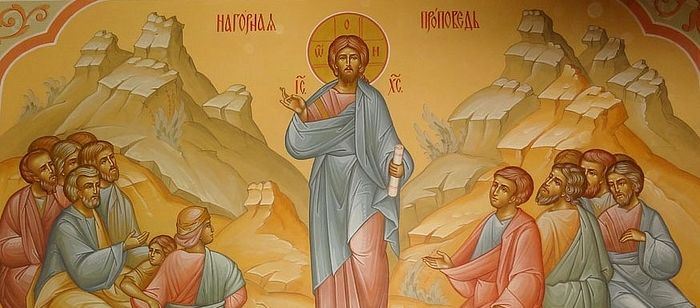
The sixth verse of the fifth chapter reads:
Blessed are those who hunger and thirst for righteousness, for they shall be filled.
St. John Chrysostom, in commenting on this verse, draws attention to the Lord’s words which express the true disposition toward righteousness, saying:
“Reflect deeply on the intensity with which Jesus articulated His commandment. He did not say that those who simply seek righteousness are blessed, but rather those who hunger and thirst for righteousness—thus teaching us that we must not pursue righteousness casually, but with wholehearted love… Since many believe that avarice makes one wealthy, Jesus teaches that the opposite is true: righteousness makes one truly rich. Therefore, when acting justly, do not fear poverty or hunger. Indeed, those who seize what belongs to others are ultimately deprived of all things, while those who love righteousness reign securely over everything. And if those who merely refrain from stealing enjoy such abundance, how much more will those who give away their possessions?”
St. Chromatius of Aquileia supplements Chrysostom’s words by explaining the attitude we must cultivate toward righteousness and a righteous life. He writes:
“We are obliged to strive for righteousness not merely with desire, nor through fleeting impulses of passion. That is why the Lord declares as blessed those who strive for righteousness with an inner longing akin to hunger and thirst.”
Thus, the saint teaches that an inner zeal is necessary—that our piety and desire for righteousness must not be governed by passing moods, but should resemble the natural urgency felt when one is physically hungry or thirsty—even when one might not ‘feel like it.’ Therefore, Blessed Jerome says that one must reach a spiritual condition in which the need to do righteous deeds is felt continually.
St. Justin of Ćelije provides a deeply insightful reflection on the hunger and thirst experienced by the human soul. He explains that every human being feels such hunger; the only question is: of what kind?
“Hunger and thirst of the soul can be either normal or abnormal. Abnormal hunger and thirst occur when the soul craves sin, pleasures, and passions. Through such hunger and thirst, the soul seeks its nourishment and drink in all that is sinful and mortal within man. Yet sin and death are the only abnormalities in human existence. And because they are abnormal, such hunger and thirst can never be satisfied or quenched. The more the soul feeds on sin and passions, the hungrier it becomes; and the more it drinks of pleasures, the thirstier it grows. It is like a man chewing air to satisfy his hunger or drinking salt water to quench his thirst. The best example of this is the prodigal son, who could not satisfy his abnormal hunger or quench his abnormal thirst, despite feeding them constantly with passions and pleasures.”
St. Justin thus perfectly identifies the central spiritual problem of modern man. Nevertheless, while this kind of hunger and thirst is insatiable, he continues with these words regarding hunger and thirst for God:
“Normal hunger and thirst occur when the soul longs for eternal Truth, eternal Love, eternal Goodness, eternal Life, eternal Blessedness—in short, eternal Righteousness… As the soul is made in the image of God, its essence is always drawn towards God—it is always hungry and thirsty for that which is immortal… Therefore, the normal hunger and thirst of the soul can not only be quenched and satisfied, but fulfilled only by God.”
While St. Justin speaks about the peace the soul finds in God alone, St. Peter of Damascus adds a complementary perspective, explaining that the soul, even when moving towards God and finding fulfillment, still experiences an unquenchable longing for Him. He writes:
“If someone does not taste something, he cannot know what he is missing, as St. Basil the Great says. So also, the person who has experienced the sweetness of the commandments, and knows that they quickly lead to the imitation of Christ, desires even more strongly to acquire the rest, often even despising death for their sake. Having tasted a bit of the divine mysteries hidden in the Holy Scripture, he longs to know more; and the more he attains knowledge, the more he thirsts and burns, like a blazing fire. And since the Divine is ultimately inaccessible to all, he remains always in that state.”
Thus, we see that true hunger for God arises only after one begins to experience the sweetness of His commandments and to live according to the Gospel. For this reason, it is essential that a person learns how to seek God in the right way—in the way God Himself desires. Not every path to God is valid, and the popular claim that many different spiritual paths lead to the same God is false. It is enough to say that the Lord Jesus Christ does not agree with this notion, as He declares:
I am the Way, the Truth, and the Life. No one comes to the Father except through Me (John 14:6).
A particularly arly insightful interpretation of these words of Christ comes from Saint John of Kronstadt. His explanation remains highly relevant today, in an age marked by numerous disturbances within the Church—schisms often instigated by ignorance of Orthodox doctrine and Church history, and sometimes even by occult ideologies masquerading as authentic Christian teaching. Here is what Saint John writes:
“Oh, if only those afflicted by the sickness of schism… would hunger and thirst for the righteousness of the one, holy, catholic, and apostolic Church—for unity with it, for sanctification through its services, sacraments, and instruction in the Word of God. Do they not feel the saving hunger and thirst for the maternal, life-giving milk of the Church? Have they forsaken the fountain of living waters and dug for themselves broken cisterns that can hold no water? How long will divisions and stubbornness in vain wisdom persist? How long shall the spiritual wolf attack and scatter the flock of Christ? … Such people will constantly thirst for divine grace and will never be satisfied unless they return to the Mother who once gave them birth, and from whom they have fallen away through ignorance, delusion, and obstinacy.”
Another deeply meaningful and timely interpretation of this beatitude is provided by Saint Philaret of Moscow (Amphiteatrov), who reflects on the inner needs of the human soul and the spiritual damage that can occur when these needs are improperly satisfied. Saint Philaret writes:
“In the human heart, there is an indelibly sealed and insatiable yearning for a higher good than anything one might possess. No matter how fortunate a person might appear in the eyes of the world, his soul still longs for a greater good. This yearning reveals two truths: first, that no material possession can satisfy the desires of our immortal soul; and second, that human nature continually groans over the loss of the beatitude and greatness from which it fell through sin… One of the most deadly illnesses afflicting our souls as a result of sin lies in this: rather than directing all the desires of our hearts towards God—and seeking in Him alone the inexhaustible, ever-flowing source of all blessings—we seek our happiness everywhere except in God, and therefore we do not attain it. We deceive ourselves into thinking that the fleeting, vain pleasures and goods of this world can satisfy the hunger of our immortal soul, but in vain. This deadly disease of our hearts, Christ the Savior, the only true Healer of souls, seeks to cure by saying: Blessed are those who hunger and thirst after righteousness, for they shall be filled… With these words, the Lord teaches that in order to regain the blessedness we lost, we must desire to fulfill the commandments of God with the same urgency that a starving and thirsty person desires food and drink. Jesus Christ wants us to gather all the desires of our souls into one holy desire—to please God and to fulfill His will with all our love and longing.”
Now we read the next beatitude, verse 7:
Blessed are the merciful, for they shall obtain mercy.
Blessed Augustine provides a lofty yet practical spiritual insight for our daily lives in connection to this beatitude. He writes:
“You listen to the pleas of the poor, but you yourself are a beggar before God. Others ask from you, and you yourself ask. As you behave towards the one who begs from you, so will God behave toward you. For though you are rich and full, you are also poor: fill him who lacks from your abundance so that the abundance of God may fill your poverty.”
Saint John Chrysostom, for his part, emphasizes that the mercy God shows in response to our human acts of mercy far surpasses our own efforts. He writes:
“What is the reward for mercy?—They shall obtain mercy. At first glance, this seems a reward equal to the virtue. But in reality, it far surpasses it. For the merciful are merciful as humans; but they receive mercy from the God of all. Human mercy and divine mercy are not equal, but differ as light from darkness.”
In other words, the goodness of our fallen human nature cannot compare to the goodness that comes from God. This is why the Lord came into the world—for our good deeds without God cannot lead us to salvation. This is important to understand in view of the belief that anyone who does good can be saved regardless of their faith, or whether they belong to the Orthodox Church.
Blessed Jerome of Stridon also addresses the spiritual aspect of this beatitude. He explains that condescension toward the sins of a brother can be seen as an expression of the mercy that God expects from us—not in the sense of approving sin, but in recognizing the shared weakness of human nature.
This idea is further developed by Saint Peter of Damascus, who articulates a profound truth that can help us live according to this commandment—namely, the awareness that everything a person has is received from the Lord. He writes:
“A man is merciful who shows mercy to his neighbour with what he himself has received from God—be it money, food, strength, useful words, or prayer. If he has the means to help someone who asks him, he considers himself a debtor, for he has received more than is asked of him… A beggar may survive without the alms he requests, but a man without the virtue of mercy according to his means cannot live, nor can he be saved.”
Thus, Saint Peter clearly teaches that in giving mercy to others, we are ultimately giving mercy to our own souls.
Adapted and for the contemporary reader based on the teachings of the Holy Fathers by: Stanoje Stanković.