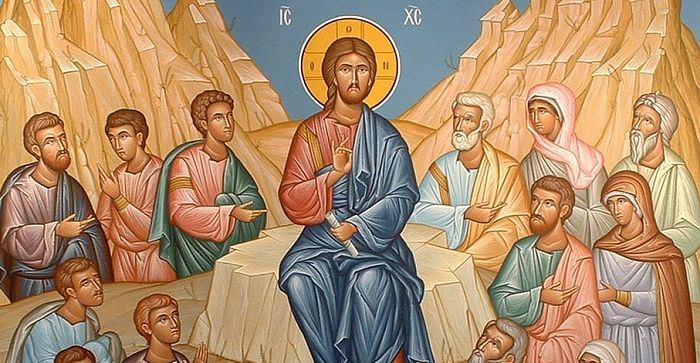
We now begin with the fifth chapter of the Gospel according to Matthew, the chapter in which the famous Sermon on the Mount is recorded. The first verse reads:
“And seeing the multitudes, He went up on a mountain, and when He was seated, His disciples came to Him.”
The Holy Fathers approached the interpretation of this verse with particular attentiveness. For instance, Saint Isidore of Pelusium explains that the Lord chose to speak on a mountain, in a secluded place, rather than in the noise and bustle of the city, and he offers a reason for this. He writes:
“Withdrawing from the clamor of the city is so beneficial for the work of salvation that the Son of God, having left the cities behind, declared those who live purely to be blessed upon the mountaintop. By this very act, He taught through His example that a man who does not renounce the earthly and ascend to the heights of virtue cannot be deemed blessed by God, nor can he acquire the good things to come.”
Saint Chromatius of Aquileia adds to this reflection and emphasizes that it was by no means accidental that the Lord gave the New Testament commandments precisely on a mountain, since it was on Mount Sinai that the same Lord had once given the Ten Commandments to Moses. He notes that this is further proof that Jesus Christ is the Author of both the Old and the New Testament law:
“In ancient times, when the law was given, the people were forbidden from ascending the mountain; now, however, as the Lord teaches upon the mountain, no one is forbidden, indeed all are invited to listen—because the Law instilled fear in the unbelieving, while the Gospel pours out the gift of grace upon the believing. Back then, there was severity; now, there is blessing. Therefore, it was not by chance that our Lord and Savior gave His blessing to His disciples on a mountain—not on the earth below, but above, on high. If you too desire to receive heavenly blessings from the Lord, ascend the mountain—that is, seek a lofty way of life—and you will rightly and justly receive the blessing you seek.”
Saint John Chrysostom, from a different perspective, sheds light on the mystery of Christ’s action and reveals the astonishing humility of our God. He explains this verse as follows:
“Behold how far removed Christ was from vanity and pride! He did not lead the people after Himself, but when it was necessary to heal, He would Himself go everywhere, visiting towns and villages. But when a great multitude had gathered, He sat down in one place—not in a city, not in a public square, but on a mountain, in the wilderness—thus teaching us to avoid doing anything for show, and to withdraw from noise, especially when we must speak of wisdom and reflect upon important matters.”
Chrysostom also points out that it was the behavior of the disciples that prompted Christ to begin His discourse:
“When He had gone up and sat down, His disciples came to Him. Do you see how they have advanced in virtue and how quickly they have grown? The crowd looked for miracles, but the disciples desired to hear lofty and profound things. This is what moved Christ to propose His teaching and begin His preaching. He did not merely heal bodies but also healed souls. And again, after caring for the soul, He would turn to care for the body, showing diverse benefit and combining the display of signs with rational teaching. By this care for both soul and body, He silences the shameless mouths of heretics, demonstrating that He is the Creator of all life.”
Thus, we see that God awaits our initiative—that we show interest in the spiritual life, that He may see our desire to strive. And then He comes to meet us. Chrysostom, in his final observation, addresses the ancient heretics who claimed that matter was evil, that the body was a prison of the soul and must be destroyed, either through excessive restraint or by indulgence in debauchery. The body, however, is not a prison of the soul, but rather a part of the human person that has the purpose of becoming a temple of the Holy Spirit.
Additionally, the Blessed Jerome of Stridon comments that the mountain on which Christ delivered His sermon was located in Galilee. He speculates that it may have been Mount Tabor or another mountain, but in any case, it was near Capernaum, since, as the Gospel itself states, the Lord entered Capernaum immediately after descending from the mountain (cf. Mt. 8:5).
We now continue with the next verse, which reads:
“Then He opened His mouth and taught them, saying:”
A verse we often glance over quickly while reading, Saint John Chrysostom explains in the following way: “The Evangelist says: And He opened His mouth and taught them. Why is it added, He opened His mouth? So that you may understand that the Lord taught even when He was silent, not only when He spoke; He taught either by opening His mouth or by proclaiming through His deeds. When you hear the words He taught them, do not think He was speaking only to His disciples, but that through the disciples He was speaking to everyone else. But because the multitude was uneducated, composed of people whose souls still moved along the earth, Jesus, having gathered His disciples before Him, addressed them with His teaching in such a way that His discourse of wisdom became interesting even to the rest of the people, who were almost completely incapable of listening to Him.” Thus, Saint Chrysostom explains that the Lord addressed His disciples to awaken interest among the rest of the people as well, and so they might listen more attentively.
Saint Philaret of Kiev reflects deeply on this Gospel passage before us, on Christ’s Sermon on the Mount. Here is his insight: “Among all the places in the Holy Gospel, there is no other in which the duties of Christians are presented with such detail and fullness, in such order and integrity, as in this instructive sermon, which our Lord and God, Jesus Christ, delivered on the mountain to His chosen disciples and to the large crowd that had gathered. This sermon is recorded in the fifth, sixth, and seventh chapters of the Gospel according to Matthew. In it, the Savior, with divine skill and wisdom, laid out everything necessary for the beginning, growth, and perfection of true Christian life. It is desirable that everyone who values the salvation of their soul reads this sermon as often and as attentively as possible for the edification of their heart.”
Saint Justin of Ćelije adds the following important words for all of us: “In the Sermon on the Mount, the Lord Jesus Christ does not deliver His teaching in the form of instructions or commands, but in the form of beatitudes, thus making His sermon attractive to all. He did not say: this or that person is blessed, but rather all who act in such a way are blessed, whether you are a slave, a pauper, a beggar, or uneducated—it does not hinder you from being blessed if you possess the relevant virtue.”
The third verse reads:
Blessed are the poor in spirit, for theirs is the kingdom of heaven.
Since in the Gospel according to Luke, this beatitude is expressed as Blessed are the poor, for yours is the kingdom of God (Lk. 6:20), the Holy Fathers have explained what exactly the Lord means by this beatitude. Thus, Saint Chromatius of Aquileia writes the following: “We know many who are poor, but they are not blessed merely because they are poor. What makes each of us blessed is not the necessity of poverty, but faith in pious poverty. We know that many are poor in worldly possessions, yet they have not renounced sin and are strangers to faith in God. They obviously cannot be called blessed. And so we must explain who the blessed ones are of whom the Lord speaks: Blessed are the poor in spirit, for theirs is the kingdom of heaven. He indicates that the blessed are those who, having despised the riches of this world and cast off worldly possessions in order to become rich in God, have desired to become poor in the world.”
However, one should not think that it is necessary to be materially poor in order to be poor in spirit. Old Testament righteous men such as Abraham, Isaac, Jacob, Solomon, and David, as well as New Testament saints like Saint Nicholas of Myra, Melania the Roman, and others serve as examples to the contrary. What matters is not wealth itself, but our attitude toward wealth, in the words of King David: If riches increase, set not your heart upon them (Ps. 62:10).
Thus, Blessed Jerome of Stridon speaks in the following way on this matter: “In order that no one might suppose that the Lord preached poverty which is sometimes the result of necessity, Jesus added poor in spirit, so that you may understand this not as material poverty, but as humility. Blessed are the poor in spirit, those who are poor by the will of the Holy Spirit. It is precisely in reference to such poor people that the Savior speaks through the Prophet Isaiah: The Spirit of the Lord is upon Me; because He has anointed Me to preach the Gospel to the poor (Luke 4:18).”
Saint Justin of Ćelije explains the inner disposition of those who are poor in spirit and writes: “Who is poor in spirit? A person is poor in spirit who feels with all his being that his human spirit is utterly impoverished, utterly insufficient, utterly destitute to be able to live by itself, but always needs the One who alone is rich in spirit: God. A person is poor in spirit who feels that not a single one of his thoughts, not a single one of his feelings, not a single one of his actions can either live or prosper, but must perish and vanish if they are not nourished by God, immortalized by God. A person is poor in spirit who, with all his being, feels that his entire human spirit is profoundly impoverished in relation to the all-rich Spirit of God… This sense of spiritual poverty is the beginning of Christianity… For within the very feeling of spiritual poverty there is found the immortal sense of a singular blessedness.”
Adapted for contemporary readers based on the Patristic interpretations:
Stanoje Stanković