We continue with the interpretation of verses 5 and 6:
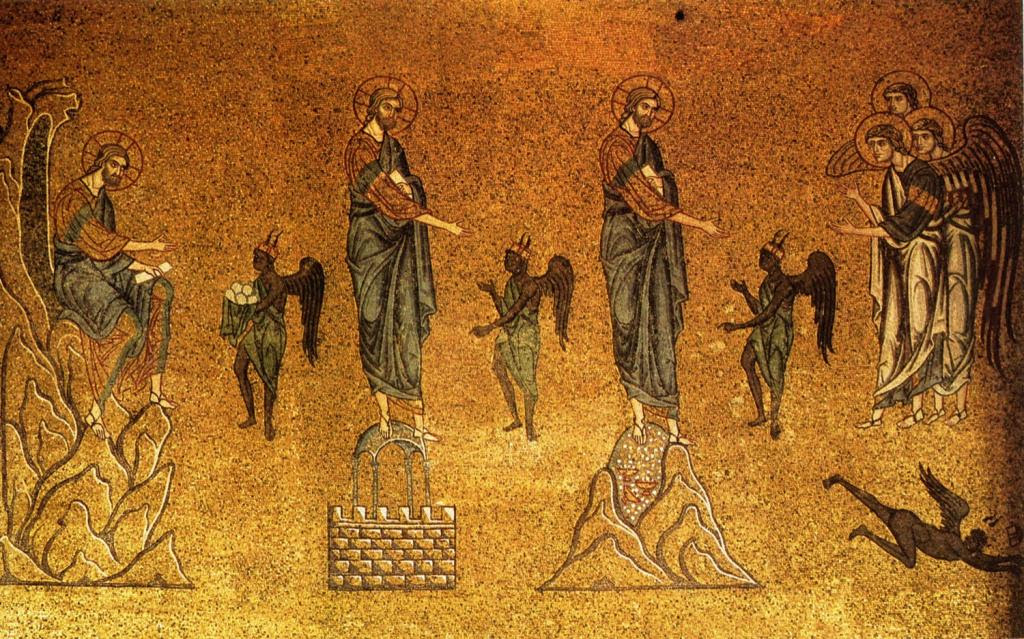
Saint Luke of Crimea focuses on the inner meaning of this temptation, explaining that the devil desired the Lord to manifest His miraculous power not when it was genuinely needed, but rather to use it for empty, ostentatious wonders. He writes:
“Consider what would have happened if the Lord had listened to the devil and performed such a miracle—ascending to the roof of the Jerusalem Temple and throwing Himself down. His fall would not have been an actual fall, but a smooth and gentle descent to the earth, upheld by the angels of God. The people, astounded by such a miracle, would have bowed before Him involuntarily, recognizing in Him the greatest of Wonderworkers.
Yet Jesus does not seek faith and obedience through compulsion; He seeks faith, love for Himself, and a free obedience that flows from a pure heart. He has no need to perform false miracles like those that will be wrought by the Antichrist to deceive the multitudes. The miracles of Jesus always proceed from His love for humanity, His mercy, and His compassion.”
Thus, according to Saint Luke’s interpretation, the devil’s proposal aimed to dazzle the people—those who, at that time, were anxiously awaiting the coming of the Messiah—and to lead them by spectacular means. Euthymius Zigabenus writes that Satan’s expectation was that Christ would be more inclined to accept this proposal, since people were gathered outside the temple. The devil disguised his vain suggestion in the cloak of apparent usefulness, claiming that those who witnessed the miracle would supposedly become Christ’s followers more easily.
Saint John Chrysostom points out that the words “If You are the Son of God” echo Satan’s strategy in Eden, when he slandered God to the forebears by saying, “For God knows that in the day you eat of it, your eyes will be opened” (Gen. 3:5). Chrysostom reflects:
“Satan wished to convince them that they had been deceived, that God had not granted them anything of value. So now again, the devil whispers the same notion, as if saying: ‘God has called You His Son in vain; He has deceived You with this gift. If I am wrong, show Your divine power.’ And because the Lord responds to him with words from Holy Scripture, the devil too invokes the testimony of the prophets.”
Blessed Jerome of Stridon writes:
“In all temptations, the devil begins in this way, in order to discover whether Jesus is truly the Son of God. Yet the Lord answers him humbly, leaving him in doubt. The devil, who always wishes for all to fall, says: ‘Throw Yourself down.’ These words may persuade us, but they cannot compel us to fall.”
The devil can only suggest various occasions for sin; he does not have the power to force us into committing it. If we resist him, he has no strength at all to compel us. Blessed Theophylact of Ohrid adds that the phrase “they shall bear you up in their hands” refers not to Christ, but to the Saints, who require angelic help in their struggle against the devil.
We now proceed to verse 7:
Jesus said to him: “It is also written: You shall not tempt the Lord your God.”
Christ quotes the words spoken by Moses to the Israelites (Deuteronomy 6:16), teaching that one ought not to expose oneself to danger unnecessarily, thereby putting to the test the miraculous power of Almighty God. For this reason, Saint Isidore of Pelusium writes:
“God has promised help to the one who finds himself in danger, not to the one who tempts Him; to the one who is in need, not to the one who does everything for show and pursues empty glory.”
Blessed Jerome draws attention to the weapon by which the Lord repelled all of the devil’s proposals—namely, His knowledge of Holy Scripture. He writes:
“He shattered the devil’s deceitful arrows with the true shield of Scripture. And it is worth noting that all of the Lord’s quotations were taken exclusively from the Book of Deuteronomy, in order to reveal the mysteries of the New Covenant.”
When contemplating the theme of trust in the Lord, one may wonder whether relying on God in daily life resembles the act of tempting God. The key distinction lies in this: trusting in the Lord presupposes human effort. When a person does all that is within their power, they entrust the rest—what lies beyond their control—to God. In contrast, tempting God means exposing oneself to danger needlessly, while presuming upon divine intervention.
In Scripture, we see that the Lord helped the Israelites escape from Egypt, granting them a miraculous crossing of the Red Sea. Yet that same Lord refused to protect them when, contrary to His will, they attacked the peoples of Canaan and Amalek. Here is the passage from the Book of Numbers:
“And they rose early in the morning and went up to the top of the mountain, saying, ‘Here we are, and we will go up to the place which the Lord has promised, for we have sinned.’ But Moses said, ‘Now why do you transgress the command of the Lord? For this will not succeed. Do not go up, lest you be defeated by your enemies, for the Lord is not among you. For the Amalekites and the Canaanites are there before you, and you shall fall by the sword, because you have turned away from the Lord, and the Lord will not be with you.’ But they presumed to go up to the mountaintop; nevertheless, neither the ark of the covenant of the Lord nor Moses departed from the camp. Then the Amalekites and the Canaanites who dwelt in that mountain came down and attacked them, and drove them back as far as Hormah.” (Numbers 14:40–45)
Saint John Chrysostom highlights the way Christ responded to temptations and to the devil’s malicious provocations:
“And how did Christ respond? He did not become indignant or enraged, but answered once again with great meekness using the words of Scripture: ‘You shall not tempt the Lord your God.’
By this, Christ teaches us that the devil must be conquered not only by miracles, but by meekness and long-suffering, and that nothing should be done from vanity or the desire to appear impressive.
Moreover, see how absurd the tempter’s logic is, even in his quoting of Scripture. Both of the Lord’s citations were given with precision, whereas what the devil quoted was taken without thought, disconnected, and unrelated to the matter at hand. The phrase ‘He shall give His angels charge over You’ does not imply that one should throw oneself into the abyss; nor was it even said with reference to the Lord.
Yet the Lord did not rebuke the devil’s foolishness, even though the devil had cited Scripture in order to insult Him, and in a completely distorted form.”
Verses 8 and 9 read:
Again, the devil took Him to a very high mountain and showed Him all the kingdoms of the world and their glory. And he said to Him: “All these I will give You, if You will fall down and worship me.”
Blessed Theophylact explains the nature of the devil’s appearance:
“The Lord did not receive thoughts—God forbid!—but the devil appeared to Him openly. Upon the mountain, he showed Him in visible form, before His eyes, all the kingdoms of this world, saying: ‘All these I will give You.’”
The Holy Fathers teach that the devil hoped this vision would disturb the human soul of the Lord Jesus and sow within Him fear and doubt regarding the fulfillment of the great work of human salvation. According to the Apostle Luke (Lk. 4:5), Satan presented this image of the kingdoms in an instant, knowing that human beings are more easily ensnared by what they see than by what they merely hear.
As with the previous temptation, the Lord again permitted Himself to be taken to a high mountain. Blessed Jerome of Stridon offers a mystical interpretation of this event. He writes:
“The glory of this world, which will pass away with it, is displayed on the mountain in pride. The Lord, however, descends into humility and the plain in order to defeat the devil through humility. Then Satan hurries to take Him to the mountain, so that others may fall by the same cause through which he himself fell—as the Apostle Paul says: ‘lest being lifted up with pride, he fall into the condemnation of the devil’” (1 Tim. 3:6).
Saint Luke of Crimea draws attention to yet another dimension of this temptation: the proposal made to the God-Man to accomplish the work of salvation through human power and earthly authority. This temptation has reappeared throughout Church history, when some have believed that the Church should become like secular institutions or states, and proclaim the Kingdom of Heaven by worldly means alone.
Saint Luke writes:
“Satan proposed that the Lord gain full dominion over all earthly rulers—that He become a great sovereign, a worldly king, endowed with all the might of earthly rule. The devil sought to lead Christ astray, urging Him to act through the application of earthly, human authority. The devil did not want Christ to act by another power—by the power of God, the power of love, the power of His crucifixion. He did not want Christ to become the Heavenly King. Yet the Lord rejected this proposal to become the absolute Ruler of all earthly kingdoms.”
Here, Saint Luke implies that the Lord rejected the devil’s proposal according to His human nature—for in His divinity, the Lord already reigns over all earthly powers.
Adapted for the contemporary reader based on patristic commentaries by: Stanoje Stanković